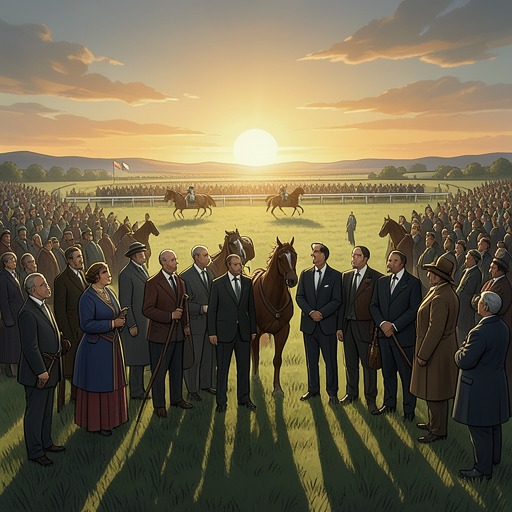
The Fatal Hunt
Black BeautyThe Fatal Hunt is a formative episode in Black Beauty’s early life: a springtime chase across the meadow where he is growing up ends in the deaths of George Gordon and Rob Roy. At first, the hunt appears to the young colts as a spectacle of speed and excitement. Its conclusion instead teaches the narrator to see the human and animal cost of sport, a memory that remains with him long after the riders have gone.
Setting and the Approach of the Hunt
The episode takes place before Black Beauty is two years old, in early spring. He and the other colts are feeding in the lower part of their meadow when distant hounds draw their attention. The meadow’s position makes the approach visible: beyond its hedge lie other fields, while at its lower end a brook runs beneath a steep bank. Black Beauty’s mother and an older riding horse recognize the sounds and understand that a hunt is underway. The colts, by contrast, are eager to watch and initially share the excitement of the pursuit.
The hounds pass through a neighboring field of young wheat, then turn back toward the meadow. The hare they are pursuing runs in that direction, and the dogs and mounted hunters follow. Six or eight riders take their horses over the bank and stream. The chase thus crosses from distant commotion into the colts’ familiar pasture, bringing its consequences close to the young animals who had been watching from safety.
The Chase and Its Reversal
The hare attempts to escape through a fence but cannot get through, turns toward the road, and is caught by the dogs. A huntsman intervenes before they can tear her apart. The episode’s quick reversal is stark: what had seemed to the colts like a thrilling display of pursuit ends with the hare’s death and the riders’ attention shifting to the brookside.
Black Beauty had not at first seen what happened there. When he looks, two horses are down: one is in the stream, struggling, while the other lies on the grass and groans. One rider climbs out of the water covered in mud; the other lies still. His mother identifies the motionless young man as dead. The sudden change from the hounds’ noisy chase to the quiet around the fallen riders makes the danger of the hunt impossible to mistake.
George Gordon and Rob Roy
Black Beauty’s master is the first to raise the young rider. The man’s head falls back and his arms hang down; those gathered around him become serious and carry him to the master’s house. Only afterward does the narrator learn his identity: he is George Gordon, the Squire’s only son, a tall young man and the pride of his family. The narrative first presents him as a fallen rider, then reveals the personal and familial significance of his death.
The other fallen horse is a black horse with a broken leg. When Mr. Bond, the farrier, examines him, those present conclude that he cannot recover; someone fetches a gun, and the horse is killed. Black Beauty’s mother recognizes him as Rob Roy, a good horse she had known for years, and insists that he had no vice. Her knowledge of Rob Roy makes the loss specific: he is not an anonymous casualty of the chase but a familiar horse whose character she can attest to. She is deeply troubled and never again goes to that part of the field.
Aftermath and Significance
The consequences continue beyond the meadow. Riders set off to fetch the doctor and farrier and to inform the Squire. A few days later, church bells toll for a long time as black coaches carry George Gordon to the churchyard. The funeral confirms the permanence of the loss that the scene first suggested. The narrator never learns what was done with Rob Roy after his death, leaving that part of the aftermath unresolved.
For Black Beauty, the contrast between the hare and the fallen horse and rider gives the incident its enduring moral force. The hunters had pursued a hare, but the excitement of the chase brought loss to several lives. His mother questions why people choose a sport that can hurt riders, ruin horses, and damage fields when the animal being pursued could be obtained another way. The young narrator initially shares a colt’s instinctive sense that the fallen rider deserved his fate, but his mother refuses that judgment and turns instead to the broader consequences of the sport. Her response helps shape the episode not as a celebration of daring, but as a remembered warning about the suffering concealed within human entertainment.