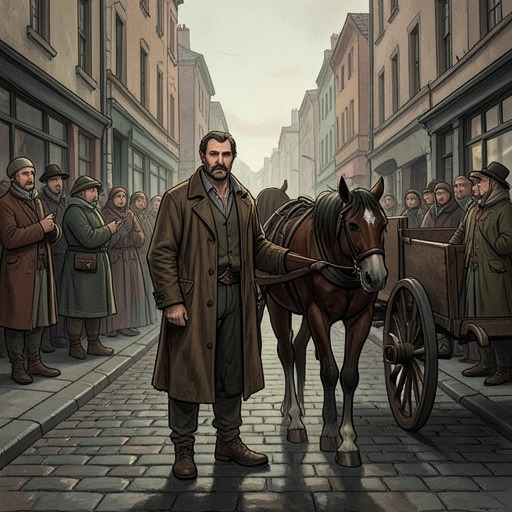
The Relationship Between Black Beauty and Jerry Barker
Black BeautyThe relationship between Black Beauty and Jerry Barker is a partnership between a working horse and the man who owns and drives him, founded on trust and sustained by practical care. Jerry’s kindness does not remove the strain of cab work, but it changes how Black Beauty experiences it: the horse learns to rely on his driver, while Jerry treats Black Beauty’s comfort as part of his responsibility. Their bond is measured both in daily habits and in the sadness of their final parting.
A partnership built on trust
Black Beauty’s first week as a London cab horse is anxious and disorienting. The noise, crowds, and hurried traffic are unlike the surroundings he has known, but he soon discovers that he can trust the man at the reins. Jerry is not simply his driver: he owns the horse, and their interests are joined in the ordinary demands of work. Black Beauty describes Jerry as one of the best drivers he has known, attentive to his horses as well as to himself.
That trust takes practical form in the way Jerry gives signals. He does not strike Black Beauty to make him move; at most, he gently draws the end of the whip over the horse’s back. Often the reins themselves tell Black Beauty what is wanted, and the whip remains at Jerry’s side rather than in his hand. The horse’s willingness to work is met not with force but with communication, until, as Black Beauty understands it, man and horse come to understand one another as well as they can.
Care in work and at rest
Jerry’s consideration continues in the stable. The stalls slope too much, but he fits movable bars across their backs. When the horses are resting, he can remove their halters and put up the bars, allowing them to turn and stand whichever way they please. The arrangement gives the horses a small but meaningful measure of comfort within a working stable.
He keeps them clean, varies their food as far as he can, and provides plenty of fresh water, leaving it available day and night except when the horses come in warm. Black Beauty contrasts this practice with the hardship of being left thirsty and then drinking too much at once. Jerry’s care is therefore not only a matter of gentleness in the street: it includes attention to the horses’ daily needs and to the conditions under which they recover from work.
The weekly rest matters as much as these stable routines. Black Beauty says that the horses work hard through the week and that Sunday gives them time both to rest and to enjoy one another’s company. When a gentleman asks Jerry to take Mrs. Briggs to church on Sunday mornings, Jerry declines: he has taken out a six-day license and says that carrying a fare on Sunday would not be legal. His refusal preserves the horses’ rest as well as the terms under which he works.
A humane partnership under economic pressure
Black Beauty’s comparatively good treatment stands out against the conditions discussed among cab drivers. Some large owners rent out cabs and horses by the day, leaving drivers to earn enough first to cover the charge and then to support themselves. Seedy Sam describes paying eighteen shillings a day for a cab and two horses, with nine shillings to be earned from each horse before the driver can begin making a living. His account links the pressure on drivers to the exhaustion of the animals they drive.
Jerry’s position is different because his horses belong to him. Black Beauty observes that this gives Jerry a financial reason not to overwork them, even apart from his good character. The contrast does not make cab work easy or harmless: after three years, even work under the best conditions has reduced Black Beauty’s strength. It does, however, clarify what distinguishes their partnership. Jerry’s care is personal, but the security it provides is also tied to his control over the horses and their working conditions.
Separation and the lasting bond
When Jerry becomes ill, his family decides that they will move to the country once he is well enough, and that the cab and horses will be sold. Black Beauty receives the news heavily. He is no longer young, cannot expect his condition to improve, and has not been so happy since leaving Birtwick Park as he has been with Jerry. Their shared years have become the happiest part of his working life, even as the labour has taken a toll.
Jerry refuses to let Black Beauty return to cab work with just anyone. Governor Grant agrees to find him a comfortable place, but this protection cannot prevent the separation. Jerry is not permitted to go out on the day the family leaves, so Black Beauty never sees him again after New Year’s Eve. Polly Barker and the children come to say goodbye. Polly touches and kisses his mane and neck; Dolly Barker kisses him too, while Harry Barker strokes him in silence. Their farewell makes clear that Black Beauty has become more than an item of working property to the household.
The relationship’s significance lies in the difference between ownership as control and ownership accompanied by responsibility. Jerry’s gentle driving, attention to rest, and concern about Black Beauty’s next placement allow trust to develop within a life still bounded by labour. The final parting ends their daily partnership, but the period with Jerry remains, in Black Beauty’s memory, the happiest he has known since leaving his early home.