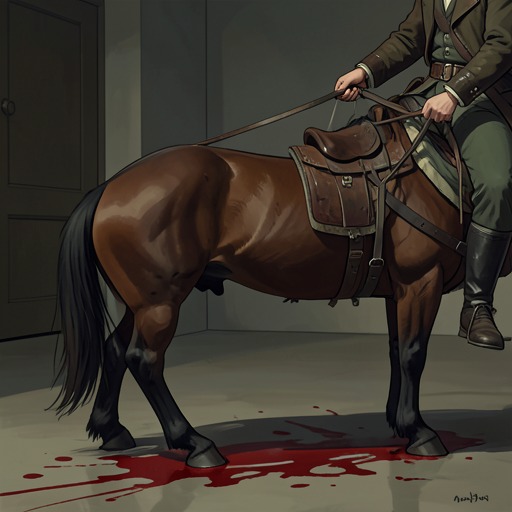
White Lion
Black BeautyThe White Lion is the inn where Reuben Smith’s failure to attend to Black Beauty’s loose shoe, followed by his delayed and drunken departure, sets in motion the ride that ends in Smith’s death and leaves the horse badly injured. The inn is more than a brief stopping place: its stable yard contains the first warning, while its staff later provide testimony that helps reconstruct the consequences of leaving it.
A Stopping Place and Point of Departure
After leaving a carriage at a maker’s shop in town, Reuben Smith rides Black Beauty to the White Lion. He asks the hostler to feed the horse well and have him ready at four o’clock. The arrangement suggests a short, practical stop before the return journey, with Smith expecting the horse to be cared for while he is away.
There is already a problem with the horse’s equipment. A nail in one of Black Beauty’s front shoes has worked loose on the way to town, but the hostler notices it only shortly before the appointed hour. The discovery gives Smith an opportunity to delay his departure long enough to have the shoe examined. Instead, when told about the nail, he dismisses the concern and says it will be all right until they get home. The inn’s yard thus becomes the point at which a manageable warning is recognized but not acted upon.
A Delay That Changes the Journey
Smith does not arrive at the yard at four. He comes at five, says he will not leave until six because he has met old friends, and then misses that time as well. He does not call for Black Beauty until nearly nine, when his manner is loud and rough. His impatience with the hostler and his bad temper mark a sharp change from the careful driver described earlier in the narrative, who had been trusted with a return journey and a horse intended for his young mistress.
The delay also changes the conditions of the ride. It is very dark, and the moon has not risen. Once out of town, Smith gallops and repeatedly strikes Black Beauty with his whip, although the horse is already moving at full speed. The loose nail, which Smith had declined to have checked at the White Lion, gives way over the recently mended, stony road. By the turnpike gate, the shoe has come off. The sequence links the decision made in the yard to what follows: the horse leaves the inn with a known defect, then is driven hard over rough ground in darkness.
The Inn’s Role in the Fatal Ride
The White Lion does not witness the whole journey, but its staff recognize the risk as Smith departs. The landlord stands at the door and warns him to take care. Smith answers angrily and rides on. That warning makes the departure a moment of exposed judgment: the danger is not wholly hidden, since the loose shoe has been reported and the landlord adds a final caution, yet Smith continues without changing course.
Beyond the turnpike, freshly laid large stones make fast travel especially hazardous. Black Beauty is forced to gallop over them without a shoe, while Smith continues urging him onward. The horse’s hoof is severely damaged. The inn is therefore not the scene of the final accident, but it is the last named place where intervention might have altered the journey. Its importance lies in that threshold between an ordinary stop and a preventable disaster.
Testimony and Narrative Significance
After Smith’s sudden death, an inquest examines how the ride began. The landlord and hostler at the White Lion, along with other witnesses, testify that Smith was intoxicated when he left the inn. The toll-gate keeper reports that he galloped through the gate, and Black Beauty’s missing shoe is found among the stones. Together, these details make the case clear to those conducting the inquest and establish that the horse was not to blame.
The inn consequently returns in the story not only as a place of departure but as part of the later account that restores responsibility to its proper owner. The stable-yard warning, the hostler’s discovery, the landlord’s caution, and their testimony after Smith’s death form a connected record. Against this record stands Black Beauty’s prolonged recovery: the farrier hopes that the joint has escaped injury, but the horse is left with a lasting blemish after a long and painful cure. The White Lion’s brief appearance thus anchors a wider contrast between attentive care and reckless haste, and between a horse’s observable needs and a rider’s refusal to heed them.