York
Black BeautyYork, the head coachman at Earlshall Park, is a skilled horseman who understands that horses have individual temperaments and need different treatment. Through Black Beauty’s account, he emerges as both a considerate professional and a constrained employee: he can recognize the harm caused by fashionable harness practices, yet the lady of the household has the authority to insist on them. His conduct after Ginger’s resistance turns that conflict into more than a difference of opinion, while his later support for Reuben Smith shows his willingness to use his standing on another man’s behalf.
Position and Approach to Horses
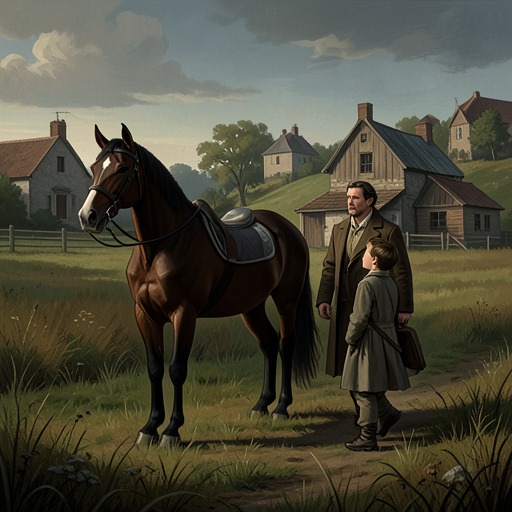
York first appears when Black Beauty and Ginger arrive at Earlshall Park, the home of the Earl of W——. He is to be their new coachman. After asking for him, John Manly waits while York comes to meet them; York looks them over, arranges for a groom to take them to their stalls, and invites John to refresh himself. The welcome is polite, but York’s careful attention to the horses matters more: he wants to know whether either animal has particular needs before taking responsibility for them.
John describes Black Beauty as exceptionally even-tempered and eager to do what is asked of him. Ginger, by contrast, had arrived at Birtwick Park suspicious and snappish after earlier mistreatment, though she had become willing and calm during three years of good care. John warns that she is more irritable by nature, is easily troubled by flies or faulty harness, and may retaliate if treated unfairly. York listens without dismissing the distinction. He acknowledges that a large stable cannot guarantee that every groom will be suitable, but says he will remember what John has told him about Ginger. His exchange with John establishes York as attentive to individual character, even as it hints at the limits of what a head coachman can control.
The Bearing Rein at Earlshall
Before leaving, John explains that neither horse has been made to wear a Bearing rein. Black Beauty has never worn one, and the dealer believed a gag-bit had damaged Ginger’s disposition. York says he also prefers a loose rein and opposes the gag-bit, but warns that the horses will have to wear the rein because the lady wants her carriage horses’ heads held high. He distinguishes the Earl’s more reasonable attitude from the lady’s insistence on style, making clear that the rule comes from above him rather than from his own judgment.
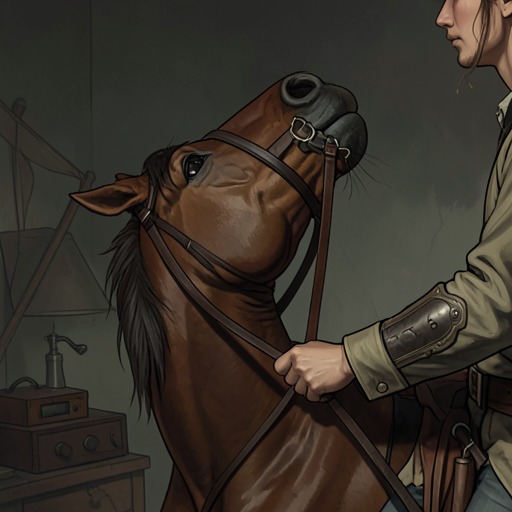
The consequences appear when the horses are put to the carriage. At first, Black Beauty finds the rein uncomfortable but manageable, while Ginger seems quiet. The next day the lady orders York to raise the horses’ heads higher, saying they are not fit to be seen as they are. York respectfully points out that the pair have not been reined up for three years and that the Earl considered it safer to accustom them gradually. The lady nevertheless orders him to tighten the rein. York complies: he draws Black Beauty’s head back until the restraint is almost intolerable, then turns to Ginger, who is already jerking her head against the bit.
Ginger’s Resistance and York’s Response
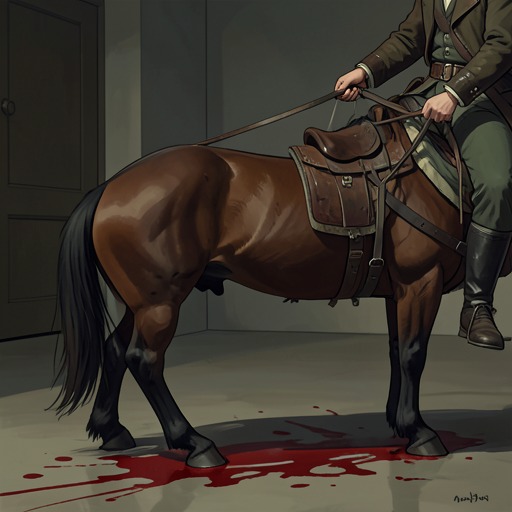
When York removes the rein from its fitting to shorten it, Ginger rears. Her resistance escalates into plunging, rearing, and kicking; she goes over the carriage pole and falls, striking Black Beauty above the hock. York sits on Ginger’s head to prevent her from struggling and calls for the others to release Black Beauty and free the carriage. The episode makes visible the danger John had anticipated: Ginger’s history and sensitivity matter, but the imposed restraint and the demand to tighten it create the immediate crisis.
Once the horses are separated, York returns to Black Beauty and lets his head down. Speaking privately, he blames the Bearing reins and admits that he had expected trouble. His remark that a servant cannot rule a woman whom her husband cannot rule reveals the hierarchy that has shaped his earlier obedience. In front of the men he remains respectful toward the lady; away from them, he expresses his frustration and disclaims responsibility for whether the horses can attend the garden party. His response does not undo the accident, but it shows that he understood the risk and had warned against the practice in substance, even though he carried out the order.
York also attends to the consequences for the horses. He examines Black Beauty, finds the swelling above the hock where Ginger struck him, and orders the injury to be sponged with hot water and treated with lotion. Ginger is led back bruised and badly knocked about. York’s practical care contrasts with the display-driven decision that helped bring about the accident: once the damage is done, his attention returns to the animals’ condition rather than to appearances.
Reuben Smith and York’s Influence
York’s judgment is also important in Reuben Smith’s history at Earlshall. Reuben is an accomplished driver and a gentle, knowledgeable handler of horses, but his recurring drinking has previously made him unreliable. After an incident in which he was too drunk to drive a party home, he was dismissed, and his wife and children lost their cottage by the park gate. York interceded with the Earl, who was kind-hearted, and Reuben was taken back after promising not to drink while he lived there.
When York later goes to London, Reuben is left in charge of the stables. York’s confidence in him follows from his evident skill and the promise he has kept, not from ignorance of his past. This detail broadens York’s portrait: he is not only a manager who notices differences between horses, but also an advocate prepared to seek another chance for a capable worker. The narrative gives him real discernment and humane instincts, while showing that his power remains bounded by household authority and the choices of those above him.