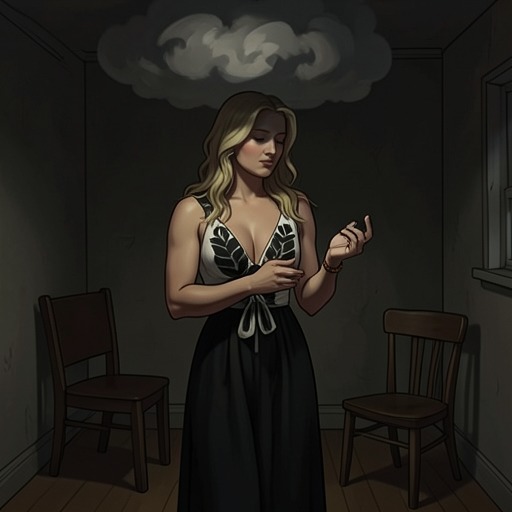
Escape by Hidden Speedboat
Black Box (Jennifer Egan Edition)The escape by hidden speedboat turns a concealed possibility into a narrow, improvised route out: the Unnamed narrator reads the shoreline, gets the boat moving with a functional arm, and disguises flight as carefree departure until the guard is behind her. The sequence makes survival depend on both physical action and performance, while its final turn from exultation to pain denies escape an uncomplicated triumph.
Discovery and Preparation
Along the rocky, moonlit shore, the narrator searches for irregular movement rather than relying on a clear view. One movement lurches in time with the water beneath an overhang of brush. It is a small, ambiguous sign, but it distinguishes the possible boat from the surrounding motion of the shore and sea. The hidden craft is not presented as a certainty: it has most likely been concealed by the new host as an emergency means of escape. The cautious inference matters. She has to act on a likely opportunity before she can confirm what it contains.
The narrator’s attention to the surroundings is connected to her husband’s unusual awareness and scientific genius, qualities that have made him a national-security hero. Intimacy with another person, the instructions suggest, can let her scrutinize a situation as he would. Here that way of looking is practical rather than abstract: moonlight, moving water, brush, and a concealed object become information from which a route can be assembled. The boat’s apparent purpose is already double-edged, since the host who has hidden it may have provided an emergency exit, yet the narrator must locate and use it herself.
Boarding and Launch
The narrator slips between branches and boards the boat, then unties it and lowers its motor into the water. Each action is part of a sequence that has to be completed before the craft can carry her away: reaching it is not enough; it must be freed, prepared, and made mobile. The instructions specify that the key will be inside. That detail turns the hidden boat from a mere possibility into a usable escape plan, though the narrator still has to carry out the physical work of getting underway.
Her ability to pilot a motorboat comes from experience on the lakes of Upstate New York. The remembered setting gives this departure a concrete, unheroic preparation: an earlier practical skill now has immediate value on a different body of water, at night, under pressure. The narrator uses her functional arm to manage the boat, and the action is described through tasks rather than a pause for explanation. Once the motor is lowered, she turns the key, guns it once, aims toward the blue-black sea, and jams the accelerator. The escape gathers speed through a succession of deliberate movements.
The Smile as Cover
Before accelerating away, the narrator fluffs her hair with her functional arm and puts on a wide, carefree smile. These gestures do not change the danger around her, but they change what she presents to the people watching. The smile works as a shield and a mask: by holding her face in a familiar expression, she gives herself something to hide behind while concealing the urgency of her departure. It is also likened to a door that can be open and closed at once, an image suited to a performance that appears welcoming while withholding its purpose.
She waves and giggles loudly at the stunned, sleepy guard. The conspicuous friendliness is part of the escape rather than a break from it. Instead of openly announcing flight, she offers a display that can pass as casual behavior even as the motor carries her away. The contrast between her apparent ease and the haste of the boat gives the moment its tension: the guard sees a smiling figure, while the narrator is making distance. The scene does not claim that charm removes the threat; it shows her using an appearance of ease to buy the opportunity to leave.
Distance, Relief, and Pain
Once underway, the narrator steers in a zigzag until she is out of gunshot range. The course is not a straight dash but a practical response to the danger still represented by the guard and the shore. Reaching that range marks the decisive change in the scene: the boat has carried her beyond the immediate possibility of being shot. The successful escape depends not on one dramatic gesture but on the combined effect of recognizing the boat, launching it, maintaining the disguise, and continuing to steer until the distance is sufficient.
The departure brings exultation, but the relief lasts almost no time before a crushing onslaught of pain follows. That abrupt sequence keeps the escape from reading as a clean resolution. The narrator has achieved distance, yet the body registers a cost that the exhilaration cannot erase. The scene’s movement—from uncertain observation beneath the brush, through controlled performance at the shore, to flight and pain—makes survival both an accomplishment and a bodily ordeal. Its central reversal is therefore qualified: she gets away from the guard, but safety does not mean that suffering is over.