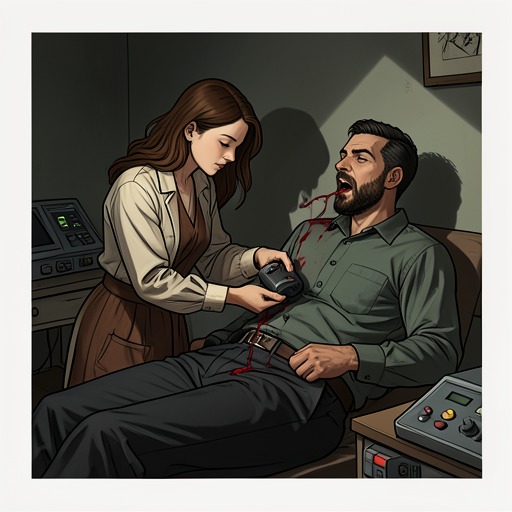
Gunshot wound
Black Box (Jennifer Egan Edition)Gunshot wound is treated not as a single instant but as a sequence of changing demands: the shot may not be recognized at once, the danger of further attack can remain immediate, and pain may surge after escape has begun. The guidance turns that sequence into a survival problem in which removing oneself from an enemy’s control, navigating, and staying conscious matter more than any account of recovery.
Delayed Recognition and Bodily Specificity
The account stresses a lag between being shot and knowing it has happened. That interval makes the wound distinct from an event that is immediately understood: physical harm and conscious recognition do not necessarily arrive together. The guidance gives no measurement for the delay and describes no particular response to it. Its significance is practical and temporal. A person may still be acting under threat before being able to identify the change in their own condition.
The right shoulder is singled out as a bony, tendony part. The brief anatomical description keeps attention on the body without offering a diagnosis, treatment, or forecast. In the context of the surrounding rules, its specificity makes the shoulder a concrete point of reference within an otherwise urgent sequence. The text does not elaborate on the wound’s appearance or explain its medical effects; instead, it makes the body’s location part of the operational framing.
Threat and Immediate Priorities
The guidance addresses the case in which someone has fired at the person and missed. Its priority is to prevent that person from firing again by incapacitating them. The rule therefore treats a missed shot not as the end of danger but as a moment in which another attack remains possible. It concentrates on stopping that renewed threat, rather than on interpreting the other person’s intentions or describing the exchange in detail.
The setting of a powerful man’s home adds a separate pressure: after shots have been fired there, security may arrive within minutes, or even seconds. The short and uncertain interval places a limit on what can be done before others enter the situation. The instruction to remove oneself from enemy possession follows this urgency. Escape is framed as a necessary change in control, not as a completed resolution; the passage gives no assurance that reaching safety will end the consequences of the wound.
Escape, Pain, and Consciousness
Escape brings a sharp reversal in the sequence. The exultation of getting away is followed almost immediately by a crushing onslaught of pain. Relief and suffering are not presented as separate stages with a comfortable interval between them: the positive force of escape gives way at once to a condition that may make thought impossible. This contrast makes survival itself provisional. Leaving immediate danger does not mean that the body has ceased to impose urgent demands.
When pain prevents thought, the instruction narrows attention to navigation alone. It does not ask for complex reasoning or a broad assessment of circumstances; it reduces the task to finding a way onward. The next imperative is to remain conscious. Together, these directions establish a limited but clear order of priorities: movement must continue even when thought is impaired, and consciousness must be preserved. No medical intervention or eventual recovery is described, so the account ends with these immediate demands rather than a claim of resolution.
Narrative Function and Limits
The wound is presented through compact instructions rather than through a fully narrated scene. This form links bodily timing, threat, escape, pain, and orientation as successive problems to be managed. Its direct progression carries the reader from the uncertainty of recognizing the shot to the practical necessity of leaving enemy control, then to the altered conditions of movement once pain becomes dominant. The emphasis falls on what must happen next, not on reconstructing how the wound was inflicted.
The passage also distinguishes between the danger posed by another person and the consequences that continue after separation from that person. The possibility of another shot and the arrival of security belong to the immediate external threat; delayed recognition, pain, navigation, and consciousness shape the later effort to escape. The guidance supplies no further outcome: it does not establish how long the pain lasts, whether consciousness is lost, or whether the person reaches help. Its significance lies in making survival a chain of changing priorities rather than a single successful departure.