Primal Roar
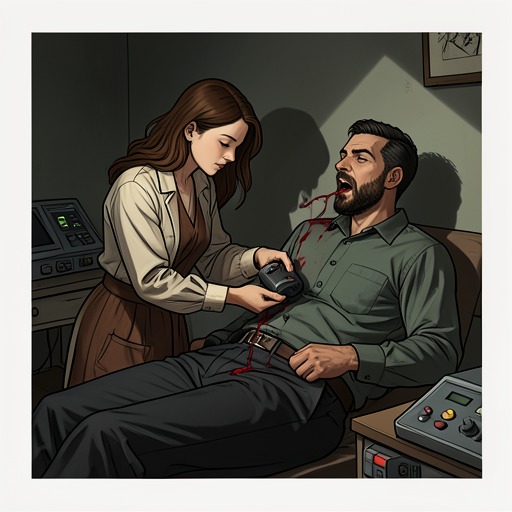
Black Box (Jennifer Egan Edition)Primal Roar is an emergency escape procedure in the Field Instructions, reserved for the moment when an agent is cornered and outnumbered. It reverses the logic of the Beauty disguise: instead of remaining attractive and unobtrusive, the agent deliberately becomes a frightening spectacle. The transformation is meant to create an opening, not to sustain a confrontation; the Roar must end as soon as immediate danger has passed.
Trigger and Purpose
The procedure is explicitly a last resort. Its trigger is a situation in which the agent is cornered and outnumbered, making ordinary escape appear unavailable. The instruction does not present the Roar as a general tactic or a display of aggression for its own sake. It is a brief means of breaking out of enemy control and reclaiming the chance to flee.
That emergency purpose belongs to a broader concern in the surrounding instructions: the agent’s physical person is the Black Box, the sole record of what has happened on the mission, and must be removed from enemy possession. The Roar’s immediate objective is therefore practical and bodily. It is a way to get free when remaining composed, concealed, or conventionally persuasive is no longer enough.
Performance of the Roar
The Roar is defined as a human equivalent of an explosion. Its sound combines screaming, shrieking, and howling; its physical performance requires facial contortions and frenetic movement. These elements are prescribed together, so that the agent does not merely shout but presents an entire body in apparent disarray. The effect should suggest a feral, unhinged state rather than a controlled performance.
The procedure also requires repeated camera flashes while the Roar is underway. Sound, motion, and flashes thus converge in one disruptive act. The instructions do not describe the flash as a means of recording or as a precision device; its stated place is within the display, adding to the approach of a howling, spasmodic, flashing figure. The agent’s appearance is meant to cross a threshold: the Beauty must become a monster.
Fear, Recognition, and Escape
The tactic depends on horror rather than persuasion. Its stated aim is to horrify an opponent in the manner of a trusted figure turned evil in a movie or nightmare. That comparison gives the transformation its particular force: the threat comes not simply from unfamiliarity, but from the shock of a recognizable figure becoming radically disturbing. The Beauty’s former social legibility is overturned and used to make the sudden change more alarming.
The instructions also anticipate how other people may react. Most women holding newborns, they say, will step aside when approached by a howling, spasmodic figure flashing light. The predicted opening is a gap in a crowd, not the defeat of every pursuer. This practical detail makes the tactic depend on bystanders’ recoil and movement as much as on the opponent’s fear: a momentary clearing can be enough to pass through.
A second contrast concerns the response to a powerful man. People stampeding to help him are said barely to notice a dishevelled Beauty as they pass in a hallway. The same appearance that becomes impossible to ignore during the Roar can therefore become easy to overlook once the immediate spectacle has redirected attention. If circumstances are favorable, that brief interval buys time to flee the man’s house. The instructions frame escape as an opportunity, not a guaranteed outcome.
Limits and Tactical Logic
The Roar’s stopping condition is as important as its performance: it must be discontinued the instant the agent is free from immediate danger. The procedure does not recommend continuing the display after its purpose has been achieved. Its logic is sharply bounded—become conspicuous enough to disrupt pursuit, then cease once a route out is available. Continued roaring would exceed the stated need and leave the escape tactic without its prescribed limit.
As a rule, Primal Roar turns the Beauty disguise inside out without simply abandoning its tactical function. At first, the disguise depends on managing how others perceive the agent; in this emergency, perception is still the instrument, but the desired response changes from attention or attraction to horror, recoil, and then neglect. The sequence moves from monstrous visibility to the relative invisibility of a dishevelled figure passing through a hallway. Its central resource is not force but a fast alteration in how the agent is seen, followed by immediate flight.