Temporary blindness
Black Box (Jennifer Egan Edition)Temporary blindness is a brief but consequential state caused by the flash of the Left-eye Camera when the operative has not covered the non-camera eye. The Field Instructions frame it not as an abstract technical malfunction but as a bodily crisis: blindness collides with speed, uneven ground, high heels, and dependence on the Designated Mate, leaving the operative disoriented and alone until sight begins to return.
Cause and Prevention
The Left-eye Camera is operated by pressing the left tear duct; in poor light, its flash can be activated by pressing the outside tip of the left eyebrow. Because the flash can blind the uncovered eye, the instructions require the operative to shield that eye whenever using it. The warning is practical and specific: temporary blindness is not an incidental inconvenience but a foreseeable consequence of operating the camera without taking that precaution. Flash photography is also forbidden in the presence of other people, a separate restriction that places the device’s use within the demands of covert work.
The danger becomes especially vivid in total darkness, where a flash is more dramatic. A bright, throbbing experience of complete blindness signals that the non-camera eye was not covered. The instructions advise the operative to cry out that they cannot see, truthfully distancing themselves from the flash’s cause. This response does not restore control; it manages how the loss of sight is presented while leaving the immediate physical impairment in place.
Blindness on the Clifftop
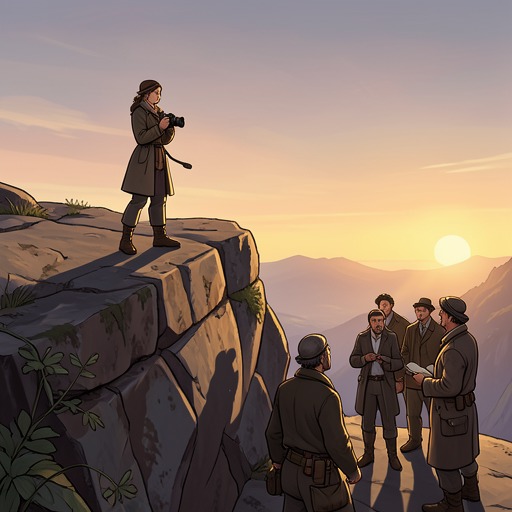
The consequences are sharpened by the setting. Navigating a clifftop promontory at high speed is already difficult while blind; the Designated Mate’s forceful tugging makes it harder to slow or defer that movement. The operative must negotiate both the loss of vision and another person’s momentum, a combination that turns a correctable device error into a danger of falling or losing footing. The instructions’ matter-of-fact emphasis on how hard this is makes the body’s limited capacity, rather than the camera’s technical operation, the center of the episode.
As the pair moves below the cliff’s edge, cooler air and a downward slope register as clues to the changing terrain. But such partial information cannot substitute for sight. On the crumbling wooded path, blindness and high heels lead to tripping and collapse. The Designated Mate’s footsteps then recede downhill, indicating that the operative has become less useful to him. The operative is left sitting in the dirt, helpless and disoriented, unable to do much beyond remain where they have fallen. The episode thus links sensory impairment to a practical and relational reversal: the person who had been pulled along is abandoned once their usefulness diminishes.
The Return of Sight
Recovery is marked first by texture. Variegation in the surfaces around the operative signals that temporary blindness is beginning to fade; sight returns as differences become perceptible again, rather than through an announced instant of full restoration. The instructions make that return a change in attention as well as ability: temporary blindness heightens appreciation for not being blind. The experience is measured against the ordinary capacity that had been taken for granted, now felt as newly valuable.
In the aftermath, objects gathered around the operative acquire an almost sensual quality. Their presence is no longer transparent or merely practical; after a period in which the world could not be seen, the material surroundings press themselves back into awareness. A departing boat’s vibration trembling through the soil offers another physical trace of what is happening nearby. The scene’s movement from flash, to darkness, to texture and material presence gives the recovery its shape without suggesting that the fall or abandonment has been undone.
Narrative Function
The episode presents temporary blindness as a bodily condition with concrete limits, not simply as a metaphor for ignorance. The operative cannot safely move quickly, cannot reliably read the terrain, and is left sitting in the dirt when sight and support are both absent. At the same time, the instructions absorb these consequences into the procedures of covert action: they specify how to operate the camera, warn against the flash, and describe what follows when the safeguard is missed. That procedural voice makes the danger feel both preventable and brutally immediate.
The return of vision does not erase the episode’s dependence on touch, sound, movement, and texture. Instead, those sensations show how much the operative must rely on when vision fails. The state’s significance lies in this contrast: a device intended to capture information can temporarily remove the user’s own ability to perceive, while the surrounding terrain and the Designated Mate’s actions determine how severe that loss becomes.