
The Moon as Companion
Black Box (Jennifer Egan Edition)This flow traces the moon’s changing emotional function from childhood comfort to a guide through isolation and danger.
increasing Bearing strength in each event
 decreasing
Bearing strength in each eventdecreasingThe Child’s Moon
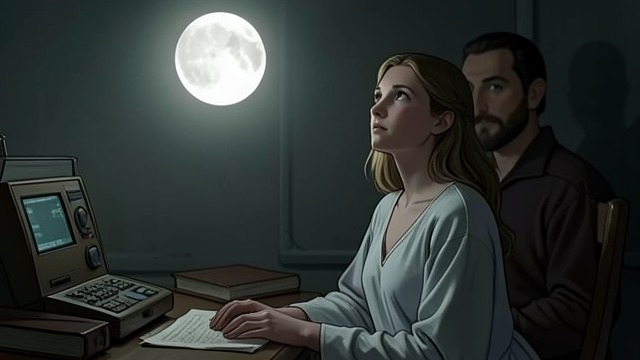
A Face in the Sky
Early attachment
The narrator loves the moon as a child and associates it with a paternal promise. Her belief that her father died before she was born gives the distant object an intimate emotional charge.
The moon offers continuity without conversation. It is a presence she can revisit even when the story of her family leaves an absence unresolved.
Memory that endures
Adult knowledge changes the meaning of the childhood belief but does not erase the feeling. The moon remains one of the images through which the narrator recognizes her earlier self.
A Familiar Night Sky
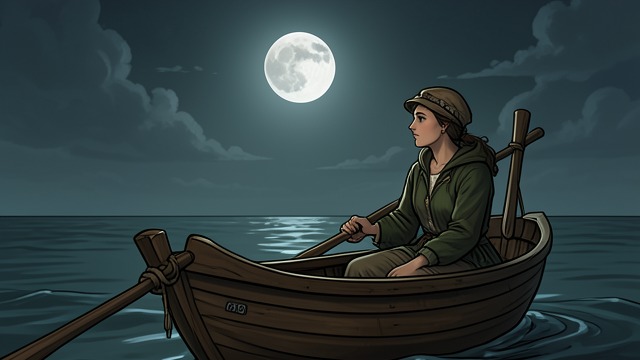
Looking Up at Sea
The moon in motion
During the crossing, the narrator watches the moon appear to move, though the boat is the thing moving beneath it. The image captures her uncertain position in a landscape with few fixed landmarks.
She uses the moon as a Personal Calming Source when fear and excitement become difficult to distinguish. The sky provides steadiness without telling her where she will end up.
Orientation and limit
The moon can soothe her but cannot replace navigation or rescue. Its value is emotional: it helps her remain present enough to continue interpreting the journey.
The Moon Below the Cliff
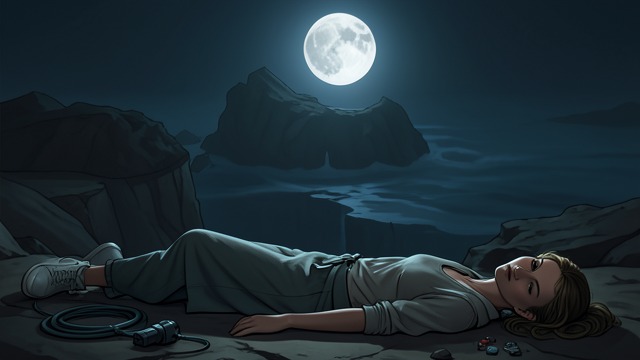
A Light Across Isolation
Stillness in the dirt
After being left behind, the narrator lies on the ground in darkness and sees that the moon shines everywhere. It can seem expressive, almost like a face, while she waits for her blindness to fade.
The moon gives her a point of contact when she has lost the Designated Mate and no longer knows how to reach the others. Its presence helps her endure a paralysis that is emotional as well as physical.
Not a rescuer
The moon does not bring practical help or guarantee safety. Its companionship is a temporary resource that lets the narrator recover enough agency to act.
Stars on the Open Water
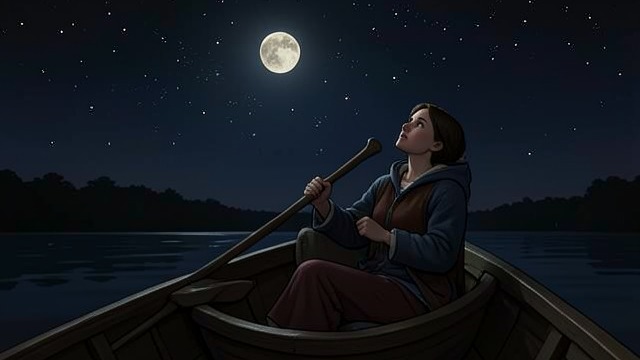
A Wider Sky
Navigation in pain
The narrator lets the moon and stars direct her as she pilots the boat in a semi-conscious state. Their light offers bearings when her injured body can barely sustain thought.
The Mediterranean once seemed vast enough to be infinite, and now that scale makes her feel small and exposed. The same heavens that comfort her also emphasize how alone she is.
Human persistence
She continues because a human being can do more than her pain suggests. The sky gives no rescue promise, but it helps keep her moving toward the designated area.
The Sky as Temptation

Floating Above the Body
An escape from pain
At the Hotspot, the narrator dissociates without intending to and imagines wafting freely through the night sky. The stars become a possible realm beyond physical pain and the burdens of individual life.
The temptation to remain detached is real, especially when returning means accepting injury and an altered future. She must keep her body in view if she hopes to reunite with it.
Choosing return
The helicopter arrives, and the narrator returns to her body before it reaches her. The sky has offered comfort and escape, but she chooses life on earth and the pain that comes with it.
during the narrator’s childhood
after the narrator leaves the villa by speedboat
after the failed photograph, while the narrator is alone
during the escape boat journey toward the Hotspot
near dawn, while waiting in the boat
