
Visibility and Invisibility
Black Box (Jennifer Egan Edition)This flow traces how the story turns the beauty’s performance into a broader question about being seen, overlooked, and recognized.
increasing Bearing strength in each event
 decreasing
Bearing strength in each eventdecreasingA Designed Paradox

Irresistible and Invisible
The operative ideal
The narrator is told that her goal is to be both irresistible and invisible. She must attract enough attention to enter a powerful man’s life while avoiding the attention that would reveal her purpose.
The paradox defines the beauty cover as more than disguise. It demands that the narrator manage what others see while remaining alert to what they fail to notice.
A social method
Her apparent youth, shyness, and pliability make her seem familiar rather than dangerous. Invisibility is achieved not by vanishing, but by being misread.
The Overlooked Guest

Being Present Without Registering
The host’s gaze
The host fails to acknowledge the narrator, and she recognizes that women may not register in his field of vision. His disregard appears to offer protection from close scrutiny.
At the same time, the villa’s neglected beauties compete for his scarce attention. Their visibility is defined by his power to grant or withhold recognition.
A useful absence
The narrator works to be forgotten yet still present. Her social invisibility lets her listen and observe, but it also leaves her dependent on men who may decide her fate without considering her perspective.
The Woman as Claim
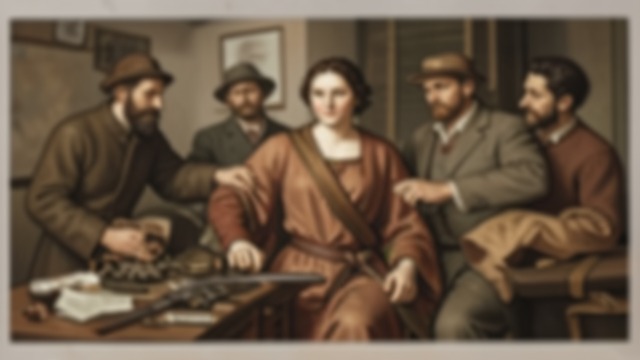
Seen as a Prize
A power gesture
The host dismisses the narrator, while the Designated Mate keeps an arm around her. Her body becomes visible as the object of a contest even though her understanding and purpose remain concealed.
She sustains her appearance of ignorance to prevent the conflict from escalating. The men can see her without seeing her as a person capable of strategic action.
The cover’s paradox
Visibility grants her a place near the business, while the assumptions attached to that visibility erase her agency. The scene shows how being looked at and being recognized are not the same.
The Flash of Recognition
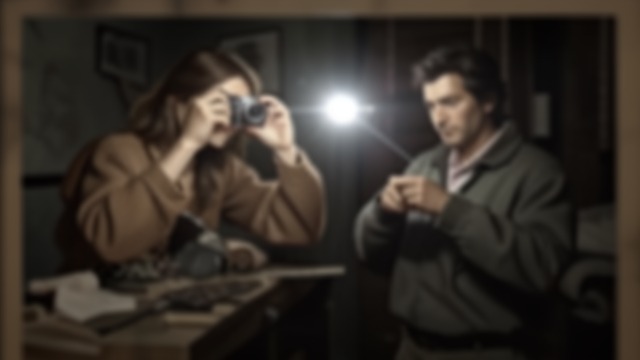
A Hidden Eye Exposed
Technology becomes visible
The narrator presses the Left-eye Camera to photograph the sketches. Its flash announces the hidden act and temporarily blinds her, making the secret observer suddenly conspicuous.
The men’s response shows the danger of changing from an overlooked beauty into a visible agent. Her apparent harmlessness no longer protects her once the camera reveals intention.
A broken gaze
Blindness reverses the narrator’s usual task of watching others. She is left unable to orient herself while others control the scene and the route away from the cliff.
The Rescuer’s Faces
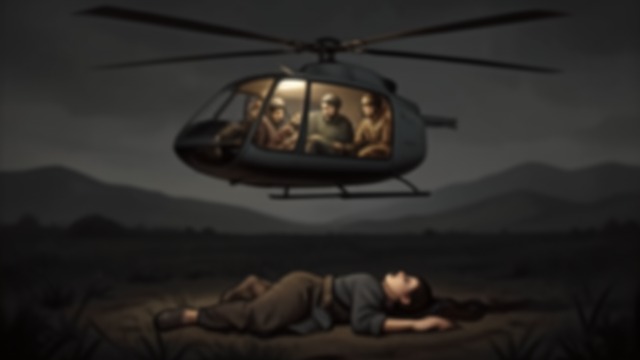
Recognition at Last
The machine overhead
The helicopter first appears to the wounded narrator as a mechanical force that might wipe her out. In darkness, its unlit form seems alien and menacing.
Only when she sees the people inside, crouching with hope, does the machine become recognizably human. Rescue depends on seeing faces rather than merely tracking a point on a screen.
A person beyond the dot
The agency has watched her as a dot of light, one among hundreds. The final encounter restores the individual dimension that the doctrine of collective service has sometimes obscured.
during the narrator’s training
on arrival at the remote villa
during the clifftop exchange
during the failed photograph at the cliff
at the end, as the helicopter reaches the boat
