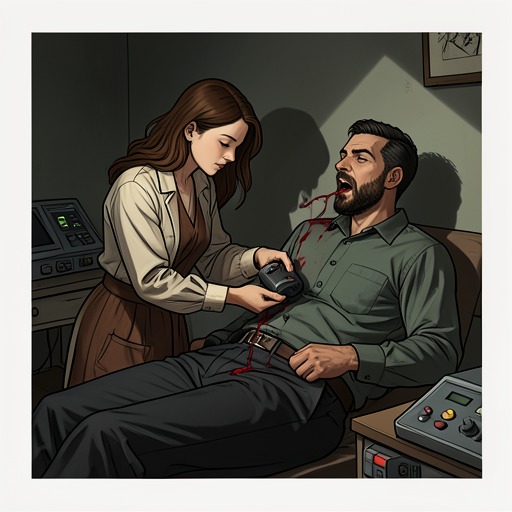
Dissociative state
Black Box (Jennifer Egan Edition)The Dissociative state is a form of mental separation from the body that the text presents both as a deliberately timed survival procedure and as an experience that may occur involuntarily. Its central tension is practical: detachment can release the mind from immediate pain, but it must not begin too early, continue too far, or sever awareness of the body that must eventually be rejoined.
Threshold and Timing
The Dissociation Technique is compared to a parachute whose cord must be pulled at the correct moment. The comparison makes timing part of the technique rather than a minor precaution: separation begun too soon may hinder the ability to function when action is crucial, while separation begun too late may leave the mind too deeply lodged in the unfolding event to withdraw. The state is therefore neither an automatic refuge nor an instruction to disengage at the first sign of fear.
The stated threshold is precise: the technique should begin only when physical violation is imminent. This rule follows a sequence of warnings addressed to a person in an encounter that grows more coercive. The instructions first urge reminders that the person is not being paid as a man climbs from the water, then as he leads the person behind a boulder and pulls the person onto his lap. When he says to relax in rhythmic, throaty tones, the manual reads that reassurance as suggesting that the discomfort is not unwelcome to him. The procedure thus appears in a setting where the subject is being directed to recognize the danger without confusing another person’s soothing manner with safety.
The timing rule also defines the state’s purpose narrowly. It is not described as a way to change what the body is experiencing or to stop the surrounding action. Rather, it offers a means of shifting the mind’s relation to that action at the point when physical violation is about to occur. The distinction matters: the instructions treat mental distance as a response to an immediate threat, while warning that distance itself can compromise later awareness and control if it is misjudged.
The Stepwise Separation
The procedure begins with closed eyes and a slow backward count from ten. With each number, the mind is to imagine rising out of the body and moving one step farther away. The count gives the separation a measured pace, turning an abstract instruction to detach into a sequence of imagined positions.
At eight, the imagined viewpoint hovers just outside the skin. At five, it floats a foot or two above the body, with only vague anxiety about what is about to happen to it. At three, the instructions describe full detachment from the physical self; at two, the body is expected to act and react without the mind’s participation; and at one, the mind should drift so freely that it loses track of what is happening below. Each number marks a distinct change in proximity, sensation, and awareness, rather than merely repeating the same idea of escape.
The count’s ordered descent creates a striking contrast between procedural precision and diminishing participation. The mind follows a specific series of directions even as the intended endpoint is a loss of connection to what the body is doing. That contrast helps explain why the technique’s warnings about timing and bodily awareness are essential: the same gradual process that promises distance can carry separation to a point where the person no longer knows what is happening below.
Rejoining the Body
The instructions present return as dependent on safety: the mind will rejoin the body when it is safe to do so. Reentry is not depicted as an instantaneous switch. It should happen carefully, like returning home after a hurricane, an image that gives the aftermath of danger the scale of damage and disruption without specifying what the body has endured.
This careful return distinguishes the state from a simple disappearance. The body remains the place to which the mind must come back, and the possibility of reunion is built into the procedure. Yet the text does not promise that the transition will be effortless. Its emphasis on care implies a passage out of separation that deserves attention in its own right, rather than a return that can be assumed as soon as the threat ends.
Involuntary Detachment and the Body in View
A later passage describes dissociation arising without intention. Looking upward at the sky from below can feel like floating, suspended and looking down, while the universe seems to hang beneath the observer in a glittering expanse. Recognition comes only when the observer notices a woman like herself, crumpled and bleeding at the bottom of a boat. The sight identifies the body that the preceding sensation had left behind and reveals that the Dissociation Technique has been deployed unwittingly.
The passage does not treat this unbidden detachment as inherently harmful: released from pain, the mind can drift in the night sky and enact a childhood fantasy of flying. But that release is paired with a forceful warning to keep the body in view. If the mind loses track of it, reuniting the two may be difficult, even impossible. The earlier, deliberate count and the later, unintended flight therefore share a central risk: distance can relieve pain while making return harder if awareness of the body disappears.
The skyward perspective also gives the state a double character. It offers an image of freedom, with the universe suspended below and the mind moving beyond pain, but the body at the bottom of the boat anchors that image in injury. The passage’s turn from apparent flight to recognition makes the body not an incidental detail but the condition that the dissociated mind must continue to register. Even when the mind feels released, the text insists on preserving a line of sight to the physical self.
Form and Significance
The instructions address the subject directly and organize experience through commands, thresholds, numbers, and cautions. This instructional form makes dissociation legible as a procedure, but it also exposes the limits of procedure: a state that can be counted into existence may also arrive without conscious choice. The text moves between these modes without presenting them as identical. One is prescribed for a narrowly defined moment of imminent violation; the other is recognized retrospectively through the injured body seen from above.
The recurring images sharpen that tension. The parachute figures a controlled departure whose timing matters; the hurricane figures a careful return to a damaged home; the night sky offers release, while the boat’s bleeding body imposes a material limit on that release. Together, these images frame the Dissociative state as a temporary separation with consequences, not as a clean escape from embodiment. Its promise and its danger are inseparable: distance may make pain bearable, but the possibility of return depends on remembering the body that remains below.