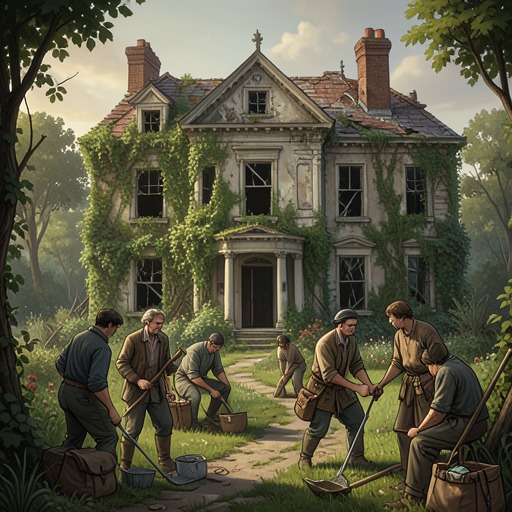
Gideon family mansion
Black BoxThe Gideon family mansion is more than an abandoned family property: its proposed sale, preservation, and occupation connect Alexander Gideon’s inheritance to Michel Sommo’s political land projects and Boaz Brandstetter’s search for independence. Near Zikhron Yaakov, the house passes through competing possibilities—as a source of money, a restoration project, and a home for Boaz and the people he chooses to live with.
Identity and Setting
The mansion is identified with the large, empty house near Zikhron Yaakov that Alexander offers to Boaz. The offer describes a property in poor condition, abandoned but with room for repair, possible agriculture, and access to the seaside. A later letter is addressed to Boaz at Gideon House, Zikhron Yaakov (South), confirming the estate’s association with him as a place to receive correspondence. The evidence does not establish a completed transfer at this point; it shows Alexander making the house available on terms that could allow Boaz to shape its use.
The property is an old stone residence with a tiled roof and surrounding grounds. When Ilana Sommo arrives, its windows are open and the roof has partly collapsed. Weeds and brambles have overrun the gardens, obscuring features that once included a fish pool, fountain, and mosaic terrace. The estate’s deterioration is concrete rather than abstract: both the house and its grounds require work before they can serve as a settled home. The contrast between the neglected property and the newer houses built farther down the slope also places it at the edge of an expanding town, still distinct from its surroundings.
Inheritance and the Prospect of Sale
The mansion’s future is bound up with Alexander’s changing instructions about his property. At the end of February, he tells Manfred Zakheim to sell the Zikhron property to finance Rabbi Sommo’s campaign. Zakheim delays, hoping Alexander will reconsider, and later admits that he sold another property instead, thereby preserving the Zikhron estate. Alexander changes his mind again, first dismissing Zakheim and then urgently asking for his forgiveness and help. The episode makes the mansion’s status precarious: its preservation depends not on a settled plan but on Alexander’s shifting decisions and Zakheim’s intervention.
The larger financial context joins private property to competing ideas about land. In a letter, the Sommo family requests funds for its mortgage, an additional room and a half, and provision for the children, as well as a separate contribution toward purchasing and renovating Alkalai House in Hebron. Michel Sommo’s political activity likewise connects land ownership with territorial aims. After the Six-Day War he worked in the Greater Israel Movement; later he helped found the Jewish Fellowship Movement, which demonstrated against troop disengagements and tried to purchase land near Bethlehem. Alexander’s proposed sale of the Zikhron estate to support Sommo’s project therefore places the mansion within a broader contest over what property is for, and who will live on the land.
Zakheim’s account also reveals the difference between public arguments about peaceful purchase and the financial arrangements behind them. He describes a plan to pay Arab owners for their land and property and provide them with one-way tickets, while questioning whether the cost could be borne without effectively selling the state. He also discloses that a Paris trip by Sommo, funded by a supporter, concerned negotiations with a religious order over land west of Bethlehem. The proposed transaction depended on an exchange involving property within Israel’s pre-1967 borders, and Zakheim hoped to soften Alexander’s resistance to completing the arrangement. In this setting, the mansion is not merely a family asset: its possible sale is one element in a chain of political and commercial transactions.
Offered to Boaz
Alexander’s letter to Boaz presents the house as one of two routes to a self-directed future. The alternative is a move to America, with accommodation and work arranged there. For the Zikhron option, Alexander offers a fair monthly wage while Boaz begins restoring the house and promises to cover the cost of building materials. Boaz may invite anyone he chooses to live there; there is also scope for agriculture. The proposal combines practical support with an explicit allowance for independence: Boaz is to be free to do what he wants.
Alexander makes the arrangement actionable through Roberto di Modena, a lawyer in Jerusalem who shares an office with Zakheim. Boaz is instructed to go directly to di Modena, not Zakheim, and tell him which option he has chosen; arrangements are already in place to implement either decision. Alexander says that Boaz need not reply to him. The house is thus offered not as a demand for reconciliation but as a concrete resource, accompanied by a procedure that allows Boaz to act without negotiating directly with his father.
Occupation and Narrative Significance
Ilana’s visit shows the difference between the estate as an offer and the house as a lived-in place. She approaches the property hesitantly, sees its overgrown grounds and damaged building, and hears voices from within. In the yard, two young women, Sandra and Cindy, are working with hoes among the weeds. Boaz appears with a small goat. These details establish that the abandoned property is no longer simply empty: people are living and working there, and the scene suggests the practical beginnings of a communal household. It does not, however, establish that the restoration is complete.
The mansion’s narrative importance lies in the way its condition and ownership put different claims into the same physical space. Alexander can treat it as saleable wealth, then preserve it for Boaz; Boaz can receive it as a place to work and invite others, rather than as an inheritance already converted into money. Its ruins make the cost of rebuilding visible, while the household taking shape around it gives the estate a possible future beyond the financial and political plans made elsewhere. The house remains a contested inheritance, but Alexander’s offer gives it a new potential use: a home whose inhabitants, and daily life, Boaz may help determine.