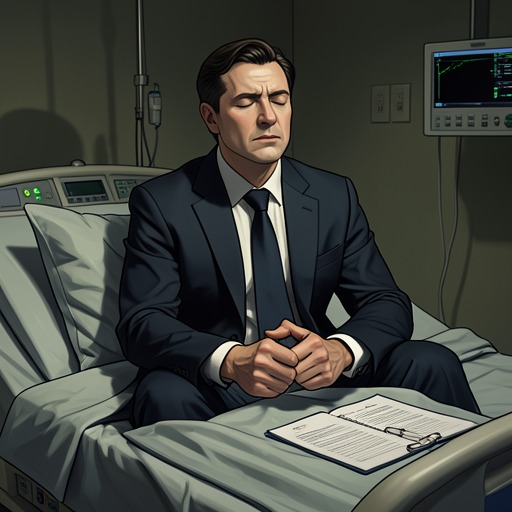
Gideon undergoes chemotherapy
Black BoxAlexander Gideon undergoes chemotherapy in Haifa as Ilana Sommo manages his daily care at home. The treatment coincides with an unexpected easing of his pain, but not a return to independence: he remains weak, tired, and muddled by medication. His illness is shown through the small routines and humiliations that reorganize the household, as well as through the harsh discipline Ilana imposes when caring for him.
Treatment and condition
Every Sunday, Ilana accompanies Alexander Gideon by taxi to a hospital in Haifa for chemotherapy. Radiotherapy has been stopped. His condition has surprisingly improved in one important respect: he is in less pain. Yet he still dozes through much of the day and lies half-awake at night, his mind clouded by drugs. The improvement is therefore limited and uneven, not a simple recovery.
His increased mobility is measured in short distances. He can walk for two or three hours between the wall and the door, and in the evening he can make his way to the kitchen with a stick. Ilana lets him remain there among the others until they disperse to their rooms near midnight, and encourages him to talk as a way of occupying his mind. Before the rain begins, he even manages a little walk by himself in the garden, tall and gaunt in patched jeans and a sweatshirt.
Care, dependence, and discipline
The home routine also exposes the indignities of Alexander Gideon's illness. One evening, while with the others, he wets himself, having either forgotten or not bothered to ask Ilana for help getting to the toilet. She tells Boaz Brandstetter to take him upstairs, cleans and changes him, and then bars him from coming downstairs the following day as punishment. Since then, she reports, he tries harder to control himself.
His dependence becomes more pronounced after he secretly climbs to the rooftop observatory one night, slips from the rope ladder on his way back, and lies stunned in the hallway until Ilana finds him. She beats him, comparing the punishment to what one might give a puppy. The fall makes clear to Alexander Gideon that he lacks the strength to climb stairs; thereafter he lets Boaz Brandstetter carry him upstairs to their room each evening. Care here is neither simply tender nor simply clinical: it involves practical assistance and encouragement, but also reprimand and physical force.
Narrative significance
Told by Ilana Sommo in a personal address, the account places chemotherapy within the intimate particulars that medical progress cannot erase. Less pain coexists with drug-induced confusion, incontinence, a fall, and growing reliance on others. The contrast between the modest improvement and the continuing loss of bodily control gives the treatment its significance: the measure of change is not cure, but a little less suffering within an increasingly managed life.