Land Redemption as Religious Mission
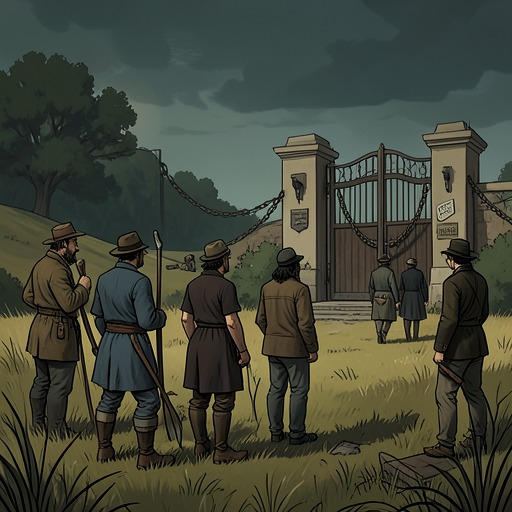
Black BoxLand Redemption as Religious Mission is the idea that acquiring land can serve both a religious obligation and a national-political project. In the novel, its language moves between a stated preference for payment over violence, schemes that depend on Arab residents leaving, and the use of commercial networks to obtain territory. The contrast makes redemption more than a devotional ideal: it becomes a practical program whose moral claims and material operations do not always align.
Religious Language and Political Formation
Michel Sommo’s commitment develops through a sequence of political affiliations and campaigns. In 1964 he helped organize Moledet, a group of North African intellectuals and students in Jerusalem. It split over financial and ideological differences and ceased to exist the following year. On the eve of the Six-Day War, Sommo campaigned against the Eshkol government’s wait-and-see policy and for taking the military initiative against Egypt and other Arab countries.
After the war, he volunteered for the Greater Israel Movement, working in propaganda and demonstrations. He left in 1971, then made a public display of returning his National Religious Party membership card. In 1972 he helped found the Jewish Fellowship Movement, whose members were mostly young immigrants from America and Russia, and served on its executive committee. The succession of organizations shows that his land activism was not a single institutional affiliation: it persisted through changes in political setting and public identity.
After the Yom Kippur War, the Jewish Fellowship Movement demonstrated against troop disengagements in the Sinai and the Golan Heights and became involved in attempts to buy land illegally from Arabs near Bethlehem. Sommo was interviewed by police twice in connection with the group, in October 1974 and April 1975, but was not charged. The report on his activities says it could not establish that he personally took part in violent lawbreaking. It also records a dozen letters he had published urging Arab residents to leave Israel and the occupied territories peaceably, with financial inducements. That language presents departure as voluntary and compensated, while making the removal of a population part of the political project.
Purchase, Exchange, and Population Transfer
A letter from the Sommo household to Alexander Gideon makes the material scale of land redemption explicit. Alongside requests for money to address the family’s mortgage, build additional living space, and provide for the children’s futures, it asks for $95,000 toward purchasing and renovating Alkalai House in Hebron’s Jewish quarter. The letter describes the property as having been seized by force by Arab rioters during the 1929 Palestine riots, and presents its repossession as an effort to proceed without violence by paying full market price. The appeal thus frames payment as an ethical alternative to force, while making a specific property acquisition part of a larger request for substantial private support.
Sommo’s proposal to Gideon for the territories likewise relies on payment. The plan would compensate Arab landowners for their property and provide one-way tickets for departure. Gideon’s response, conveyed through a letter, questions the financial arithmetic: paying $20,000 to each of two million people would cost more than the state could afford. He also entertains exchanging the coastal plain for the mountains, imagining that Arab residents might accept the arrangement voluntarily. The exchange proposal does not resolve the underlying question of who determines where people may live; its language of choice sits beside a plan organized around large-scale population movement.
The letters also reveal a transnational land transaction behind the public language of redemption. Manfred Zakheim tells Gideon that an unnamed Paris-based patron financed Sommo’s semi-secret trip to Paris and helped arrange the restoration of his French nationality, which Sommo had relinquished in 1963. According to Zakheim, the restored citizenship would provide a legal basis for a proposed deal with a Christian religious order headquartered in Toulouse. The order was not prepared to sell its land west of Bethlehem, on the West Bank, but might exchange it for a substantial building and attached land within the pre-1967 borders. Zakheim describes the proposal as a way to complete a triangle linking Bethlehem, Toulouse, and Zikhron Yaakov, dependent in part on Gideon’s unsettled decision about selling his property there.
From Religious Fellowship to Commercial Enterprise
The movement’s religious vocabulary increasingly accompanies business organization. In a later account to Gideon, Zakheim says Sommo has turned the Jewish Fellowship Movement into a kind of reconnaissance or security unit for Tentpeg, an investment company Sommo and Zohar Etgar established with pious investors and discreet backing from Paris. Zakheim reports that Etgar controls the financial side, while the partners have persuaded revenue authorities to recognize the enterprise as a charitable institution. These details place religious affiliation, charitable status, and land investment in the same operating structure.
Zakheim portrays Sommo as lobbying across government offices and institutions: meeting party officials and administrators, seeking permits and certificates, and promoting land investments south of Jerusalem. He describes the work as both the preparation of a redemptive future and the consolidation of current investments. The account is openly strategic and comic in tone, but its concrete details point to the practical means by which the project advances: political access, financial partnerships, administrative permissions, and advocacy framed in religious terms. Zakheim also advises Gideon not to manage Sommo’s affairs formally, while offering to advise him without a fee and arranging a meeting with Etgar, whose land-development interests might benefit from Sommo’s connections.
Gideon’s Wealth and Sommo’s Mission
Sommo’s work is entangled with the expectation that Gideon will provide money or property. In Ilana Sommo’s account, Michel has entered a new business whose exact nature is unclear to her, but he teaches her about building plots, grants, Jordanian property law, loans, working capital, bonuses, securities, income, and infrastructure costs. He appears confident that Gideon will eventually leave money or property to him, Ilana, or Boaz Brandstetter. He treats the expected inheritance as already available for investment in the redemption of the land, and represents Gideon’s giving as a means of atoning for past wrongs.
Sommo’s appeal to Boaz Brandstetter brings the mission into the family as well. In a letter, he says he has stopped teaching and now devotes himself almost day and night to land redemption with comrades from the Jewish Fellowship Movement. He invites Boaz to join them, offers the possibility of work as a security man, and promises religious instruction and a useful role. The invitation links employment, belonging, religious revival, and land acquisition, while offering a route back into the family after Boaz’s departure from Kiryat Arba. Sommo also tells him that his mother cried with relief on receiving his letter and offers to help with money if needed.
Significance and Tensions
Across the requests, reports, and letters, redemption is at once a religious command, a nationalist objective, and an investment strategy. The purchase of Alkalai House is presented as a paid recovery of property; the proposed departure of Arab residents is described through compensation; and the contemplated exchange with the religious order depends on a network of private wealth and political connections. These methods differ, but each makes territory available through a combination of money, institutional influence, and claims of moral purpose.
The evidence does not give Arab residents an equivalent voice in these plans. They appear chiefly as property owners to be paid, a population to be encouraged to leave, or an obstacle to territorial acquisition. That absence matters to the concept’s meaning: the language of peaceful redemption does not by itself settle questions of consent, power, or the consequences of population transfer. By bringing together family appeals, religious invitations, lobbying, and commercial arrangements, the narrative shows how a sacred description of land can authorize practical ambitions while leaving their human and political costs contested.