Relationship between Michel Sommo and Ilana Sommo
Black BoxThe Relationship between Michel Sommo and Ilana Sommo develops through courtship, marriage, parenthood, and a difficult negotiation between tenderness and resentment. Michel becomes Ilana’s husband and a steady presence in the lives of her children, but their partnership is never insulated from poverty, Boaz’s estrangement, or the emotional force of Ilana’s former marriage. Its defining feature is the difference between the care Michel gives in practical acts and the unsettled meanings Ilana sometimes assigns to receiving it.
Courtship and Marriage
Ilana and Michel meet after Ilana’s divorce, when she is working in a bookshop in Jerusalem. Michel visits the shop and waits until it closes; their early outings take them to inexpensive restaurants, films, and public discussion groups, followed by long walks through the city. He is shy about inviting her to his room and about introducing her to his family, and Ilana describes him as hesitant to take even small steps toward intimacy. After nearly three months, she initiates their first kiss. She accommodates his reserve rather than pressing him, and, months later, invites him to her room herself.
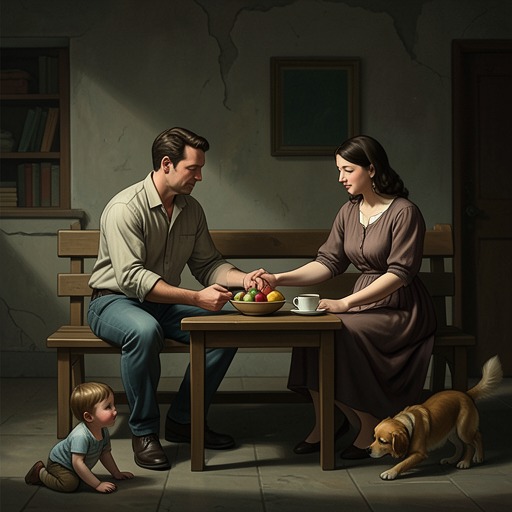
Their courtship leads to marriage. Michel proposes after becoming anxious that he has offended her, and Ilana becomes pregnant after their wedding. Their early married life includes a gradual adjustment to one another: Michel learns to attend more closely to Ilana’s needs, while she describes his growing confidence with affection. His response to a moment of closeness is not self-satisfaction but modest, almost astonished pride. The next day he borrows money from his brother to buy her a summer dress and an electric mixer, then cooks her a four-course meal. These gifts establish a pattern in which care is expressed through modest purchases, food, and attention rather than grand declarations.
A Household Under Pressure
After Alexander Gideon expels Ilana and Boaz, she takes Boaz to stay with her sister and brother-in-law at their kibbutz. She returns to Jerusalem after six months and works in a bookshop, while Boaz remains at the kibbutz for five more years. Ilana visits him every three weeks. After she marries Michel, Boaz refuses to visit the family in Jerusalem and reacts angrily to news of the birth of their daughter, Madeleine Yifat Sommo. The strain enters the marriage as a persistent family problem: Ilana and Michel must make a home with a boy who regards Michel as an interloper and keeps his distance from his mother.
When Boaz appears at their home one winter night, demanding an agricultural school place or threatening to live on the streets, Michel responds first with practical hospitality. He tells the boy to get out of his wet clothes, eat, wash, and talk in the morning. Boaz rejects Michel’s authority. Ilana steps between Boaz and the doorway, then agrees that he can attend agricultural school if that is what he truly wants. Michel adds a condition: Boaz must apologize to his mother and ask politely. The scene shows the couple negotiating both a parental decision and a boundary around how they may be treated. Michel is willing to help, but not to present help as permission for contempt.
With assistance from Michel’s brother, they secure Boaz a place at Telamim Agricultural High School. They pay the fees and honor his request not to visit. Over the following two years, messages from the school report fights, nighttime absences, and probation; he faces expulsion. Ilana later appeals to Gideon for help, even offering to put a claim about Boaz’s paternity in writing if that will persuade him to intervene. Michel knows about the letter and agrees that she should send it, although not every sentence meets with his approval. Their response to the crisis is therefore shared but not identical: Ilana makes an intensely personal appeal, while Michel’s participation is part of a wider effort to keep the family and Boaz afloat.
Care, Money, and Competing Obligations
Michel’s care for the household is concrete and often costly. He accepts responsibility for Boaz’s schooling, and his family contributes money toward the boy’s boarding-school expenses despite their own limited means. When Ilana and Michel later set out their financial needs to Gideon, their request itemizes household costs: money to pay off the mortgage and build another room and a half, provision for the futures of Boaz and Madeleine Yifat, and a separate contribution toward buying and renovating Alkalai House in Hebron. Their letter presents these as the needs of a family, combining domestic security and the children’s future with a property project they describe as an effort to regain a Jewish-owned house through payment rather than violence.
The requests also expose how financial help complicates relations between the two households. Gideon suspects Michel of directing Ilana’s appeals and describes him as the force behind her demands. He instructs Manfred Zakheim to transfer an additional five thousand dollars to Michel’s account and invites him to state the final amount needed to settle his problems. The assistance is thus offered alongside suspicion and a demand that Michel not question the giver’s motives. Ilana’s later letter says that Gideon’s money and Michel’s judgment have helped extricate Boaz from trouble, and that the family’s friends have helped close Boaz’s police record. Michel’s practical efforts do not resolve the family’s difficulties, but they make continued support possible.
Tenderness and Resentment
Ilana’s letters to Gideon sometimes cast Michel as a source of security and sometimes reveal her resistance to the obligations that security entails. She describes him as a rare and loving man, using shifting images of him as father, child, and brother to convey forms of intimacy that do not fit a single role. In another letter, after Michel has helped draw Boaz back into family life, she recounts the pleasure of seeing the small, careful man and his much larger stepson competing for Madeleine Yifat’s attention. Michel makes a meal for the household after the Sabbath, arranges a babysitter, and takes the family to a film. He and Boaz are becoming nearly friendly; at home, Michel climbs onto Boaz’s shoulders to change a light bulb. Ilana watches these gestures with amusement and warmth.
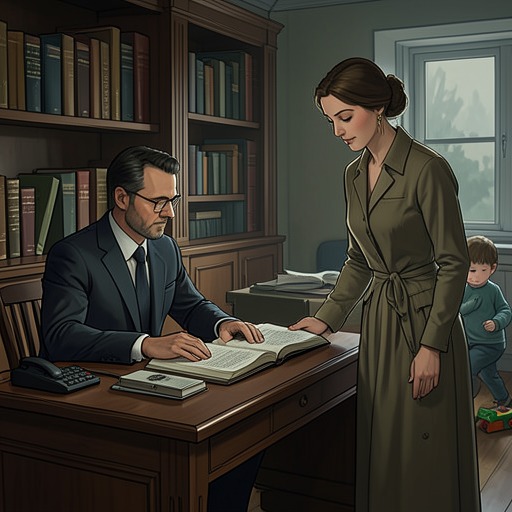
That affection coexists with her unease about being cared for. When she returns from visiting Volodya Gudonski in Haifa, she finds Michel asleep beside Madeleine Yifat’s bed. He has canceled an important meeting, taken the child to a clinic, obtained medicine, prepared meals, and stayed beside her as her fever rose and fell. Instead of responding with gratitude, Ilana rebukes him for not calling relatives for help and interprets his decision to stay home as an attempt to make her feel guilty for going away. The episode does not diminish the work Michel has done; it shows how readily his devotion can become, in Ilana’s reading, an implicit claim on her. Her account registers both his attentiveness and her resentment at the possibility that care might create a debt.
Enduring Attachment and Significance
The relationship is not reducible to either Michel’s kindness or Ilana’s resistance. In one letter she leaves the apartment to post a message to Gideon and then returns to Michel’s arms, calling him simple and tender. Her description makes physical closeness a refuge, even as she continues to write to her former husband. Elsewhere she acknowledges a powerful attachment to Gideon while also affirming Michel’s importance. The two bonds occupy different, conflicting places in her life; the text does not suggest that one straightforwardly cancels the other.
Michel and Ilana’s marriage is consequently portrayed as an ongoing practice rather than a settled resolution. They share a household, raise Madeleine Yifat, and attempt to protect Boaz even when he rejects Michel and withdraws from the family. Michel’s attention takes the form of meals, school fees, medical care, and small gifts; Ilana can receive these acts with love, yet also experience them as obligations that threaten her independence. Their partnership gives the family a working structure amid financial need and estrangement, but it cannot make the past disappear. Its tenderness is real precisely because it remains entangled with the pressures that test it.