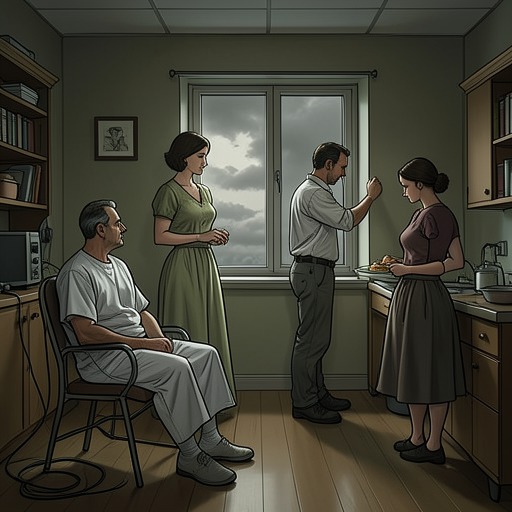
Separation, divorce proceedings, and hopes of reconciliation between Michel Sommo and Ilana
Black BoxThe relationship between Michel Sommo and Ilana develops from a troubled marriage into a bitter divorce and, later, an unsettled effort to recover a shared family life. Its course is marked by practical acts of care—toward Boaz, Yifat, and eventually the sick Alexander Gideon—but also by legal disputes, financial grievances, and long stretches in which one spouse tries to reach the other through intermediaries. Neither reconciliation nor final estrangement fully describes their bond: affection and dependence remain present, but so do accumulated injuries and unequal claims to decide where the family belongs.
Marriage and Divorce
Michel and Ilana married in September 1959. In a later letter, Michel described the marriage as having been more Ilana’s choice than his, and said that he had told her from the beginning that he did not see himself as suited to fatherhood. Ilana nevertheless chose to have Boaz. Michel later came to believe that he had caused her suffering, but said that weakness of character had led him to delay their separation until September 1968. He characterized the divorce as vicious on both sides and acknowledged that hatred and vindictiveness had shaped his own conduct.
The separation was also decided through competing legal systems. The Rabbinical Court found that Ilana had committed adultery by her own admission and ruled that she forfeited her ketubah and maintenance. At the Jerusalem District Court, the question of maintenance for Ilana and her young child was complicated by Michel’s insistence that Boaz was not his son. A blood test had produced inconclusive results, and the court advised tissue testing; both parties declined. Ilana then withdrew her claim for maintenance for herself and the child, and the court struck it out after both declared that they would make no further claims against one another. The formal closure did not end the relationship’s practical or emotional consequences.
Cooperation Around Boaz and Yifat
After the divorce, Michel and Ilana formed a household with Boaz and their younger daughter, Yifat. Their letters reveal that Michel’s concern for Boaz could coexist with conflict between the adults. When Boaz disappeared from the family with whom he was staying and sent word that he intended to work aboard a ship, Michel broke an oath to have no further dealings with Alexander Gideon and asked him to help find the boy. Michel stressed that the appeal was urgent, not a request for money. In the same correspondence, he reproached Gideon for failing to answer Ilana’s earlier letters and argued that an apology was needed if the suffering caused to her was ever to be eased.
The family’s situation later improved. Ilana wrote to Gideon that his money and Michel’s judgment had helped get Boaz out of trouble, while Sommo-family friends had arranged for his police record to be closed. Michel was gradually making his way toward a better relationship with Boaz: he persuaded him to visit the family in Jerusalem, and the two competed for Yifat’s attention. Their domestic life included a Sabbath meal prepared by Michel and a family outing to the cinema. Ilana also recalled small scenes of physical ease between them, including Michel climbing onto Boaz’s shoulders to change a veranda light bulb. These moments offered evidence of an emerging stepfather-son bond, but also of Ilana’s continuing work to hold the household together.
Michel’s care for Yifat likewise appears as an ordinary, demanding practice. When she became ill, he cancelled a meeting he had waited nearly two months to attend, took her to a clinic, obtained medicine, prepared food, and stayed beside her through the day. He slept on a mattress at the foot of her bed in case she needed him. Ilana returned from visiting Gideon and found him still there. Rather than receiving his devotion as proof of partnership, she questioned his decisions and suspected that his sacrifice might be intended to make her feel guilty. The episode exposes a central tension: Michel’s care is concrete, but Ilana experiences it within a relationship already burdened by resentment and struggles over obligation.
Separation, Return, and Care for Gideon
In 1976, Ilana left Paris with Yifat for Gideon’s childhood home near Zikhron Yaakov. She sent Michel a message explaining that she had to go, promising to try to observe the Sabbath and eat kosher, and telling him that Boaz sent affection. Michel answered that she should return with Yifat at once, threatening to send someone to fetch them, but also saying that he forgave her if she came home that day. His response joined attachment to command: he wanted his wife and daughter back, yet framed their return as a condition she was required to meet.
Michel later received word that Ilana had chosen to remain with Gideon and nurse him until his hospital treatment began. Gideon wrote to Michel that there had been no deception and asked him not to treat Ilana harshly on her return. The circumstances made her absence a source of jealousy and distress for Michel, while her decision to stay was presented as her own. At Gideon’s house, she and Gideon shared a restrained routine in the garden, exchanging only necessary words. Her role as caregiver thus placed her in a complicated position: she was caring for her former husband, while her current husband remained elsewhere and questioned the separation from his family.
Custody, Money, and the Unfinished Bond
By the eve of the Jewish New Year, Michel had sent his brother-in-law Armand to take Yifat to him and had begun divorce proceedings. Through Rabbi Bouskila, he informed Ilana that she was regarded as a rebellious wife and that he was raising loans to repay what he called her tainted money. Ilana’s sister Rahel and Rahel’s husband urged her to hire a lawyer and assert her right to know what had happened to Yifat and to see her. Rahel offered to speak with Gideon in person and pursue reconciliation, but Ilana initially responded with silence and asked to be left alone.
Gideon intervened in the financial dispute by instructing Manfred Zakheim to transfer another twenty thousand dollars to Michel. Michel accepted the payment, though the money had been characterized as tainted, and Gideon also directed that the house and surrounding land be put in Boaz’s name. Ilana’s later appeal to Michel made clear that money and legal procedure could not resolve the central loss: she wanted him to bring Yifat to her and reopen contact. She asked for reconciliation and portrayed his silence as a means of punishing her, while also acknowledging that he could show compassion to causes and people beyond his immediate family. The available account records this plea but does not establish that Michel brought Yifat back or that the couple reconciled.
The Relationship’s Later Meaning
The marriage is presented through repeated collisions between care and control. Michel looks after Yifat when she is ill, tries to guide Boaz, and later seeks the children’s return; Ilana recognizes these acts but also questions the guilt and authority attached to them. Conversely, Ilana’s care for Gideon becomes a cause of separation from Michel, even as Gideon urges Michel to treat her kindly. Their dispute is conducted through letters, relatives, religious authorities, courts, and money as much as through direct conversation. By the final appeal, Ilana is still asking for a response, while Michel’s silence leaves the outcome unresolved. The relationship endures not as a settled partnership but as an active contest over family responsibility, forgiveness, and the right to make decisions for one another.