The Desperate Violence: A Study in Comparative Fanaticism
Black BoxThe Desperate Violence: A Study in Comparative Fanaticism is a 1976 scholarly work by Alexander A. Gideon that examines fanaticism across religious and secular movements. In the narrative, the book has a double presence: it establishes Gideon’s public authority through an international reception, yet Ilana’s letter insists that the subject of the book is not the same as the private despair she sees in its author. Its critical acclaim and her intimate recollections therefore place his reputation beside a more troubled personal history.
Work and subject
The title identifies the book as a comparative study of fanaticism, and the reviews describe its range as extending from the Middle Ages to the present. They present Gideon’s subject as messianic fervor in both religious and secular forms, and as a recurring feature of movements that have shaped the modern century. The book’s central concern, as reviewers characterize it, is not faith as a source of moral guidance but the way faith can become bound to violence and the prospect of salvation.
One review attributes to Gideon the argument that world-reformers across history have surrendered themselves to fanaticism. It describes the fanatic’s willingness to die for an idea as inseparable from a readiness to sacrifice other lives, and says that violence, salvation, and death become fused in the fanatic’s outlook. The review emphasizes that Gideon supports this account through close analysis of the language used by fanatics across eras and ideological positions, rather than through psychological speculation. The book’s comparative method thus treats language as evidence of a shared structure beneath movements that may otherwise appear very different.
Publication and reception
The narrative dates the book to 1976 and records an international press response. The Times Literary Supplement presents it as a major work that casts a stark light on the psychopathology of different faiths and ideologies. The New York Times review similarly emphasizes the book’s cool analysis of messianic fervor in religious and secular settings. The Frankfurter Allgemeine Zeitung describes it as useful for understanding movements that have affected, and continue to affect, the century.
A review in the New Statesman stresses the book’s challenge to readers: its analysis, the reviewer argues, invites them to reconsider their own convictions and look for signs of latent fanaticism in themselves and their surroundings. Another excerpt praises the work for exposing institutions and ideologies across a broad political and religious spectrum, including the Church, fascism, nationalism, Zionism, racism, militarism, and the extreme right. These responses do not reduce the book to one political target. Instead, they present its comparative reach as a reason for both its force and its unsettling implications.
Ilana’s letter and Gideon’s public image
Ilana invokes the book while writing directly to Gideon about the state of their relationship and her uncertainty about what he knows of her life. She acknowledges that she has read his work, but distinguishes its subject from what she calls the substance of his soul: frozen, Arctic despair. The contrast is significant. The book makes fanaticism an object of learned analysis, while Ilana’s address turns from that public subject to the private condition she believes the analysis cannot explain away. She imagines that Gideon may be monitoring her family through Manfred Zakheim, or may have cut them out of his life altogether, leaving his knowledge of their circumstances uncertain.
Later, Ilana reports that the Hebrew edition has become widely discussed in Israel and that Gideon’s photograph appears in newspapers. The image is at least ten years old: she remembers his lean, concentrated face and military sternness, and wonders whether it was taken after he left regular army service and returned to university to complete his doctorate. The book’s public success thus brings an earlier image of Gideon back into her present, while her description connects scholarly authority to the severity she associates with him.
Family history and the book’s narrative significance
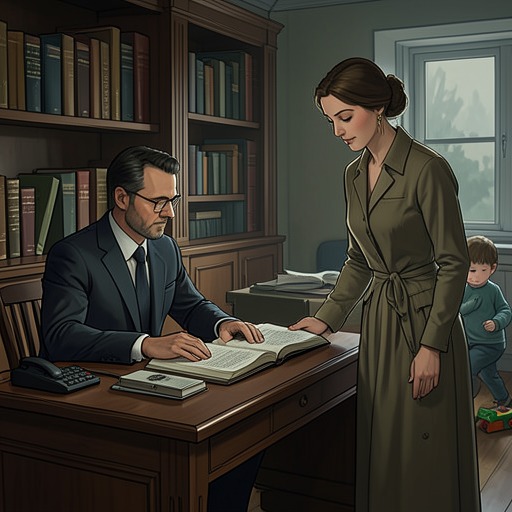
Ilana places the book’s rise alongside memories of the years before Gideon completed his house in Yefe Nof. Manfred Zakheim had secured money for the construction from Gideon’s father, who, in Ilana’s account, was already withdrawing into melancholy. The remembered domestic setting is different from the stern public image attached to the book: during rainy weekends in their old Abu Tor flat, Ilana and Gideon would emerge late from their bedroom to find Boaz already at Gideon’s desk.
Boaz, dressed on his own and often incorrectly, would sit under the desk lamp with Gideon’s pipe, drawing instrument panels for spaceships or an airplane crashing in flames. He also cut neat rectangular cards as a contribution to Gideon’s doctorate or to the Armored Corps. These details connect the book’s academic history to a household in which a child tried to participate in Gideon’s work through drawings and small tasks. The memoir-like recollection does not explain the book’s argument further; instead, it complicates the distance between the celebrated scholar and the family life Ilana remembers. The work consequently functions both as an intellectual achievement in its own right and as a recurring point of contact between Gideon’s public identity and the intimate history his former wife addresses.