The Image of the Stars
Black BoxThe image of the stars is a recurring point of connection—and disagreement—between Boaz Brandstetter’s desire to look beyond ordinary troubles and other characters’ attempts to give the heavens a moral or religious meaning. A telescope first figures as Boaz’s imagined route to perspective and release. Later, the same instrument and the stars it reveals are invoked as evidence of order, purpose, and obligation. The motif does not settle the difference between these outlooks; it makes their contrast visible.
A telescope against everyday conflict
Boaz introduces the stars while describing the friction of his life in Zikhron. Even simple errands for building supplies, he says, can end with someone irritating him, him irritating someone else, or a fight beginning. His proposed answer is a serious telescope, impressive enough to watch spaceships passing over the country and to look toward the moon’s sea without water. He asks that his father be told to send money if he has any saved, making the instrument part of a practical request as well as a fanciful project.
The telescope is also a way of changing the scale of attention. Boaz imagines that people who noticed the stars more would pay less attention to the trouble continually surrounding them. His remark does not claim that looking upward will resolve any dispute; it proposes a temporary widening of view, away from the irritations that keep producing conflict. The image carries both distance and relief: the stars are far from the immediate quarrels of the estate, yet a person can attend to them from there.
Boaz places the telescope beside a possible future yacht. He imagines building from the materials available to him and eventually cruising on the sea, which, like the night sky, promises to clear his head. These are possibilities rather than completed plans in his first account. The stars belong to a larger pattern of imagined escape, but their particular force is contemplative: they offer something to watch that is not another person’s grievance or provocation.
A commandment in Ilana Sommo’s account
In writing about her relationship with Boaz’s father and the distance between their temperaments, Ilana Sommo records Boaz’s ten commandments. One of them is to take more notice of the stars. In the list, that instruction stands among injunctions against bitterness, mockery, hatred, beating, and killing, alongside the demand to pity everyone and the reminder that even bastards remain human beings. The star-gazing advice is thus placed within an ethical code, not presented as a substitute for one.
That placement gives the image a social consequence. Attention to the stars sits beside rules against harming or despising other people: looking outward is associated with a restraint that might interrupt the narrowing effects of resentment. The list does not explain precisely how astronomy produces compassion, and it leaves the relation between the two as an implication rather than a demonstrated argument. Still, its arrangement makes the heavens part of Boaz’s effort to formulate a life less governed by bitterness and violence.
Ilana’s account also sets the commandments against her description of the qualities that drew her to Boaz’s father, including his harshness and capacity to intimidate. This contrast matters to the star image because the instruction to look upward appears within a family history marked by sharply different dispositions. The stars belong to the son’s moral language, while the parental relationship recounted around the list is described in terms of power, fear, and attraction. The motif offers an alternative orientation without erasing that history.
The heavens as proof of order
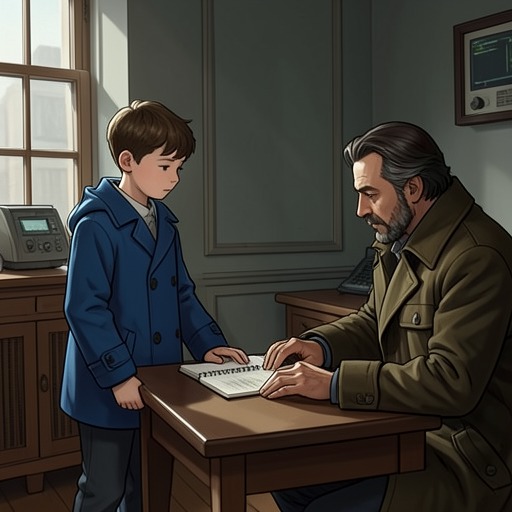
A religious correspondent writing to Boaz takes up the stars more insistently. The letter reports that Boaz has built a telescope and looks at the night sky through it, then argues that sustained attention should lead him to praise the Creator. The telescope therefore changes status: what Boaz imagined as a means of seeing more becomes, for the letter writer, a means of recognizing a divinely ordered world.
The letter interprets the heavens through the regular paths of the stars. Their movement, it argues, displays order, plan, and purpose, and this celestial pattern is made a model for human life. Just as each star has an allotted course, each person has a purpose and an obligation to follow it. The writer joins this claim to divine justice and guidance, treating the sky not as a remote spectacle but as an instruction about how people should live.
The correspondent anticipates that Boaz may regard the stars as matters of optics and astronomy. Rather than treating that scientific account as sufficient, the letter reads the same visible heavens as testimony to the Creator. It also balances human smallness against human significance: the vastness of the sky makes people seem tiny, yet the writer insists that humanity was made in God’s image. In this argument, astronomical distance does not diminish moral responsibility; it intensifies the question of how a person should use a life within a purposeful creation.
A shared image, different demands
The two uses of the stars overlap without becoming identical. Boaz associates them with relief from conflict and a wider field of attention; the list preserved by Ilana Sommo links that attention to compassion and nonviolence; the letter turns it into evidence for religious law, conscience, and a divinely assigned path. Across these appearances, looking upward repeatedly contests absorption in immediate trouble, but the proposed result changes—from mental respite to ethical restraint to obedience.
The telescope makes that difference especially clear. It is an instrument Boaz wants for his own purposes, yet the letter writer uses its supposed existence to redirect his attention toward a religious interpretation. The object that enables looking does not dictate what the observer will see: the same stars can be a welcome distance from everyday quarrels or a sign that no one is free to choose a course without moral consequence. The motif preserves that tension rather than resolving it.
The correspondence also connects the image to a specific appeal. After arguing that the stars and conscience disclose a proper path, the writer invites Boaz to join religious companions devoted to redeeming the Land and suggests that he could take up work as a security man. The letter thus brings its cosmic claim down to a concrete proposal: purpose is not only something to contemplate in the heavens but something the writer expects Boaz to enact among other people. The stars remain both a reprieve from the troubles below and a demand to return to them differently.