The black-and-white room
Black BoxThe black-and-white room is Ilana Brandstetter-Sommo’s recurring imagined setting for Alexander A. Gideon, and a compact image of the distance between them. Its fire, empty desk, and snowfields do not accurately describe the room Alexander occupies; they give visible form to the solitary figure Ilana imagines while writing to him. When Alexander corrects the picture, Ilana does not relinquish it. Its return makes the image a persistent feature of their correspondence rather than a stable account of his surroundings.
The imagined room
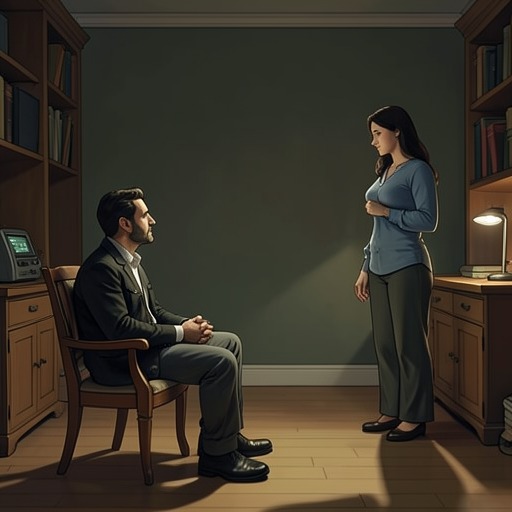
Ilana first pictures Alexander alone at a black desk in a long, book-lined room, with dazzling snow-covered plains beyond the window and a fire burning at his side. An empty glass and bottle sit on the desk. She makes the entire scene black and white, including Alexander, whom she imagines as monkish, ascetic, and haughty. The arrangement draws his isolation into a stark visual composition: the desk is empty, the drink has been consumed, and the landscape stretches without hill or tree.
The room also belongs to the imagined act of reading. Ilana anticipates Alexander’s response to her letter: he will crumple it and throw it onto the fire, suspecting that she is trying to manipulate him. The scene therefore stages not only the solitude she attributes to him but also her expectation of rejection. The fire that gives the room its striking focus becomes, in her imagined exchange, the place where her words may be destroyed.
A picture carried through correspondence
In a later letter addressed to Alexander’s Illinois address, Ilana again places him inside this visual world. She does not know where he is, yet the black-and-white room, empty desk, empty bottle, and empty glass surround him in her thoughts wherever he travels. She compares the room to the capsule of a spacecraft moving from continent to continent, while the fire and snowfields remain unchanged. The image thus holds steady even as she imagines Alexander in motion: his location may shift, but the solitary interior follows him.
The letters make the room a form of address as well as a description. Ilana writes to a distant recipient by repeatedly picturing him, and the imagined setting supplies continuity across their separation. Her description gives her a scene in which to place Alexander when she cannot know his actual surroundings; its repetition also lets her speak to the version of him she has constructed, even while anticipating that he will distrust her account and intentions.
Correction and persistence
Alexander answers the image with concrete corrections. He says that he has central heating, not a fireplace; it is May, and outside is not snow but a small garden with a neat English lawn, a forsaken wooden bench, a weeping willow, and a grey sky. He also states that he has been forbidden to drink or smoke for more than a year. The ordinary details replace the austere woodcut: instead of a vast white expanse and blazing fire, there is a modest garden and a specific season.
Ilana acknowledges the correction but does not let it settle the image. In a subsequent letter she says that, despite his denial, she still sees him at the window with snowfields running into grey fog, all as in a woodcut and in the heart of winter. The persistence is significant precisely because the factual discrepancy has been made explicit. Her imagined room does not function as reliable reportage; it preserves her way of seeing Alexander even after he offers a different account of his life.
Summer against the snowfields
The final contrast places Ilana’s image beside the present she describes around herself. While her imagined Alexander remains enclosed by winter, she writes of summer in Jerusalem: short, cool nights and blazing days. Through her window she sees workers digging trenches for an extension Michel-Henri Sommo is building with Alexander’s money; beyond the fence stand fig trees and an olive, with a wadi and an Arab quarter across it. The scene is materially and socially specific, unlike the bare, monochrome landscape she assigns to Alexander.
Her closing opposition is between a summer that has arrived where she is and the absent man still fixed in his winter room. The black-and-white room consequently gathers several tensions in the correspondence: fact against projection, movement against stasis, and the living present against an image that remains unchanged. Its force lies not in accurately locating Alexander but in showing how insistently Ilana continues to imagine him at a distance.