Time just doesn’t pass
Black Box“Time just doesn’t pass” is a reflection that turns an idle-time question into a change of perspective: rather than treating time as an empty interval to be filled, the speaker links it to the passage of people, the study of language, and the work of daily life.
The Language Book
The exchange begins with a practical choice: the speaker has a language book, identified as Grammar Made Simple, to finish, including its spelling lessons. Asked whether such a book can be read simply to pass the time, he answers by connecting words with people. Learning words means learning where people come from, who is related to whom, and how each behaves in different situations. The book is therefore not merely a way to occupy an interval; its subject opens onto the dense relations and conduct of human life.
Reversing the Direction of Time
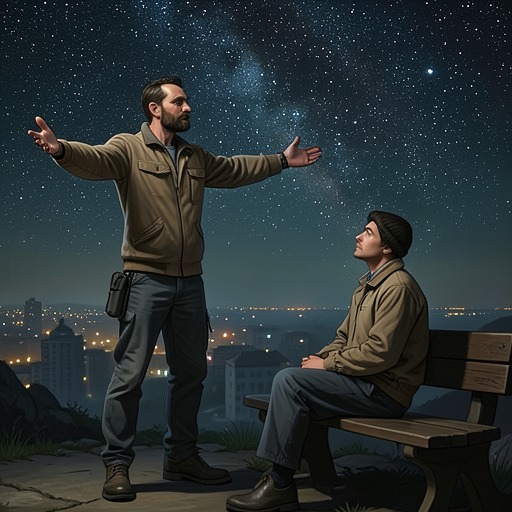
The phrase arrives as the close of a measured explanation. After a pause, the speaker circles back to the idea that there is no such thing as “passing the time.” When asked what that means, he does not settle on a single formulation. Perhaps, he suggests, people pass in time; perhaps time passes people. The alternatives reverse the ordinary expression without resolving its uncertainty. The phrase’s force lies in that reversal: time is no longer just something a person watches go by, but a condition in which people themselves are moving and changing.
From Reflection to Work
The conversation does not remain abstract. The speaker offers a choice between sorting seeds in the shaded shed and folding empty sacks, adding that the listener need only do something if he wants to. The reflection is thus followed by a concrete use of time: a task, freely offered, within a shared work routine. In the account that follows, the narrator is introduced to the work roster, usually spending about half an hour each morning sorting seeds when his pains are not especially bad, and sometimes dozing there. The phrase consequently joins thought to circumstance: time is not simply passed as entertainment, but inhabited through relationships, bodily limits, and ordinary labor.