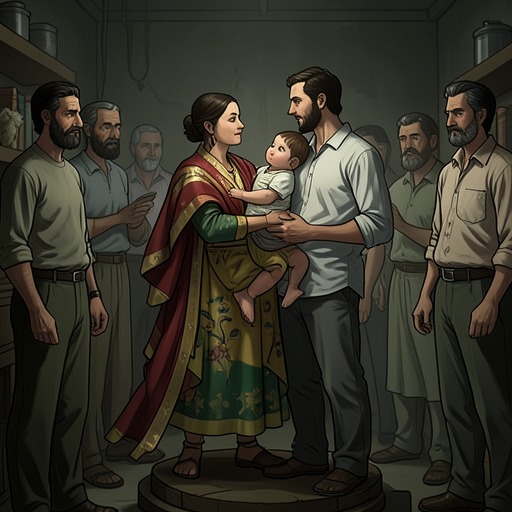
Uncertainty over Boaz’s biological father
Black BoxUncertainty over Boaz’s biological father is not resolved by a definitive test; instead, the novel reveals how uncertainty became a legal instrument, a source of estrangement, and a way for Ilana Sommo and Alexander Gideon to interpret one another’s choices. The question persists because the available tests are inconclusive and because the adults’ decisions were shaped as much by custody and fear as by the possibility of biological proof.
The legal record and the unmade test
In 1968, the Rabbinical Court and the Jerusalem District Court addressed the divorce and the dispute over maintenance. The Rabbinical Court found that Ilana had admitted adultery and ruled that she forfeited her ketubah and maintenance. The District Court record, however, gave the paternity question a separate procedural form: the blood test had produced inconclusive results, and the court advised the couple to undergo a tissue test. Both Ilana and Alexander declined. Ilana withdrew her claim for maintenance for herself and her child, and the court struck it out after both parties declared that they would make no further demands on each other. The unresolved test thus entered the record alongside a settlement that formally closed claims without settling the biological question.
The distinction matters. The court’s record establishes that no conclusive blood-test result identified Boaz’s father, and that a more decisive test was proposed but never undertaken. Years later, Alexander focused on Ilana’s refusal and asked whether she had doubted the result. His questions treated the decision as evidence that she might have feared being proved wrong about Boaz’s paternity. Ilana’s later explanation changes the meaning of the refusal: she says that her concern was not simply what the test would reveal, but what a positive result might allow Alexander to do.
Ilana’s reason for refusing
In a later letter, Ilana explains that her lawyer had warned her that if a tissue test established Alexander as Boaz’s biological father, the Rabbinical Court or another court might award him custody. She believed that Alexander hated her and Boaz enough to take the child and leave her money instead. Boaz was eight years old. For Ilana, the choice was therefore not between obtaining support and learning a fact in the abstract; it was between pursuing financial claims and risking the loss of her son. She says she wanted maintenance because she had no money, but not at the cost of giving Boaz up.
Ilana also answers Alexander’s question about why she would agree to a test now. She is no longer opposed to one, she writes, but the decision belongs to Alexander and Boaz. She urges Alexander to find Boaz himself and persuade him, rather than sending Manfred Zakheim and investigators. This shifts the test from a dispute between former spouses to a choice involving the adult son whose identity and consent have become central. Her account does not provide a test result; it explains why she once refused one and makes clear that she cannot decide for Boaz now.
Alexander’s concealed intention and later admission
The letters disclose that Alexander’s relationship to Boaz cannot be reduced to his public denial of paternity. Two months before his divorce from Ilana, when Boaz was hospitalized at Shaarei Zedek Hospital with a kidney infection and complications, Alexander secretly asked Dr. Blumenthal whether an adult could donate a kidney to an eight-year-old child. He intended to offer one of his own, on the condition that Ilana and Boaz never learn of it. Boaz recovered, so the donation did not take place. Ilana learned of the plan later from Dr. Adorno, an assistant whom Alexander had intended to sue over Boaz’s treatment.
The disclosure complicates the image Ilana has formed of Alexander as a remote father who relied on money and influence instead of direct care. His intention to donate was serious, she concludes, even though he concealed it and never acted on it. The episode is not proof of biological paternity, but it reveals that Alexander had contemplated a bodily sacrifice for Boaz while maintaining distance from the child and denying responsibility in court. The secrecy also echoes the larger pattern: a potentially decisive fact exists, but is withheld from those whose lives it concerns.
In a private reply, Alexander supplies a further explanation for his refusal to pursue the tissue test. He says he could not and did not want to take Boaz away, and did not know what he would do with him. Had he agreed to testing, he feared that a court order would attach the boy to him. This admission does not erase the years of denial or establish what a court would actually have decided. It does, however, meet Ilana’s account at its central point: both describe the prospect of a positive test as a threat to Boaz’s custody, though from opposite positions. Ilana feared that Alexander would take him; Alexander says he did not know how to take him in.
A question used to reopen the past
When Ilana first writes to Alexander about Boaz’s troubles, she anticipates that he will rely on the divorce, his denial of paternity, and the inconclusive blood test to refuse involvement. She later admits that the factual details in those letters were accurate, while also acknowledging that she was using them to draw Alexander into contact. She believed Michel Sommo, not Alexander, would rescue Boaz, and that Michel would do so without Alexander’s money. Her letters therefore carry two truths at once: Boaz needed help, and Ilana was trying to force a response from a man whose prolonged silence had become part of their conflict.
Alexander’s response makes the unresolved paternity question the condition of renewed communication. He offers another fifty thousand dollars and the possibility of naming Boaz his heir if Ilana explains why she resisted testing in 1968 and why she is willing to consider it now. He also says that a convincing answer could make the test unnecessary. The offer joins money, inheritance, and biological identity, but his demand is ultimately answered by an account of custody and fear rather than by scientific proof. Ilana’s explanation does not satisfy the test’s evidentiary function; it reveals what the test had meant to the people who rejected it.
Meaning and continuing uncertainty
The later correspondence never supplies a conclusive tissue-test result. Instead, the narrative replaces a missing biological verdict with partial revelations: the inconclusive court evidence, Ilana’s fear of losing Boaz, Alexander’s concealed offer to donate, and his admission that he would not have known how to raise the boy. Each disclosure revises the reader’s understanding without producing certainty about the underlying fact. The question of paternity remains open, while the reasons the adults avoided resolving it become more legible.
That unresolved status also shapes Boaz’s position in the family. Ilana says that he used her maiden name, Boaz Brandstetter, even on official documents, and that he rejected the adults around him with hostile labels. Such details do not determine his biological parentage, but they show that the dispute has consequences beyond the court file: the child at its center resists being securely claimed by any of the adults. The paternity question consequently becomes inseparable from the difference between biological connection, legal responsibility, custody, and the work of care. The novel leaves the test undone and makes that absence itself consequential.