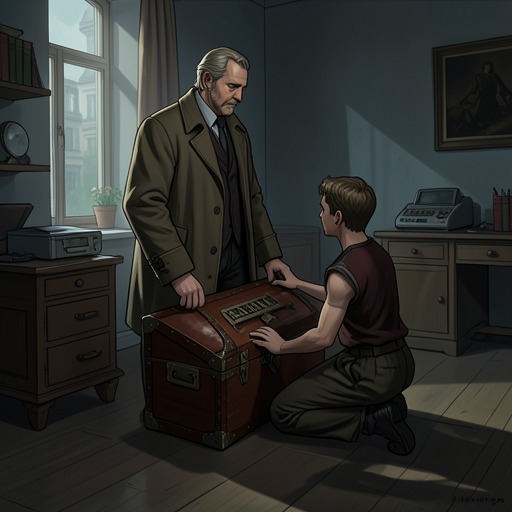
Vladimir Gideon’s cognitive decline
Black BoxVladimir Gideon’s cognitive decline appears not as a single lapse but as a changing pattern of recognition, memory, and speech. During Ilana Sommo’s visit, he moves between social poise and disorientation, recollects people and places through unstable associations, and cannot consistently hold on to who she is. The encounter makes his mental confusion visible while preserving moments of wit, courtesy, and emotional attention.
Identity and the Visit
Vladimir, whom Ilana addresses as Volodya, is seated with cake and a glass of yogurt when she approaches. At first he treats her visit as a formal occasion: he rises, bows, accepts her chrysanthemums, puts one in his dressing-gown buttonhole, and places the rest in the yogurt glass. He calls her Madame Rovina and thanks her for attending his funeral. That remark establishes the scene’s governing dislocation. He responds to a living visitor as if she has arrived at a ceremony for him, and his polite gestures proceed within a mistaken account of what is happening.
Ilana touches his hand and asks after him. He fixes her with an intense look, then chuckles as though he has understood that she came under a pretext and has chosen to forgive it. His attention is not simply absent: he can follow the social encounter and respond to its emotional tone. Yet the subject he turns to is Dostoevsky, asking whether such a writer can be pardoned for the contradiction between religious stature and cruel conduct. The abrupt change from a personal question to a moral-literary dispute shows how readily the conversation leaves its immediate setting for an older preoccupation.
Recognition and Its Collapse
The clearest test comes when Ilana asks whether he remembers who she is. Vladimir withdraws his hand and admits, with evident sadness and shame, that he cannot remember. He has not asked who the visitor is or why she requested an audience. Ilana settles him back into his chair, kisses his forehead, and supplies her name. His response seems at first to restore recognition: he identifies her as Ilana and describes her as his son’s widow.
But recognition does not hold. In the same exchange, he places her within a story in which everyone at Simferopol was killed and no one remained to witness the beauty of autumn. He then turns again to questions about her identity and purpose, as if the name she has just given him has already slipped away. The contradiction is more revealing than a simple failure to remember: a correct name briefly returns, but it is absorbed into a mistaken account of bereavement. Ilana is both recognized and lost inside the same conversation.
Memory as Association
Vladimir’s speech ranges widely, connecting Dostoevsky with Binyomin, a boy remembered near the Arab village of Budrus, and with Sioma Axioma, whom he recalls as a man from his hometown of Shirky in the Minsk Region. He speaks of these figures alongside his own earlier life and Palestine, moving between literary judgment, remembered people, and personal history without consistently marking the transitions. The sequence gives the impression of memories becoming available through association rather than through a stable chronology.
His recollection of childhood brings Palestine into relation with the steppe and landscapes of his youth. The places are not presented as interchangeable facts so much as overlapping frames through which he tries to make sense of his past. He can distinguish dream from painful reality in his reflections on Palestine, yet the distinction does not provide a firm boundary for the narrative of memory. His account continues to branch into remembered scenes and images, then loses its thread. The conversation’s movement itself becomes evidence: recollection remains abundant, but its connections and ordering are increasingly difficult to sustain.
Repetition, Farewell, and Significance
Certain images return even as other details disappear. Vladimir repeatedly anticipates snow and departure, imagining a journey away from suffering; when he cannot remember Ilana, he again speaks of autumn and the coming snow. These recurring references give his speech a recognizable pattern, but they do not restore a secure sense of time or identity. The refrain offers continuity of its own, emotional rather than chronological: it gathers loss, escape, and the approaching end into language he can revisit.
At the close, Vladimir rises and offers Ilana a chrysanthemum that has fallen into the dust and yogurt. He tells her to live and hope, then warns her not to get lost in the snow. The small act of offering the flower contrasts with his repeated loss of recognition: he cannot reliably identify the person before him, yet he can still address her with care and give her a token of parting. The scene therefore presents cognitive decline as more than forgetfulness alone. It unsettles the continuity of personal relationships and the ordering of memory, while leaving visible the courtesy, feeling, and fragmentary acts of connection that persist within that confusion.