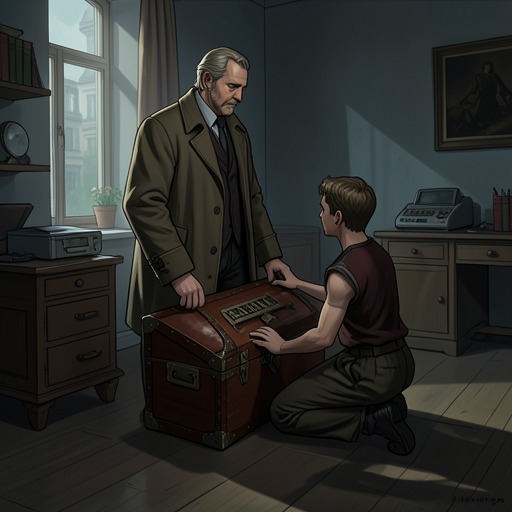
Zakheim Takes Control of and Preserves Volodya Gudonski’s Estate
Black BoxZakheim Takes Control of and Preserves Volodya Gudonski’s Estate describes Manfred Zakheim’s prolonged effort to protect Volodya Gudonski’s property from depletion and secure its succession to Alexander Gideon. The work is neither simple guardianship nor uncontested control: Volodya repeatedly resists Zakheim, while his own isolation and eventual institutionalization leave the fortune exposed to loss. In Gideon’s retrospective account, Zakheim’s professional loyalty is tested by the very family wealth he had labored to preserve.
Background and the Succession Plan
Gideon recalls that Volodya’s long decline made the management of his property a difficult, consequential undertaking. For five or six years, Zakheim worked to have Gideon appointed sole trustee of the estate. The arrangement was designed to keep the fortune together and avoid its being sharply reduced by inheritance taxes or other deductions. Gideon remembers the task as a major professional accomplishment for Zakheim, though it also brought him an ulcer and, in Gideon’s account, a fine apartment in Jerusalem.
The eventual strain on this plan came from an unexpected direction. Volodya’s only son began giving away large sums, and Gideon recognized that the inheritance Zakheim had helped preserve could again be dispersed. Gideon’s letter measures the proposed gift as roughly seven or eight percent of his own property, a figure that makes the threat concrete: the old effort to hold an estate intact had not ended the danger of its being divided or redirected. The earlier transfer of authority and the later conflict over Gideon’s generosity belong to the same history of stewardship, in which preservation could never guarantee what an heir would choose to do.
Volodya’s Withdrawal and the Estate’s Decline
The history of Zakheim’s intervention begins against the background of Volodya’s retreat from ordinary family and business life. In 1963, when Boaz was two or three, Volodya became a recluse. He dismissed his mistresses and refused to see Gideon, Ilana, or Boaz, whom he regarded as degenerates. He shut himself inside his estate with armed guards, then gradually dismissed the workmen, servants, and guards as well. An old Armenian companion remained with him in the deteriorating house, where they lived on canned food and beer while Volodya studied Persian and other subjects.
The physical condition of the property registered the consequences of this isolation. The orchard turned to jungle; branches entered the bedrooms through broken windows, plants spread into the ground-floor rooms, and rats, snakes, and birds occupied the corridors. Creepers and roots worked through the interior, while pigeons took over much of the house. These details establish what Zakheim’s management had to contend with: a fortune and estate whose owner was withdrawing from its maintenance, even as he remained capable of resisting those who tried to manage it.
Zakheim’s Efforts to Secure the Property
Volodya began distributing his wealth to people and causes around him, including claimants seeking funds for projects in Galilee and at the Red Sea. Zakheim responded by working patiently and discreetly to transfer the property into Gideon’s name. Volodya fought back: he dismissed Zakheim twice, and Gideon rehired him both times. He also assembled a panel of lawyers and paid three professors from Italy to attest that he was sane. The estate continued to leak away for nearly two years while these competing efforts unfolded.
Zakheim eventually succeeded in having Volodya taken in for observation and then committed. The account gives no detailed legal procedure, but it makes the practical significance plain: removing Volodya from the immediate struggle did not end the matter, yet it created a point at which the estate’s future could be settled. Volodya changed his position again and signed a detailed will in Gideon and Ilana’s favor. With the will, he sent a short, melancholy letter that both forgave them and asked their forgiveness, warned them against one another, and urged them to pity Boaz. Its closing expression of awe before their afflictions gives the inheritance a moral and familial weight beyond the transfer of assets.
Aftermath and Limits of Preservation
Volodya had lived since 1966 in a private room at a sanatorium on Mount Carmel, staring silently toward the sea. Gideon says he visited twice and was not recognized. He also asks whether Ilana still visits her father, suggesting that Zakheim’s work could settle property questions without repairing the human separation behind them. The fortune remained connected to the consequences of Volodya’s withdrawal: money from it had paid for the villa in Yefe Nof, while an abandoned castle between Binyamina and Zikhron remained registered in Gideon’s name.
Zakheim continued to advise Gideon about that property, arguing that its value had peaked and urging a prompt sale before the market changed. His advice shows the stewardship extending beyond the original transfer: preservation also required decisions about whether to retain or sell particular holdings. Yet the estate’s future was still uncertain. Gideon considered giving property away, including to Boaz or Sommo, or returning to the crumbling house and restoring it himself. Those possibilities are Gideon’s, not Zakheim’s; their contrast with Zakheim’s earlier labor underscores the limit of his achievement. He could protect the estate and establish a legal succession, but he could not determine what its inheritor would ultimately make of the wealth or the ruined home.