Black Hawk Super 61 shot down
Black Hawk DownThe downing of Super 61 turned a low orbit over central Mogadishu into a race to reach a crashed helicopter before the surrounding crowd could get to its crew. The strike did more than remove an aircraft: it broke the Rangers’ sense that their helicopters could keep gunmen at a distance.
The strike and the crash
Just after gunner Shawn Nelson had fired his M60 machine gun into a crowd, he heard a Black Hawk helicopter approaching. It was Super 61, piloted by Cliff Wolcott, whose men called him Elvis for the hair, walk, and manner he borrowed from his musical idol. Wolcott had delivered a Chalk of Rangers and was now flying low over the target area. The helicopter’s crew chiefs fired mounted miniguns at targets below, while two commandos in the rear selected gunmen. Overhead, the aircraft gave soldiers on the ground a sense of protection.
Nelson saw a flash and a puff as a rocket rose into Super 61’s path. The impact cracked its tail boom; its rotor stopped with a grinding sound, followed by a coughing chug. The helicopter shuddered and began to spin, slowly at first, then faster as it passed over the Rangers. It struck the top of a house, tilted, and flipped into an alley, crashing on its side. Nelson could not look away, while Private John Waddell forced himself to turn back toward his corner and watch for gunmen.
Nelson immediately urged the Rangers to move: the six men inside the helicopter needed help before Somalis reached them. The news spread across the radio in overlapping, frightened voices, replacing the controlled monotone expected of military transmissions. The crash was a sudden rupture in the soldiers’ confidence: the Black Hawks and Little Birds had been their strongest means of keeping armed opponents at a distance, and now one had fallen in the city.
A rescue mission amid civilians and confusion
The fallen helicopter turned the Rangers’ immediate problem into a race against the armed crowds gathering in Mogadishu. The rules of engagement permitted them to shoot only at people pointing weapons at them, but armed men were mixed among women and children, while residents streamed toward the fighting to witness it. The account also notes that the summer’s Ranger missions had stirred widespread hatred, placing the soldiers inside a hostile crowd whose members could not easily be distinguished by appearance alone.
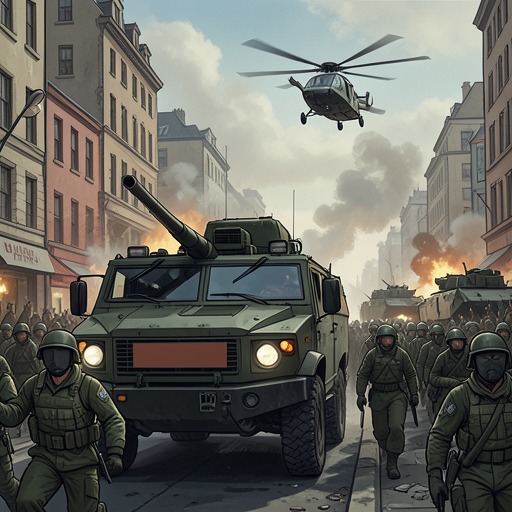
The ground convoy was supposed to reach Wolcott’s crash site, rescue the crew, and then continue about a mile south to Mike Durant’s downed Super 64. Instead, it struggled to find its way through streets where gunmen could move parallel to the vehicles and prepare to fire at each intersection. Two five-ton trucks and six Humvees stopped and darted across junctions, giving an estimated fifteen gunmen time to get ahead of them and set up ambushes.
The aerial view did not translate cleanly into directions on the ground. U.S. Navy Orion pilots and helicopter crews tried to steer the convoy around gunfire, but the Orion pilots could not speak to the vehicles directly: instructions had to pass through the Joint Operations Center at the beach. By the time a turn reached the drivers, they could have passed the intended street and taken a wrong one. From the command screens, moreover, the convoy appeared to move in an orderly fashion; the images did not convey the gunfire and blasts that made its progress desperate.
The convoy’s own command arrangements compounded the delay. Lieutenant Colonel Danny McKnight, accustomed to commanding a battalion rather than a line of vehicles, relied on directions from the aircraft and had not told the drivers where they were headed. If the lead vehicle was hit, the others therefore lacked the information needed to continue independently. At intersections, inexperienced drivers stopped in ways that exposed the vehicle behind them to crossfire. Each halt brought more people out to guard the column, and some of those who returned to the vehicles were smeared with the blood of the wounded they had carried.
The peril of distinguishing a threat from a civilian became stark during the drive. As a woman in a flowing purple robe ran beside a truck holding a baby, Specialist Eric Spalding shouted to the driver not to shoot. The woman turned and raised a pistol with her free hand. Spalding shot her, then fired four more rounds as she fell; moving quickly, he could not tell whether the baby had been hit, though he thought it probably had. The scene does not resolve the terrible uncertainty for him: the infant remained in front of the armed woman, and the convoy drove on without his learning its fate.
The return and its civilian aftermath
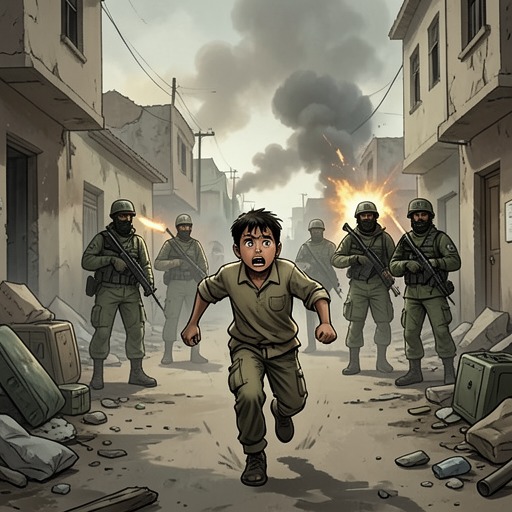
The effort to recover the men at the crash sites ended in a retreat through the same streets that had trapped the vehicles. By then, Sergeant Sizemore described the rules of engagement as off. He saw boys about seven or eight years old, some carrying weapons and others not, and shot them; he also fired into crowds of women moving alongside riflemen. His account marks a severe change from the earlier restriction to fire only at people pointing weapons: numb, angry, and focused on getting his friends back, he said he no longer cared whether he was hit or how many Somalis he struck. The impulse to protect fellow soldiers had narrowed his attention as the boundary between combatants and civilians became harder, and then seemingly impossible, for him to maintain.
The column kept firing down the alleys until it came within blocks of the airport gate. There, the battlefield appeared to stop abruptly: people moved through open-air markets, strolling and talking as if the fighting had not happened. The battered vehicles passed through the crowds, carrying dead and wounded men alongside soldiers still shaken by the ordeal. In the last hundred yards to the gate, the Somalis in the street turned toward the column, grinned, and applauded—a response that left Specialist Squeglia unable to believe what he was seeing. The return to safety did not produce a simple image of victory or defeat; it ended in a public encounter between a wounded force and a crowd whose reaction the soldiers could not readily interpret.
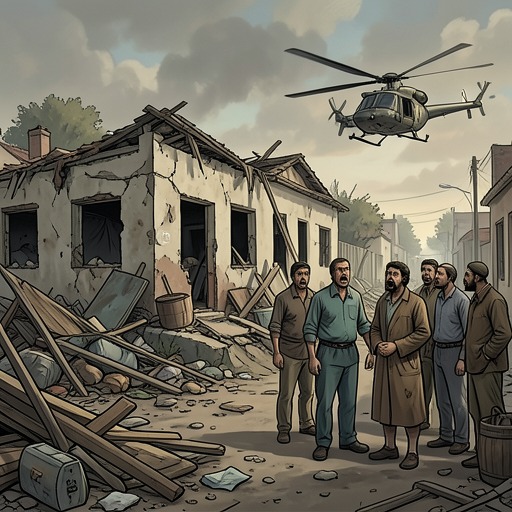
A civilian account gives that passage through the city another scale. Abdikarim, who had left home to learn what was happening near the market, encountered dead men, women, and children in the street. He saw an American soldier bleeding from the leg and trying to hide; when a woman ran in front of him, the soldier fired in their direction, and she was hit but got off the street. A Little Bird helicopter then swept down the alley firing, with bullets kicking dust past Abdikarim as he pressed himself against a stone wall. After it passed, armed Somali men ran toward a corner from which they could shoot at the Americans. Abdikarim fled to a friend's house and spent the night on the floor with others, listening to shooting instead of sleeping. His brief passage from a search for news to shelter under fire makes clear that the rescue and retreat unfolded not on an empty battlefield, but through streets shared by armed men and civilians exposed to the same violence.
Fractured signals and battlefield time
The communications problems had begun before Super 61 fell. A bullet had severed the antenna wire on Moore’s radio without the men realizing it, so he could not reach Mike Steele. After repeated attempts, Matt Eversmann got through to Steele’s lieutenant, Larry Perino, and reported that Todd Blackburn had fallen and was badly injured. The delay left Eversmann trying to convey urgency without causing alarm even as the situation around his men deteriorated. In the battle that followed the helicopter’s loss, communication was not simply a matter of getting a message through: it determined which danger commanders believed they were addressing.
The growing number of crash sites made that distinction consequential. At one point, directions from command concerned the second crash site, while Danny McKnight’s convoy was still searching for the first; he was told that his vehicles appeared to be about four blocks too far west and five blocks too far south. The episode condensed the rescue’s larger confusion into a mismatch between the map in command and the task on the streets. Meanwhile, the passage of time itself became difficult to judge for the men on the ground: events seemed to happen at twice normal speed, yet each second within Eversmann’s immediate awareness felt like a minute. The crash therefore altered more than the mission’s route and stakes. It unfolded inside a battle in which signals, locations, and even the duration of events no longer aligned reliably.