Black Hawk helicopter
Black Hawk DownThe Black Hawk helicopter carries the assault force into Mogadishu and gives troops on the ground an imposing presence overhead; when Super 61 is shot down, the aircraft also becomes the focus of a desperate rescue. The book presents it both as a machine of speed and reach and as vulnerable metal in a city where the original plan rapidly unravels. Its changing role—from transport, to fire support, to wreckage—makes the helicopter a concrete measure of how sharply the mission changes.
Assault aircraft and insertion
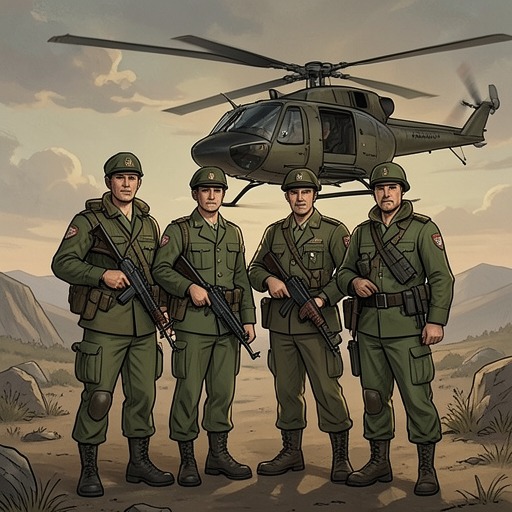
On October 3, 1993, a company of U.S. Rangers supported a commando squadron sent to capture two lieutenants of Mohamed Farrah Aidid. The plan depended on helicopters to put Rangers around the target block: four loads would rope down at its corners and seal the perimeter while commandos entered the target house. The assault force numbered about 75 Rangers and 40 commando troops in 17 helicopters. A separate convoy of 12 vehicles waited at the airport to carry the assault team and prisoners back to base.
At 3:32 p.m., Chief Warrant Officer Michael Durant announced the launch code, and the aircraft lifted over the Indian Ocean before flying low and fast above the breakers. From Matt Eversmann’s helicopter, Super 67, the city appeared as a landscape of civil-war ruin: crumbling avenues, heaps of rubbish, and buildings scarred by bullets and cannon fire. Eversmann rehearsed the plan in flight, expecting his Chalk Four to land, help secure the target, and return with the prisoners in the ground convoy. The aircraft’s speed had made the operation seem compact and controlled; the view below already disclosed the terrain in which that expectation would fail.
The insertion brought the danger down to the level of a rope. Eversmann descended from a hovering Black Hawk helicopter from roughly 70 feet, through dust stirred up by the rotors. His goggles had broken, and the nylon rope burned through his leather gloves. As he neared the street, he saw Pvt. Todd Blackburn lying unconscious and bleeding from the nose and ears. The sight overturned the expected sequence before Eversmann had even reached the ground: a member of his Chalk was already critically injured, and the plan could no longer proceed as rehearsed.
Fire support and the city below
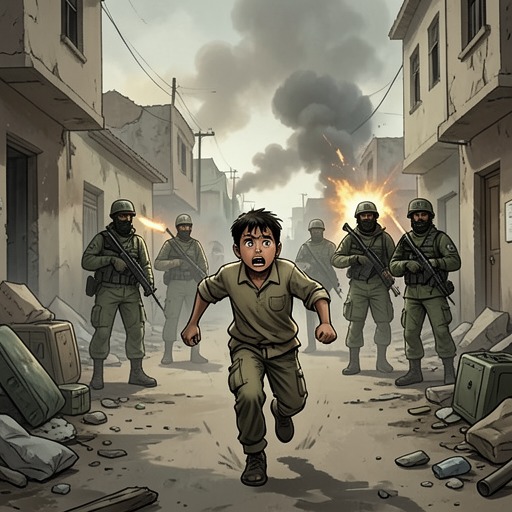
The Black Hawk helicopter’s presence overhead could be reassuring to troops surrounded by gunfire. In one street fight, the thrum of the aircraft reminded soldiers that they were not alone; a Black Hawk helicopter also fired its minigun at armed men around a cow, killing the animal. That support did not make the ground picture simple. Crowds gathered around disturbances, and people carrying weapons stood among women and children. Rangers trying to distinguish threats from bystanders faced a rapidly changing scene, while overhead fire could turn a gathering into a mass of dead and wounded.
The contrast between air power and street-level uncertainty is central to the aircraft’s role. From above, helicopters and a Navy spy plane could observe roadblocks and gunmen moving alongside the rescue convoy. Yet the convoy was lost among Mogadishu’s twisting streets, and the pilots could not communicate directly with its drivers: directions had to pass through the Joint Operations Center, introducing delays. A command to turn could arrive only after the convoy had passed the intended intersection. The helicopter offered height and visibility, but those advantages could not by themselves overcome the divided communications system or the confusion on the ground.
Super 61 shot down
The vulnerability of the aircraft becomes unmistakable in the fall of Super 61. Cameras on three surveillance helicopters recorded the crash live for Maj. Gen. William F. Garrison and his staff. The black helicopter moved smoothly, then shuddered as smoke appeared near its tail rotor. It began to rotate, made two slow clockwise turns, and struck the top of a stone building before its front end fell violently into a narrow alley. Its rotors snapped and flew away; the fuselage smashed against a stone wall amid smoke, dust, and debris.
The crash meant more than the immediate danger to the six men aboard. It crippled a ten-month American mission associated with hopes of nation-building and the New World Order. The wrecked aircraft in a northern Mogadishu alley became the physical image of those hopes under fire. The men and commanders had little time to absorb that wider consequence: the crash site itself required protection and rescue, even as the original assault and return plan broke down.
Rescue, coordination, and narrative significance
The rescue effort exposed a gap between what aircraft could see and what commanders understood. Pilots and observers watched the convoy from above and tried to steer it around gunfire, but information relayed through the Joint Operations Center reached the vehicles late. On the screens, progress could look orderly; the images did not transmit the sound of bullets or the force of grenades. Meanwhile, drivers stopped at intersections or beyond them, sometimes exposing the vehicle behind to crossfire. The helicopters’ aerial view was useful but incomplete: observation did not automatically produce shared understanding or effective control.
The aircraft therefore links the operation’s different scales. At first, the Black Hawk helicopter turns a complicated plan into a rapid insertion; overhead, it provides fire that can steady soldiers under attack. But Super 61’s destruction forces the mission to center on rescuing people from a crash site, while the convoy sent to reach them loses its way under fire. The helicopter is not merely transport or weaponry in this account. Its changing condition—from flying machine to target, then wreck—makes visible the costs of a mission whose speed of execution outstrips the ability of its forces to coordinate once the plan collapses.