CNN
Black Hawk DownCNN is a recurring conduit between the fighting in Mogadishu and those watching from elsewhere: its broadcasts bring the battle’s aftermath into a military hangar, a soldier’s family home, and the public conversation. The book gives its coverage particular force through two contrasting kinds of television material: images of a dead American being dragged through the streets, and Lorrie Durant’s message to her husband, held captive after his helicopter crashed. CNN does not control the events it carries, but the scenes it transmits become part of how the battle is witnessed and understood.
Coverage of the Aftermath
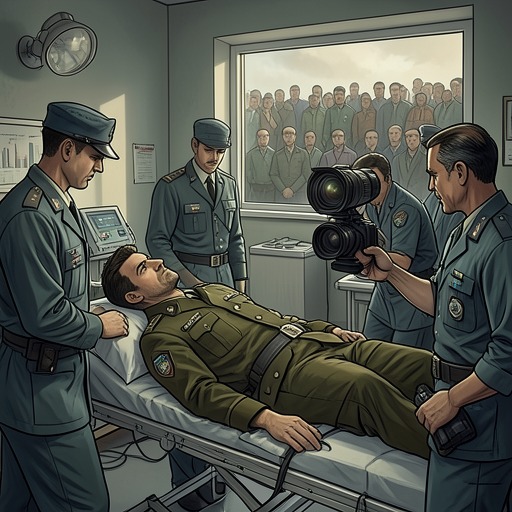
In the early morning of Tuesday, October 5, word spread through the hangar that there was something on television that the soldiers needed to see. Tired and wounded Rangers and Commando soldiers gathered around CNN. The pictures showed Somalis celebrating on the rotor blades of Super 64, the helicopter flown by Michael Durant, before turning to the sight that made the viewing almost unbearable: a dead American soldier dragged through the streets on a rope, kicked and prodded by the crowd. The men could not tell from the camera’s angles and distance whether the body belonged to a crew member or a Commando soldier.
The footage did more than report that a soldier had died. It made the body’s treatment visible to the men who feared the dead might be their own friends. Some turned away; others watched in silence. The pilots wanted to land and recover the body, but commanders judged that the crowd around it made such an attempt a potential massacre. The sequence on screen thus sharpened grief and anger while showing why an immediate response was not simple. After watching, the soldiers returned to the hangar, cleaned their weapons, and waited for orders. Paul Howe, who had already been hardened by the fighting, was ready to go back out and wanted to abandon the restraint imposed by the rules of engagement. The broadcast did not create that anger, but it gave it a devastating image around which to gather.
A Public Tragedy, Seen at a Distance
On October 4, the United States awakened to the news from Mogadishu: eighteen American soldiers dead, more than seventy wounded, and hundreds of Somalis dead. Television images showed an American soldier’s body being dragged through dusty streets by an angry crowd. Bill Clinton, in a hotel room in San Francisco, saw the pictures and was horrified and angry. He wanted to know who had authorized the mission and why he had not been informed. The book does not identify CNN as the source of the pictures Clinton watched, so his reaction belongs to the wider television coverage rather than to a specific CNN broadcast. It nevertheless illustrates the speed with which images from the city entered high-level political debate.
The public images were only one part of the story the book assembles. In Mogadishu, the account follows residents caught amid gunfire, including people whose homes were damaged and families who ran for shelter. It also traces the pressure on hospitals: by the end of October 4, all 500 beds at Volunteer Hospital were full, with at least 200 additional wounded people in the hallways, while the larger Digfer Hospital faced still greater numbers. These details do not appear as CNN reporting in the cited scenes. Their importance is the contrast they establish: a televised image can concentrate attention on a terrible, legible moment, while the surrounding narrative records the wider civilian cost and the overwhelmed medical response.
Families Watching for News
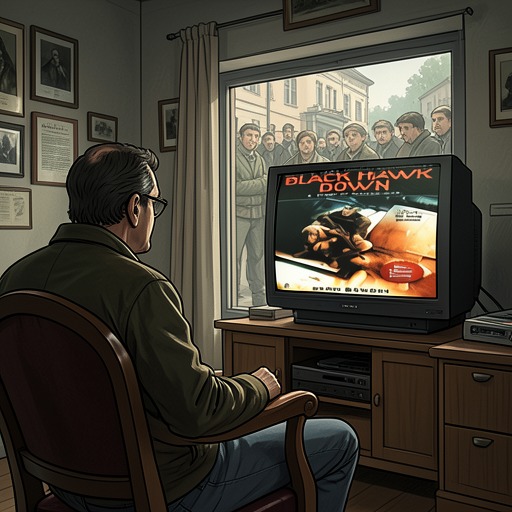
CNN also appears in a more intimate setting. At Fort Bragg on the morning of October 4, Stephanie Shughart and her boss drank coffee and watched the network as Stephanie waited for news of her husband, Randy Shughart. The previous night, another Commando wife had passed on the first, incomplete report that one of the men had been killed. When two men from Randy’s unit appeared at the door, Stephanie feared the worst. One of them told her that Randy was missing in action. In this scene, television supplies the unfolding public context, but it cannot answer the family’s central question. The official news arrives through the men at the door, not from the screen.
That distance between public coverage and personal knowledge recurs in the story of Michael Durant’s captivity. Lorrie Durant made a statement to the press, and it was carried on CNN as well as on other coverage. Hearing her voice on the BBC a day later helped her husband rally. At the end of the statement, she invoked the motto of his unit, the 160th Special Operations Aviation Regiment: Night Stalkers Don't Quit. The message had particular meaning because it connected her public words to the defiant message he had written while captive. CNN’s role here was not simply to display a captive or report his status; it also carried a family member’s voice across the distance separating them.
Broadcast Images and the Limits of the Frame
The book places CNN within a wider circulation of images, testimony, and political response rather than treating television as a complete account of the battle. Its most forceful image in the hangar is immediate and difficult to misread: a dead American is dragged through a street. The narrative then supplies circumstances that the image cannot settle on its own, including uncertainty about whose body is shown, the crowd surrounding it, the commanders’ refusal to risk a massacre, and the soldiers’ conflicting responses. The screen conveys the shock; the surrounding scenes disclose the decisions and consequences that follow it.
The network’s appearances also mark distinct forms of witnessing. Soldiers watch together in the hangar, where the images intensify anger; a wife watches at home while awaiting confirmation about her husband; and Lorrie’s statement reaches a captive through broadcast coverage. These moments are not interchangeable. In one, viewers confront the apparent desecration of a body; in another, television accompanies the uncertainty of waiting; in the third, a message spoken publicly reaches its intended listener indirectly. CNN therefore functions as a bridge, but not a transparent or all-encompassing one: it carries selected images and words across distance, while the book’s parallel accounts restore the human circumstances that a screen alone cannot show.