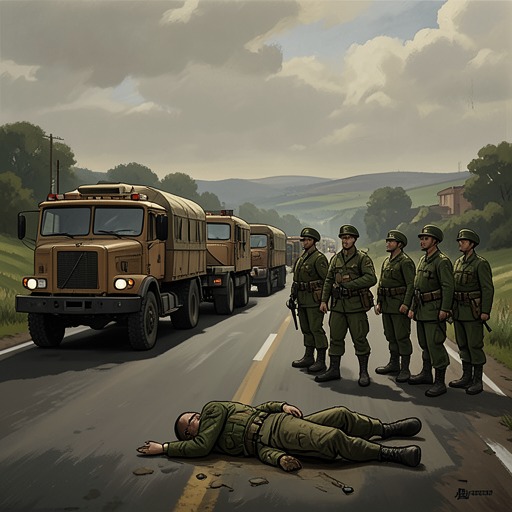
First rescue convoy's failed breakout
Black Hawk DownThe First rescue convoy's failed breakout was the initial attempt to reach the southern crash site during the battle, where Mike Durant and his crew faced imminent capture. The convoy was turned back at K-4 Circle, more than a mile from its objective; its failure left rescue efforts confronting both a dangerous route and worsening time pressure.
Stakes and Constraints
Before sunset, Charlie Company’s convoy set out with about 150 men aboard nine flatbed trucks and a dozen Humvees. Its objective was the southern crash site, where Mike Durant and his crew were about to be overrun. The distance remaining when the convoy was stopped—more than a mile—makes clear that it did not reach the decisive point of the rescue operation.
The Rangers were operating under strict rules of engagement: they were to fire only at people who pointed weapons at them. In Mogadishu, armed men were intermingled with women and children, while crowds gathered to witness disturbances. The book also notes that Ranger missions over the summer had stirred widespread hatred. These conditions define the wider battle in which the convoy moved, though the account identifies the ambush, not the rules of engagement, as the reason this attempt was turned back.
The Attempt and Its Reversal
The convoy fought its way toward the southern crash site but reached only K-4 Circle, more than a mile away. There, a blistering ambush forced it to turn back. The reversal was consequential: the force had started toward the trapped crew but could not get close enough to reach them, leaving the immediate rescue objective unmet.
The failed advance belongs to a battle in which civilians and combatants were difficult to distinguish. Elsewhere in the fighting, a soldier on a moving truck first warned its driver not to shoot at a woman because she was carrying a child; when she turned and raised a pistol, he fired at her. That episode does not describe the K-4 ambush, but it shows the perilous and rapidly changing circumstances surrounding the battle’s attempts to move through the city.
Consequences and Significance
As the evening wore on, the delay carried a stark human cost: wounded Rangers still in the city were in danger of dying unless a rescue convoy reached them soon. A much larger force was then assembled at the New Port facility, including Pakistani tanks, Malaysian armored personnel carriers, Army units, Ranger volunteers, and remnants of the earlier convoy. The subsequent preparations underline the scale of the obstacle without erasing the first attempt’s outcome: the initial force had been forced back before reaching the crash site.
The failed breakout marks an early reversal in the rescue effort. The convoy’s movement toward the objective did not become a rescue; it ended short, at K-4 Circle, under fire. The distance left to travel and the later urgency of assembling another force give the failure its significance in the larger battle: reaching the stranded airmen and recovering the wounded would require another attempt.