Fog of war
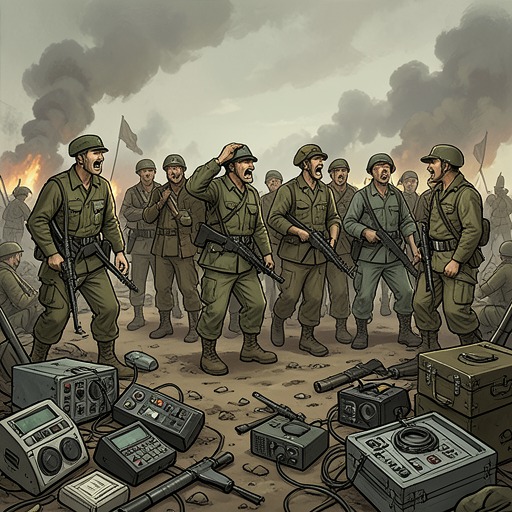
Black Hawk DownFog of war is the widening distance between events on the ground and the knowledge available to those trying to understand or direct them. In Mogadishu, the convoy’s failure to reach the crash sites makes that distance concrete: commanders can see roads and gunmen from the air, yet their instructions arrive late; soldiers can feel the incoming fire, yet cannot make their circumstances legible to those watching screens. The result is not simply confusion but a breakdown between perception, interpretation, and action, with consequences measured in lost time, wounded men, and failed rescue attempts.
Information and the limits of perception
The book presents the fog first as a distortion of time and personal awareness. Matt Eversmann experiences events as if they were moving at twice their normal speed, even as every second within his own immediate field of thought seems to last a minute. He cannot tell how much time has passed or how quickly the situation has deteriorated. His repeated checks for the ground convoy register both the need for help and the difficulty of knowing whether it is actually coming. When a humvee finally appears around a corner three blocks away, the sight brings relief, but it does not mean the mission is ending or that the men are safe.
The uncertainty is also moral and tactical. The Rangers have been ordered to fire only at people who point weapons at them, but armed men are intermingled with women and children. The crowd that gathers around disturbances includes people of all ages, while the summer’s Ranger missions have stirred widespread hatred. These conditions make it difficult to separate a visible threat from the surrounding civilian presence. The rules do not remove the uncertainty; they make accurate recognition more consequential, even as the street scene frustrates it.
Aerial knowledge, delayed instructions
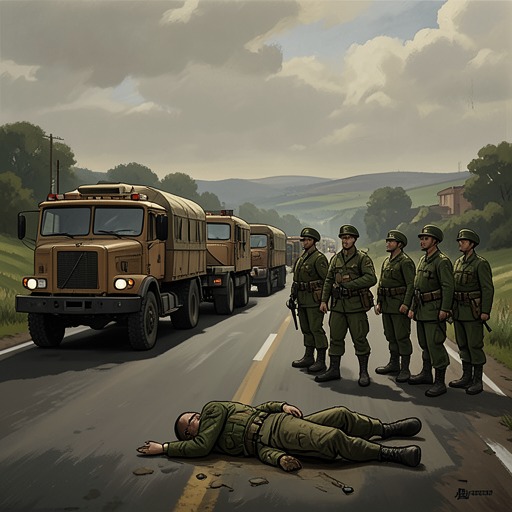
The convoy toward Cliff Wolcott’s crash site shows why more surveillance does not necessarily produce better control. A helicopter and a P-3 Orion spy plane can see gunmen moving along parallel streets and preparing ambushes. The convoy, consisting of two five-ton trucks and six humvees, stops at intersections and crosses one vehicle at a time. That pace allows roughly fifteen gunmen to keep alongside the column and reach the next street ahead of it. From above, the movement is visible; on the ground, the route is becoming a sequence of exposed crossings.
The aerial observers are not permitted to speak directly to the convoy. Their directions must pass through the Joint Operations Center at the beach before reaching the drivers. A turn instruction therefore arrives after the convoy has passed the intended intersection, and the delayed correction can send the vehicles down the wrong street. The overhead view supplies information about the maze, but the relay procedure makes that information stale before it can guide action. Surveillance becomes a source of frustration rather than a reliable means of steering the column.
The screens also omit the bodily evidence that gives the situation its urgency. Commanders watching video do not hear bullets popping or feel the bone-rattling blast of grenades. The convoy’s movement can look orderly in the images even when the men inside are under fire and the situation is desperate. The contrast is central to the book’s treatment of the fog: a view may be accurate in what it shows and still misleading in what it cannot convey.
Command, route-finding, and the convoy
The convoy is tasked with fighting its way to Wolcott’s crash site, rescuing the crew, and then moving about a mile south to Mike Durant’s crash site. Yet it cannot make progress toward the first objective because it is lost and being hit. The inexperienced drivers stop at intersections or just beyond them, exposing the vehicle behind to crossfire. Each halt brings another choice about where to turn and another opportunity for gunmen to fire. Able-bodied soldiers leave vehicles to provide security; more are shot, and the men who carry wounded comrades back become smeared with their blood.
Command arrangements add to the problem. Sgt. First Class Matt Rierson, leading the Commando team that had captured the Somalis, rides without knowing where the convoy is going. Ordinary convoy procedure is to tell every driver the destination in case the lead vehicle is hit, but Lt. Col. Danny McKnight has not done so. Accustomed to commanding a battalion rather than a line of vehicles, McKnight relies on directions from aircraft and keeps a radio in his ear. The convoy has information coming in, but the people who need a common understanding of its destination do not share one.
The route itself becomes a record of that failure. The vehicles take several doglegs onto side streets without getting closer to Wolcott’s crash site. As dusk approaches, turning west brings blinding low sun; after driving through a hail of gunfire, the column stops, makes a U-turn, and drives back through the same fire. A grenade strikes Kallman’s vehicle at the door. He regains consciousness on the front seat, accelerates, and races to catch the convoy; the metal door and reinforced glass have helped save those inside. The episode shows how quickly a driver must act on immediate, fragmentary cues, while the convoy’s larger direction remains uncertain.
Conflicting missions and isolation
The confusion sharpens when a second convoy is sent from the airport base toward Durant’s downed Super 64. Both convoys are under fire, and the radio traffic does not reliably distinguish which crash site is being discussed. McKnight receives directions that refer to the second site while his vehicles are searching for the first. Further instructions place the convoy several blocks from where it should be and direct it toward green smoke marking a crash site to the south. Amid the crowded command frequency, a voice calls for the directions to stop because the wrong convoy may be receiving them. Information is not merely delayed; it is crossed between simultaneous rescue efforts.
At the crash-site area, the confusion on the radio has a human counterpart. Men who moved from the target building toward Wolcott’s helicopter have split haphazardly into groups, pinned down in different places, and do not know exactly how far they are from the aircraft. No one is in charge of all of them: Rangers answer to Ranger officers, while Commando soldiers follow their own chain of command. The convoy expected to meet them is lost and badly damaged. Little Bird gunships overhead cannot fire freely for fear of hitting scattered American troops, and after two Black Hawks have been shot down, no helicopter can safely land to evacuate the growing number of wounded. The result is isolation produced by several interacting limits, not a single failure of courage or effort.
Images after the battle
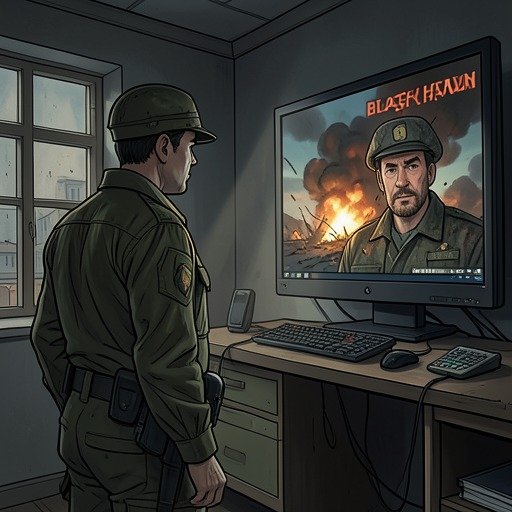
The fog persists beyond the immediate fighting, although its form changes. Early the next morning, tired and wounded Rangers and Commando soldiers see CNN footage of jubilant Somalis on the rotor blades of Durant’s Super 64 and of an American body being dragged through the street. The images make a terrible consequence visible to people back at the base, but the camera’s distant angles leave them unable to tell whether the dead are helicopter crew members or Commando soldiers. What is clear is the violence of the spectacle and the anger it provokes. The soldiers clean their weapons and wait for orders; Paul Howe is prepared to return to the streets and abandon the restraints he had previously observed. The broadcast does not resolve the battlefield’s uncertainties; it changes what the men believe the next action should be.
The same gap between event and understanding reaches the political level. On October 4, the country sees the death toll—eighteen American soldiers dead, more than seventy wounded, and hundreds of Somalis dead—alongside images of a body being dragged through Mogadishu. President Bill Clinton sees the footage in San Francisco and wants to know who authorized the mission and why he had not been informed. The day after the raid, congressional questioning of the secretaries of defense and state likewise turns on how the operation happened and why American soldiers were dying in Somalia. Clinton had been briefed on missions in advance, but this operation had been mounted so quickly that he was not told beforehand. The pictures expose the human result with brutal force, while leaving the chain of decisions and the circumstances of the raid to be reconstructed through questions.
Significance
Across these episodes, Fog of war is not a synonym for mere disorder. It describes a system in which each vantage point has a different and incomplete truth: aerial observers can track movement but cannot speak directly to the convoy; commanders can watch the column but cannot hear or feel its danger; soldiers can register the fire around them but may not know the route, the location of help, or even the extent of their own isolation. Delays and divided chains of command then turn incomplete knowledge into consequential action—or prevent action when it is most needed.
The account extends the same problem into the aftermath. Television makes suffering visible, but its images do not explain every identity or decision; political leaders receive the consequences before they have answers about the mission. In that progression, the fog does not lift simply because more information becomes available. It changes shape, moving from street-level uncertainty to confusion over responsibility and meaning. The failed convoy is its clearest physical emblem: watched from above, exposed to fire below, and repeatedly directed toward a destination it cannot reach.