Hanma military vehicle
Black Hawk DownThe Humvee was the Army’s wide-bodied, all-purpose ground vehicle, replacing the jeep. In Mogadishu it was more than transport: its capacity and mounted weapons made it a moving platform for evacuation and fire, even as the streets narrowed the distinction between a convoy’s route and a battlefield.
Transport Under Fire
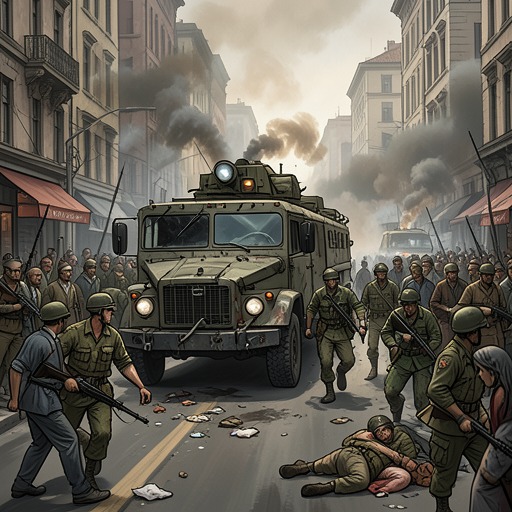
A Humvee’s role shifted as the fighting escalated. When a wounded young private needed urgent evacuation, a SEAL Humvee carried him back toward base. It had no large gun mounted on top, so two other Humvees escorted it: one with a .50-caliber machine gun and another with a Mark 19 grenade launcher. The three-vehicle column set out through streets filled with gunfire and explosions, with the wounded man in the middle vehicle.
That vehicle carried not just a patient but the fragile means of keeping him alive. A medic held an IV bag aloft with one hand and fired a rifle with the other as the convoy worked around and through roadblocks. At intersections, the vehicles faced incoming fire from rooftops, windows, and the street; a Ranger in the wounded man’s Humvee shot two gunmen who ran up behind it near an alley. The vehicles had to fight their way forward without driving so violently that the jolting ride might worsen the patient’s condition.
Convoys, Detours, and Breakdown
The Humvees were initially meant to carry 24 Somali prisoners from the raid back to the airport base, together with the commandos and Ranger teams around the target house. That plan changed when Cliff Wolcott’s Black Hawk helicopter went down four blocks east of the target. The convoy was ordered to take the prisoners as planned but then weave through Mogadishu’s narrow streets to rescue Wolcott and his crew, carrying the captives while moving toward a crash site under increasingly heavy fire.
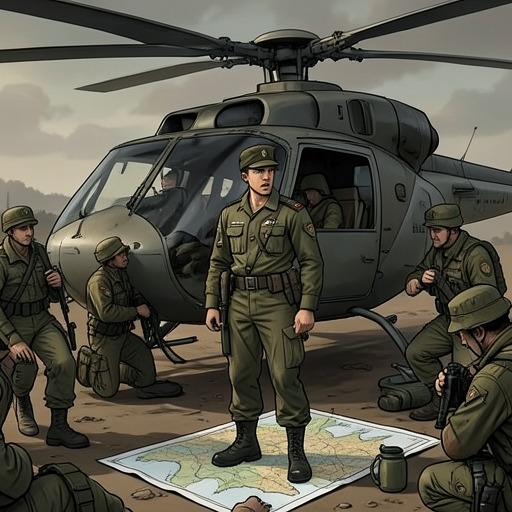
The men on the ground did not all know that their mission had changed. Lost among the alleyways, the convoy depended on officers watching video screens from above: Gary Harrell in the command helicopter at 3,000 feet and Navy pilots in a P-3 Orion spy plane flying about 1,000 feet higher. The Humvees’ mobility was therefore essential, but it could not make the streets legible or clear. The convoy’s route remained uncertain while the pressure to reach the crash site increased.
The limits of that mobility became unmistakable at K-4 Circle, where Struecker’s convoy encountered the battered remnants of Lieutenant Colonel Danny McKnight’s lost column. Its lead Humvee was smoking, with all four tires flat; the following vehicles were scarcely better, and they carried dead and wounded Rangers. The fresh convoy formed a firing perimeter while the most seriously injured were transferred to intact vehicles. Though the two columns were less than a mile from both the base and Michael Durant’s crash site, the sight of the wrecked vehicles showed that Humvees and flatbed trucks could not force a way through the Somali roadblocks. The convoys turned away, even as the command helicopter continued telling the Delta soldiers near Durant that help was only minutes away.
A Moving Boundary Between Combatants and Civilians
The Humvees moved through streets where armed fighters and civilians were intermingled, making each passing doorway and alley a potential source of fire—and each response consequential. The Rangers’ rules of engagement initially allowed them to shoot only at people pointing weapons at them, a restriction increasingly difficult to apply amid crowds that included women and children. Inside a moving convoy, that uncertainty was not abstract: soldiers had seconds to interpret what they saw, while the vehicle carried them past people who might be bystanders or attackers.
In one truck, Specialist Eric Spalding first shouted for the driver not to shoot at a woman in a flowing purple robe because she was carrying a child. The woman then turned and raised a pistol with her free hand. Spalding shot her, continuing to fire as she fell; the convoy was moving too fast for him to see whether the baby had been hit, and he believed it probably had. The Humvee’s speed carried the soldiers onward, but also left the outcome of the encounter uncertain. The scene makes the vehicle a setting for split-second judgment, not merely a means of moving combatants through the city.
Later, as a battered convoy fought its way back toward the airport, the restraints on firing were gone. Specialist Sizemore shot at boys as young as seven or eight, whether or not they carried weapons, and fired into crowds where women ran alongside rifle-bearing men. He was numb, angry, and intent on getting his fellow Rangers back safely. Yet only blocks from the airport gate, the gunfire stopped and the convoy entered a market where people were strolling and talking; as the damaged vehicles passed, the crowds parted, then turned toward the soldiers and applauded. The contrast exposes how a Humvee column could move from a street treated as a battlefield into ordinary public life within minutes, while the people inside it carried the violence of the previous streets with them.
A Sign of Relief, Then Another Ambush
Before the wounded private could be carried out, the arrival of a Humvee briefly seemed to promise that the operation was nearing its end. An officer kept looking back toward the ground convoy, knowing it was probably too soon to expect it; after checking repeatedly, he finally saw the first vehicle turn a corner three blocks away. Its appearance brought a moment of relief and the hope that the men could soon leave. But the vehicle’s arrival did not mean the streets were safe, and the convoy’s attempt to move the wounded man back to base would expose how quickly relief could turn into another fight.
The Humvee’s presence also registered differently from the street. When Abdiaziz Ali Aden ran toward the gunfire, he saw large American trucks and Humvees with mounted machine guns firing around them. The vehicle was not simply a means of transport in this view: it was part of an armed column entering a neighborhood where residents were running through smoke and gunfire. The book returns to that danger in a later convoy, when gunfire erupted almost as soon as Staff Sergeant Jeff Struecker drove his Humvee out of the American compound; the vehicle had traveled only about 80 yards beyond the rear gate. Across these scenes, the Humvee’s changing meaning—from a welcome sign of approaching help to a conspicuous combat vehicle under immediate fire—follows the battle’s repeated collapse of any clear boundary between movement and danger.