Jamie Smith and James Smith's father-son relationship
Black Hawk DownJamie Smith and James Smith’s father-son relationship was shaped by a difficult inheritance: James knew the bodily cost of combat and tried to warn his son, while Jamie had wanted to become a Ranger since childhood. In Mogadishu, Jamie’s mortal wounds turned that inherited knowledge into immediate loss; when the death notification came, James’s experience as a veteran helped him recognize its certainty and answer reporters without assigning blame he could not substantiate.
A father’s warning and a son’s ambition
James had served as a captain in the United States Army Rangers during the Vietnam War and had lost a leg in combat. Before Jamie enlisted, he tried to instill in his son a respectful fear of combat, describing in graphic detail the horrors he had witnessed. The warning was not abstract: James spoke from a life in which combat had permanently changed his body. But knowledge of that cost did not displace Jamie’s ambition.
Jamie had grown up wanting to be nothing but a Ranger. As a boy in Long Valley, New Jersey, he sometimes wore his father’s old Army jacket to school. The jacket made the connection between them visible: Jamie could wear an object from his father’s military past while imagining a future in the same service. His younger brother, Matt, was also planning to enlist and attend Ranger school, extending the family’s military aspirations beyond Jamie.
Three years before his death, while still in basic training, Jamie wrote to James about seeing two Rangers walk through the company area after lunch. He described the dream of becoming one of those men in faded fatigues and a black beret as what kept him going. The letter records an ambition that had survived his father’s graphic warnings and had become a source of endurance during training. James had tried to make Jamie understand the danger; Jamie’s words show that the danger and the dream existed together for him.
The warning becomes immediate
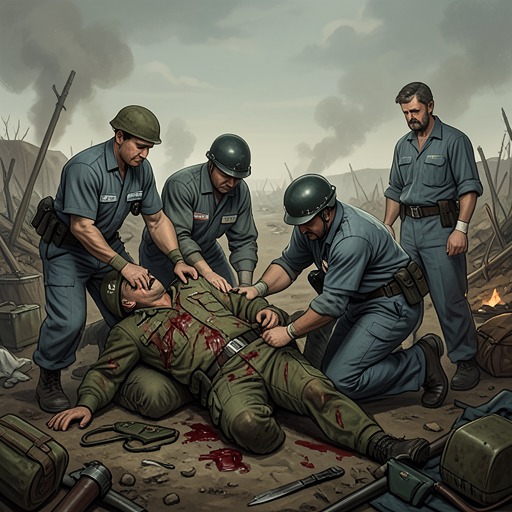
In Mogadishu, Jamie was gravely wounded. As blood flowed from him, medic Larry Perino could tell that Jamie, though weak and silent, remained alert enough to be very scared. The scene gives James’s earlier warnings a stark, bodily context: the horrors he had described were no longer recollections from Vietnam but the circumstances confronting his son. Perino and Schmid could do nothing more for Jamie, and Perino later radioed that it was too late for the medical evacuation.
The account does not show James at his son’s side in Mogadishu. Instead, the relationship reaches its crisis through what James had taught Jamie and through the later delivery of the news. That distance matters to the way their connection is presented: the father’s combat history gives him a vocabulary for understanding the danger, but it cannot protect his son from it. Jamie’s childhood jacket and his letter about the black beret stand in sharp contrast to the account of his final moments, where military aspiration meets the fear and physical vulnerability of battle.
Recognition and notification
On Monday, October 4, James was at a meeting in a bank in Long Valley when his boss’s wife entered the conference room and told him that his wife, Carol, had called. Carol told him that two officers were at their home and that Jamie had been killed. When James returned, Carol held on to the possibility that the officers might be wrong and that Jamie was only missing. James did not share that hope. His experience as a Ranger captain in Vietnam, where he had lost a leg, had taught him what it meant for a close military unit to notify a family of a death: he understood that the Army would not do so unless it had the body in hand.
James told Carol quietly that if they said Jamie was dead, they knew. His certainty was not presented as indifference or as an absence of grief; it was a conclusion grounded in his knowledge of military practice and the kind of unit Jamie had served with. The veteran who had once tried to teach his son to fear combat now relied on that same familiarity to interpret the official message. It gave him no comfort, but it left little room for the uncertainty Carol was trying to preserve.
Grief, public questions, and a family’s record
After the immediate family had been told, camera crews arrived within hours. James went into the front yard to answer questions, but was repulsed by the reporters’ manner and by questions asking how he felt, whom he blamed, and whether the Army, Somalia, or God was responsible. He said he was proud of Jamie and deeply saddened. Asked whether his son had been properly trained and led, he answered yes: Jamie had been superbly trained and led.
James also refused to turn grief into a claim of certainty about the events in Mogadishu. He said he did not yet know enough to blame anyone, and described Jamie as a soldier who had died serving his country. The distinction is central to the relationship’s final public portrait: James could affirm his pride in his son and his judgment of Jamie’s training without pretending to know more than he did about the circumstances of the death.
Two days later, a mailgram signed by a colonel James did not know formally confirmed the personal notification. Its stark language stated that Jamie had died in Mogadishu on October 3, 1993, and offered sympathy for the family’s bereavement. James already knew what it said, but the document joined him in a ritual shared by parents who lose sons in battle. The relationship closes not with the father’s earlier effort to prepare Jamie, nor with Jamie’s dream of the black beret, but with James receiving official confirmation of the loss he had already understood.