Little Bird helicopter
Black Hawk DownThe Little Bird helicopter serves as both an assault aircraft and a means of reaching casualties in streets too constricted and exposed for safer approaches. During the Mogadishu raid, its speed and maneuverability brought commandos directly to the target; after a Black Hawk went down, the same compact aircraft landed on Freedom Road to reach the wreck and evacuate wounded men. Its work links the raid’s planned opening to the improvised, dangerous efforts that followed.
Insertion and Initial Assault
At 3:43 p.m., two advance AH-6 Little Birds made the initial pass over the target, carrying rockets and checking for trouble. Surveillance cameras showed the target house across Hawlwadig Road from the Olympic Hotel, in a busy neighborhood close to Bakara Market. Residents had grown accustomed to months of helicopter overflights and did not stir as the aircraft passed. Seeing no immediate threat, the four Little Birds carrying commandos descended to the road, vanishing into swirling dust as the soldiers leaped out and stormed the house. Black Hawks carrying the Rangers followed.
The Little Birds’ role depended on speed and proximity: they could descend into the street-level action while the larger assault helicopters arrived behind them. But the initial calm gave way quickly. Gunfire could be heard as Matt Eversmann’s Black Hawk hovered above the dust, waiting for the other aircraft; its ropes were pushed out only after a delay, and one landed on a car, forcing the pilot to move until it dragged free. The contrast between the rapid insertion and the hesitation overhead foreshadowed how quickly a carefully planned assault could become difficult to control.
Landing at the First Crash Site
After Super 61 went down, a Little Bird helicopter became a means of reaching the wreck through streets where a larger landing zone would have exposed its crew to fire. The pilot took several minutes to locate the crash, with a Black Hawk helicopter overhead helping guide him in. Rather than land at the broad intersection nearest the wreck, where the aircraft could have presented a target from four directions, he set down on Freedom Road, on a slope between two stone houses. The tight street left the rotor blades just inches from the walls; dust, rotor noise, and nearby gunfire made the landing feel less like a safe arrival than an entry into the fighting.
Smoke choked the wreck, and the pilot could see that the two men in its cockpit were probably dead. Somalis were moving toward the landing site, and the pilot and copilot fired their handguns as a wounded commando emerged from the wreckage. The aircraft’s small size let it reach this exposed street, but it did not make the rescue secure: the crew had to work beside the burning Black Hawk while people approached and shots continued.
The pilot and the rescued commando then pulled a badly wounded soldier toward the aircraft. The Little Bird’s limited space turned loading into a physical struggle: when the two men could not drag the casualty, the pilot stooped, lifted him with both arms, and placed him through the helicopter’s small rear door. He then helped the wounded commando aboard as well. The casualty was still alive but had been shot beneath his armor and needed a doctor immediately. The Little Bird thus served not only as a fast insertion craft but as an improvised ambulance, carrying men out from a crash site that remained under fire.
Fire in the Alleys
The Little Bird’s presence in the streets acquired a different meaning once the fighting spread beyond the target. During the initial assault, residents accustomed to months of helicopter overflights had remained still as aircraft passed overhead. Later, Abdikarim ventured toward the shooting to learn what had happened to relatives near the market. He encountered dead men, women, and children in the road, and saw an American soldier lying by the roadside with a bleeding leg, trying to hide. When a woman ran in front of Abdikarim, the soldier fired in their direction; she was hit but managed to leave the street.
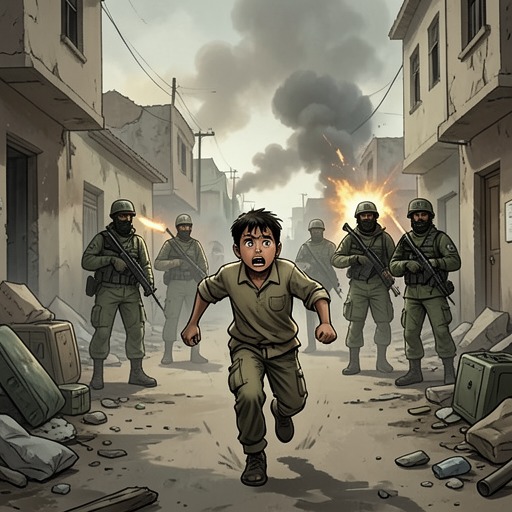
As Abdikarim ran around a corner, a Little Bird helicopter came down the alley firing. Pressed against a stone wall, he saw bullets strike the ground and raise dust just past him. After it had passed, armed Somali men ran down the alley toward the corner from which they could shoot at the American. The helicopter’s low, direct approach, useful for reaching narrow streets inaccessible to larger aircraft, placed its fire close to civilians and combatants whose movements were difficult to distinguish in the confusion. The scene also contrasts with the Rangers’ stated rules of engagement, which allowed them to shoot only at someone pointing a weapon at them, even as armed people and civilians mixed in the crowded streets.
A Civilian View of the Rescue
For a teenager sheltering in an old car near the wreck, the Little Bird’s arrival offered no safe distance from the fighting. It landed on Freedom Road, its rotor blades inches from the walls on either side, while one airman aimed up the street and another ran toward the crashed Black Hawk. The helicopter’s roar and the gunfire merged into a continuous blast; bullets struck and rocked the car shielding the teenager as he curled into a ball. The scene adds a ground-level counterpoint to the aircraft’s rescue function: its ability to reach the crash brought rescuers into the same narrow, exposed space as frightened residents and incoming fire, where arrival itself could intensify the danger.