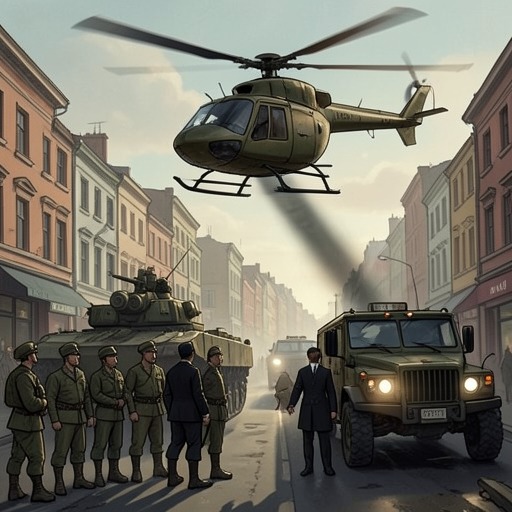
Little Bird helicopters
Black Hawk DownLittle Bird helicopters recur as close-support aircraft during the fighting in Mogadishu: their rockets and miniguns help attack gunmen around the soldiers, while their presence above streets and alleys places heavy fire within a city where civilians are also caught in the battle.
Close Support Around the Crash Site
As darkness fell, Capt. Scott Miller wanted the Rangers and Commandos scattered around Cliff Wolcott’s downed Black Hawk gathered near the crash site. Mission commander Lt. Col. Gary Harrell backed the plan, reasoning that a single position would create more effective crossfire zones and give the helicopter gunships a better shot at the gunmen surrounding the soldiers. In support of the effort, Little Bird helicopters made repeated gun runs, their miniguns sending brass links down over the fighters below.
The aircraft returned during the long night perimeter. While the pinned-down soldiers waited for a rescue column, Little Bird helicopters periodically came in with rockets and minigun fire against the men around the wreck. Their interventions offered firepower from above, but did not end the encirclement or remove the soldiers’ dependence on a ground rescue.
Limits on Evacuation
When a wounded Ranger, Jamie Smith, grew worse, Capt. Mike Steele pressed for a helicopter to land at the wide intersection outside his position. Harrell warned that the resupply helicopter had been badly shot up and had barely managed to get away; it had only hovered and had not landed. The episode exposed the difference between aerial support and evacuation: a helicopter could approach the surrounded troops, but the damage it had taken made landing too dangerous to count on.
Harrell nevertheless continued pressing the command center for help, emphasizing that Smith and Pfc. Carlos Rodriguez were critically wounded. The Little Bird helicopters’ gun runs could strike at attackers around the perimeter, but they could not substitute for a safe landing and medical extraction.
Fire in the Streets
The danger of aerial fire was not confined to the perimeter around the crash site. During the fighting, a Somali civilian who had gone toward the market to seek news of relatives encountered a Little Bird helicopter flying low down an alley and firing. He pressed himself against a stone wall as bullets kicked dust along the passage past him. The account does not identify the helicopter’s target, but it places the aircraft’s fire in the same narrow urban space where civilians were moving and sheltering.
That ground-level encounter complicates the image of the Little Bird helicopters as simply protective gunships. Their attacks were intended to support American troops facing armed opponents, yet the alley scene records how close that fire came to a civilian observer. Across the episode, the aircraft’s role is defined by both its tactical reach and the hazards of using that reach in a city where combatants and noncombatants were difficult to separate.