M60 machine gun
Black Hawk DownThe M60 machine gun is a weapon whose use in the battle repeatedly exposes the pressure placed on judgment when armed opponents and civilians occupy the same streets. First deployed according to a divided firing plan, it becomes part of scenes in which proximity, confusion, and changing rules of engagement determine who is treated as a target.
Deployment and Rules of Engagement
The Rangers were ordered to fire only at people who pointed weapons at them, but armed Somalis were intermingled with women and children, making that rule increasingly difficult to apply. The M60’s role was therefore not simply to deliver firepower: its operators had to make rapid decisions in a crowded environment where the distinction between combatant and civilian could be hard to establish.
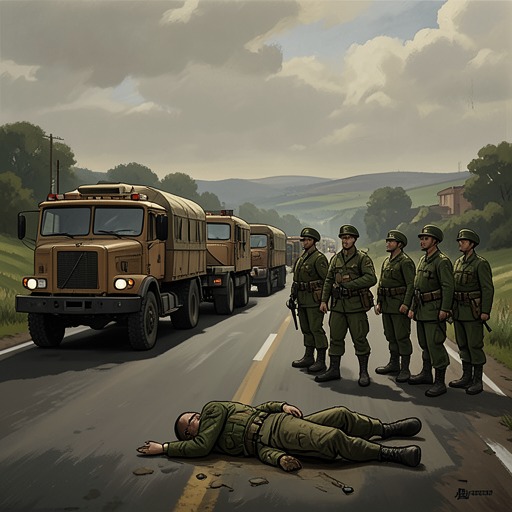
During the convoy’s movement, its commander directed the M60 gunner to concentrate fire to the right, leaving the left side to the .50-caliber gun. The vehicles were also told not to move too quickly, because a violently bumpy ride could worsen the condition of a wounded passenger. At close range, the M60 gunner and a Somali man fired at the same moment; both fell, and a bullet struck the gunner in the forehead, killing him. The episode makes the weapon’s immediate physical danger visible on both sides of the exchange: it is a means of protecting a moving convoy, but its operator remains exposed to the same sudden, close-range violence.
The M60 in the Crowded Streets
The weapon’s use varied with the position of its gunner and the shifting threat around each vehicle or defensive position. At one intersection, Staff Sgt. Chuck Elliott reported a man with a weapon concealed beneath a woman’s arm as she approached his M60, which the Rangers called a pig for its grunting firing sound. First Lt. Larry Perino ordered Elliott to fire. The burst killed both the man and the woman. The episode turned the general difficulty of distinguishing armed fighters from civilians into an immediate decision: the hidden weapon was identified, but the woman beside it was also struck down.
At the northeast corner of the target block, Spec. Shawn Nelson set up his M60 at the crest of a slight rise. From there he watched Somalis aim at the southwest corner, where another Ranger group had taken position. An elderly man with a bushy white afro remained intent on the scene and did not run when Nelson fired. Later, as crowds formed and people with guns mingled among them, Nelson tried to direct his fire only at armed people. He hesitated only briefly before firing, and the group scattered, leaving bodies in the alley. When a larger crowd gathered about fifty feet up the road, with some people shooting, he opened fire again. A Little Bird helicopter also attacked the crowd; those who did not fall fled, while the street was left with dead and wounded people. The M60’s presence in these scenes registers not as an abstract measure of firepower but as a weapon operated amid incomplete identification, close distances, and rapidly gathering crowds.
The contrast between the stated restriction on firing and Nelson’s later response is especially stark. The Rangers had been instructed to shoot only at someone pointing a weapon at them, yet the account describes armed people intermingled with civilians and crowds advancing toward the soldiers. Nelson’s initial effort to limit his fire gives way, as the group closes and shots are fired, to a burst directed into the crowd. The weapon thus recurs at the point where battlefield judgment is under greatest pressure: it is assigned a defensive sector, but its actual use unfolds in streets where the combatant-civilian distinction is both operationally urgent and difficult to maintain.
The Gunner and His Unit
Nelson’s relationship to the M60 was bound up with his place among the Rangers. At twenty-three, he was a little older than his companions; after the corporate training program he attended in Atlanta folded, he enlisted. The account connects his protectiveness toward the men not only to the weapon’s scale but to the belonging he found in the unit: they were the first real family he had had. That connection gives the M60’s role a human dimension beyond its firing sector. It was carried and used by an individual whose sense of responsibility was inseparable from the group he sought to protect, even as the crowded streets made the consequences of firing extend beyond the men around him.
The Weapon’s Human Cost
The close-range exchange also leaves the M60’s consequences inside the vehicle: its gunner, Dom Pilla, was struck in the forehead, and his body fell across Spec. Tim Moynihan’s lap. Moynihan cried out in horror. The detail shifts the weapon from a firing sector on a tactical plan to a sudden bodily loss among the men riding together, where the violence of the street enters the convoy at arm’s length.