Mike Durant and Firimbi's relationship
Black Hawk DownMike Durant and Firimbi’s relationship turned a captivity defined by coercion and injury into an uneasy but genuine form of care. Firimbi was responsible for the captured pilot’s safekeeping, yet over the days they spent together he became not only his jailer but also his nurse, companion, and advocate.
First Encounter and Custody
Firimbi, whose name was Abdullahi Hassan, was the propaganda minister for Mohamed Farrah Aidid. After Aidid’s men bought Durant back from the bandits who had kidnapped him, Firimbi was assigned to guard him. He was warned that if the pilot suffered harm, the same would be done to him. Their connection therefore began under a threat that made Firimbi’s responsibility personal as well as political: Durant’s safety was both his charge and a condition of his own.
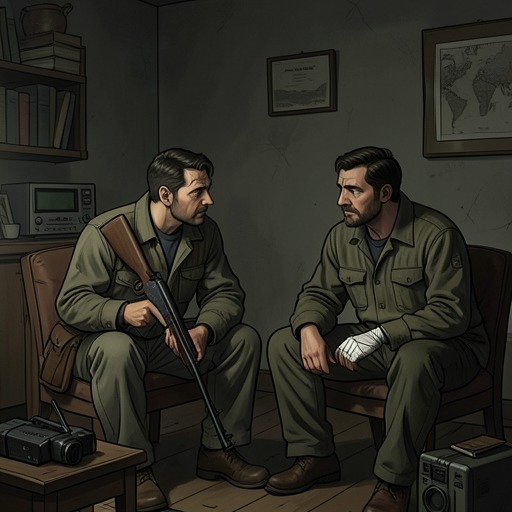
Durant was brought to Firimbi on the second night of his captivity in Mogadishu, angry, frightened, and in severe pain. His right leg had a compound fracture, his shoulder was wounded, and both injuries had become swollen and infected. He did not answer when Firimbi greeted him. Firimbi nevertheless helped wash and bandage the wounds, then passed along the message that Durant needed a doctor. The first exchange between them was thus marked by Durant’s silence and Firimbi’s practical care, before trust or even a shared language had taken hold.
The Making of a Shared Routine
As the first shock of captivity receded, Durant’s fear shifted from execution or torture to the possibility of being discovered by the Somali public. Firimbi shared that fear. Their closeness grew within a situation neither man could simply leave: they were together day and night for a week, and their limited means of communication became part of their daily accommodation. Firimbi spoke Italian; Durant knew some Spanish, close enough for them to manage a minimal exchange across the language barrier.
Firimbi regarded Durant as a prisoner of war, not merely as a captive to be kept out of sight. He believed that treating the pilot humanely could improve Americans’ view of Somalis after Durant’s release. The care was therefore both personal and public-facing: Firimbi’s concern for his prisoner became entangled with his hope that Durant would later describe that treatment to the outside world.
Durant, for his part, worked at surviving the relationship. He asked Firimbi questions and indulged his whims, finding small ways to meet the man responsible for his custody. One day, Firimbi sent a guard to buy khat, the stimulant plant he liked to chew. When the guard returned and divided it into three portions, Firimbi insisted there should be four. He indicated that Durant, too, should receive a share. Once the guard had gone, however, Firimbi gathered up the two portions for himself, winked at Durant, and grinned. The brief joke made room for complicity inside an arrangement still shaped by captivity: Firimbi could tease his prisoner, and Durant could understand and join the joke.
Their identification with one another became visible in ordinary discomforts. If Durant refused food, Firimbi refused it too; when pain kept Durant awake, Firimbi also stayed awake. He helped keep the bedridden pilot clean, and repeatedly asked what he wanted. Durant answered that he wanted a plane ticket to the United States. Firimbi then offered a radio instead. Durant accepted, and the small black plastic set arrived with its volume so low that he had to hold it to his ear. Through it he heard the BBC World Service reporting on his captivity. The English voices were reassuring because they came from the world to which he hoped to return, while the radio itself was a modest gift from the man guarding him.
Care did not erase the imbalance between them, and Firimbi’s solicitousness carried its own expectation. He asked Durant to promise that, once released, he would tell people how well he had been treated; Durant agreed. The request linked the intimate routine of tending a wounded prisoner to Firimbi’s larger concern about how Somalis would be seen in America. When helicopters broadcast, “Your friends are looking for you, Mike Durant,” Firimbi asked Durant to translate. On learning what the message meant, he protested, “But we treat you so nicely!” The exchange exposed the relationship’s double meaning: Firimbi could be genuinely attentive to Durant and still be his jailer, anxious both for the pilot’s safety and for the account he might give of his captors.
Care Before the Outside Witnesses
A doctor eventually set Mike Durant’s broken leg in a cast, but recovery remained uncomfortable and undignified. At first he was fed stale Meals Ready to Eat; later, the woman who owned the house slaughtered a goat and offered him meat and spaghetti. The meal brought its own misery: Durant developed diarrhea, which embarrassed him as well as causing discomfort. Firimbi helped keep the bedridden pilot clean, extending his care into the intimate daily work of tending a badly wounded captive.
After five miserable days, Firimbi prepared Durant for a visit from Suzanne Hofstadter, a Norwegian worker with the International Red Cross. The room was cleaned, the bedsheets changed, and Firimbi cleaned Durant, redressed his wounds, and gave him a clean shirt and a ma-awis, the wraparound skirt worn by Somali men; perfume was sprayed around the room. His attentiveness made the visit possible, while the sudden transformation of the room also gave their private custodial relationship a public face. Durant held Hofstadter’s hand and used the forms she brought to write to his family: he described his injuries, said he was doing all right, and asked them to pray for the others. He still did not know what had happened to his crew or to the two soldiers who had descended by rope to save him.
The Limits of Their Intimacy
Firimbi’s care could ease the daily hardships of captivity, but it could not remove the separation from Durant’s family or the fear that his situation had gone badly wrong. Durant grew depressed after expressing that fear, then rallied when he heard his wife’s voice on the BBC: she ended her statement to the press with the words, “Like you always say, Mike, Night Stalkers Don't Quit.” The phrase echoed the cryptic initials Durant had written at the bottom of his note, still visible despite the Red Cross scratches; it was the motto of the 160th Special Operations Aviation Regiment, not something Durant often said aloud. The message reached him through the radio that had become his lifeline, while Firimbi’s promise of humane treatment remained the immediate, uneasy bond of his captivity: genuine care between captor and prisoner, bounded by the fact that one controlled the other’s freedom.