Mike Durant's capture and release in Somalia
Black Hawk DownMike Durant's capture and release in Somalia extended the fighting beyond the wreckage of his Black Hawk helicopter: an injured pilot became a hostage whose fate was tied to the politics of Mogadishu and to the United States' refusal to pay or trade for his return. His survival depended first on successive armed groups, then on the uneasy protection of Abdullahi Hassan, while the battle's dead and wounded, televised images, and negotiations turned his captivity into a public and diplomatic crisis.
Capture and Transfer Between Armed Groups
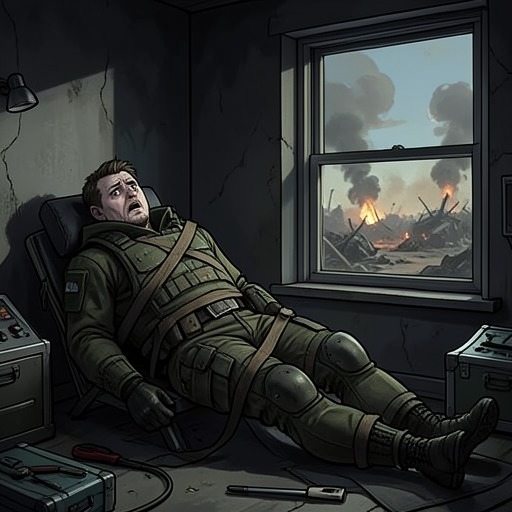
On the morning of October 4, Durant woke in a small, windowless octagonal room, chained by the hands and unable to locate himself in Mogadishu. He had not slept. The previous evening, an angry crowd had overrun his downed helicopter crew and the two Commando sergeants who had fought to protect them. Durant did not know that the others were dead. His right femur was broken, with bone having pierced the flesh, and he believed his back might also have been injured in the crash.
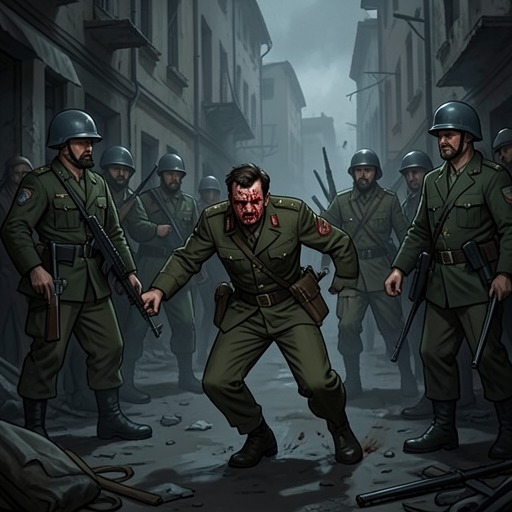
The force holding him had changed during the journey from the crash site. Yousuf Dahir Mo'Alim, a neighborhood militia leader, had spared Durant from the attacking crowd. Mo'Alim's men were carrying the pilot toward their village, intending to contact leaders of the Habr Gidir clan, when a Land Cruiser with a mounted gun intercepted them. Its occupants were freelance street fighters aligned with no clan. They treated Durant not as a prisoner of war to be exchanged for detained clan leaders, but as a hostage for whom someone might pay. Outnumbered and outgunned, Mo'Alim's men handed him over. In the account's stark summary of power in the city, the group with the bigger guns prevailed; if Mohamed Farrah Aidid wanted Durant back, he would have to pay.
The kidnappers bound Durant with a metal dog chain, wrapping it around his hands on his stomach. During the night he worked one hand free because sweat let it slide from the chain. The small gain let him wipe dirt from his face and ease his broken leg; he then put his hand back into the restraint so his captors would not notice. It was a limited act of resistance, but one that gave him a first sense of triumph while he remained helpless and alone.
A City at War, a Captive in the Middle
Durant's captivity unfolded against a battle in which civilians and armed fighters were difficult to distinguish. The Rangers had been ordered to fire only at people pointing weapons at them, but armed men were intermingled with women and children, and crowds converged on the fighting. During the convoy's movement, a woman carrying a baby ran beside a truck. A soldier warned the driver not to shoot because she had a child, then saw her turn and raise a pistol; he fired, and could not tell whether the baby had also been hit. The episode makes the battlefield's split-second judgments concrete without resolving their terrible uncertainty.
Elsewhere, the convoy's discipline collapsed under fire. A Ranger described shooting at children, some armed and some not, and firing into crowds alongside men with rifles; he felt numb, angry, and determined to get his friends back safely. The battered column eventually reached the airport gate, where the shooting stopped and people in the market streets applauded as the soldiers passed. These scenes frame Durant's captivity within a conflict that had crossed the boundary between combat and civilian life, and in which the force used to recover the trapped soldiers carried its own consequences.
The wider public learned of those consequences through television. Early on October 5, exhausted soldiers at the base watched CNN footage of Somalis celebrating on the rotor blades of Durant's helicopter and dragging a dead American through the street. The images provoked disgust and anger among the soldiers. In the United States, President Bill Clinton saw the footage and was horrified; he also wanted to know why he had not been informed before the mission. Congress questioned senior officials about the deaths of American soldiers in Somalia. The book reports eighteen Americans dead, seventy-three wounded, more than five hundred Somalis dead, and at least a thousand injured. Durant's captivity was thus bound to a larger argument over the mission and its cost.
Captivity, Interrogation, and Care
On the evening of October 4, about ten young men arrived with a camera crew and an array of lights. Durant was hungry, thirsty, frightened, and visibly injured; a militiaman had struck him in the face with a rifle butt. He had been questioned throughout the day about his identity and his unit. Trained to give as little information as possible and to avoid confrontation, he adhered to his military code of conduct during the filmed interview. When the interviewer assumed he was a Ranger, Durant corrected him: he was a pilot. He also acknowledged that the killing of innocent people was not good, without giving the interviewer more information about his mission.
After being moved from the room where he had first awakened, Durant was taken by car to an apartment. The journey sharply aggravated his swollen, broken leg: two men sat on him, and every movement caused pain. There he was left with Abdullahi Hassan, known as Firimbi, the propaganda minister for Mohamed Farrah Aidid. Durant did not know that Aidid had paid his ransom. Firimbi would remain his custodian for the next ten days.
Durant's fear changed over the first several days. He had initially feared execution or torture; later, having survived the enraged crowd, he chiefly feared being discovered by the public. Firimbi shared that fear and treated him humanely, regarding him as a prisoner of war and hoping that humane treatment would improve Somalis' image in America. The two men were together day and night for a week. Firimbi spoke Italian and Durant some Spanish, languages similar enough to permit limited communication. Their relationship did not remove the fact of captivity, but it shaped the conditions in which Durant endured it.
A small black plastic radio became a lifeline. With its volume so low that he had to hold it to his ear, Durant listened to the BBC World Service and reports about his own captivity. After five miserable days, Firimbi cleaned him, redressed his wounds, changed the bedsheets, and gave him a clean shirt and a ma-awis. The preparation preceded a visit from Suzanne Hofstadter, a Norwegian relief worker, who brought forms for a letter. Durant held her hand and wrote to his family that he was doing all right, described his injuries, and asked them to pray for the others. He still did not know what had happened to his crew or to the two men who had descended to protect him. In a separate note to his companions at the hangar, he tried to reassure them with a lighthearted request that they leave the Jack Daniels in his rucksack untouched, ending with the initials of his unit's motto.
Negotiations and Release
U.S. policy rejected both payment and an exchange. When Robert Oakley arrived in Mogadishu on October 8, Mohamed Farrah Aidid was in hiding, so Oakley met with clan leaders instead. He told them that the U.S. operation against Aidid had ended and that Task Force Ranger's original mission was over, but the leaders were skeptical. They pointed to the sixty or seventy men detained by the task force, including Omar Salad and Mohammed Hassan Awale, and insisted that Durant's release would have to involve a trade.
Oakley said he would try to secure the detainees' release but could not promise it, and only after Durant was freed. He warned that if the pilot remained captive, the United States would decide to rescue him, not pay or trade for him; renewed fighting, he said, would unleash the pent-up anger on the U.S. side and devastate the area. The warning placed the prospect of another battle beside the stated refusal to bargain. The clan leaders relayed Oakley's message and what he called friendly advice to Aidid, who offered to hand Durant over. Oakley asked them to wait a few hours so he could leave the country, instructed them to turn Durant over to Paul Howe, and flew back to Washington. Several weeks later, Clinton ordered the release of every Somali captured by Task Force Ranger.
Durant's return was staged as both a celebration and a reckoning. Everyone based at the hangar turned out to salute him as he was carried on a litter through hundreds of men in desert fatigues, an IV in his arm and his unit's red beret in his hand. The relief was enormous, but Durant was the only member of his four-man crew and the two Commando defenders to come back. His release ended his captivity, not the losses that had made him a hostage or the questions raised by the battle. The homecoming joined a single survivor's return to a casualty toll that, by the account's reckoning, made the fight the largest involving American troops since the Vietnam War.