Mike Durant—Yousuf Dahir Mo'Alim
Black Hawk DownThe relationship between Michael Durant and Yousuf Dahir Mo'Alim takes shape at the second helicopter crash site, where an armed militia leader first approaches the pilot as an enemy and later shields him from a crowd seeking revenge. Their encounter turns on a stark reversal: the Americans’ ability to resist makes an assault costly, but once Durant is at the crowd’s mercy, keeping him alive becomes more valuable to Mo'Alim than killing him.
The crash and the armed approach
The crash occurred in Wadigley, a crowded neighborhood of rag huts and tin-roofed shanties south of where Mo'Alim lived. An armed bandit and gunman for hire, he committed his gang of 26 street fighters to the citywide effort against the American incursion. When Durant’s Black Hawk struck the ground, the movement in the streets abruptly reversed: people and fighters who had been running north toward the first crash site now hurried south. Mo'Alim ran with them, waving his weapon and warning that men remained inside who could still shoot.
His authority could slow some of the people following the wreck, but it could not stop them all. Ali Hussein, a pharmacist near the crash, saw neighbors arm themselves and run toward the helicopter; his friend Cawale, who owned the Black Sea restaurant, pulled away from Hussein’s attempt to hold him back and joined them. By the time Mo'Alim and his men reached the site, Cawale lay dead in the dirt, four paces from the aircraft, amid the bodies of other Somalis. The Americans around the wreck were still fighting effectively, just as Mo'Alim had expected.
Mo'Alim tried to restrain the crowd while looking for positions from which his own fighters could fire on the Americans. Approaching the small clearing was difficult: the defenders covered every route with automatic-weapons fire. Rather than rush into that fire, he waited for more of his men to arrive so they could attack together. The delay establishes the terms of the encounter: Durant and the other Americans retained the power to defend the crash site, while Mo'Alim sought an opening without exposing his fighters to the full force of their guns.
The assault and the reversal
By the time the fighting around the wreck reached its decisive moment, anger was driving the crowd toward the helicopter despite the Americans’ gunfire. The book places that anger in the months of Ranger raids: aircraft had swept over the city by day and night, roofs had been blown off, and Habr Gidr clan leaders had been captured. At the crash site, the bodies already lying around the clearing and the defenders’ accurate fire initially helped Mo'Alim hold people back. He stayed at a distance until about a dozen of his men had joined him, then spread them out for a coordinated attack.
Mo'Alim saw two soldiers and a pilot firing from the visible side of the aircraft, while another American lay dead or badly wounded. At his signal, his men opened fire together. The exchange lasted at least two minutes; then the Americans fell silent, and the crowd poured into the clearing. People dragged the one surviving American they found by the legs and tore at his clothing. Others hacked at the dead or pulled at their limbs, while some carried away body parts. The confrontation had shifted from a firefight against a defended position to a violent rush over its survivors.
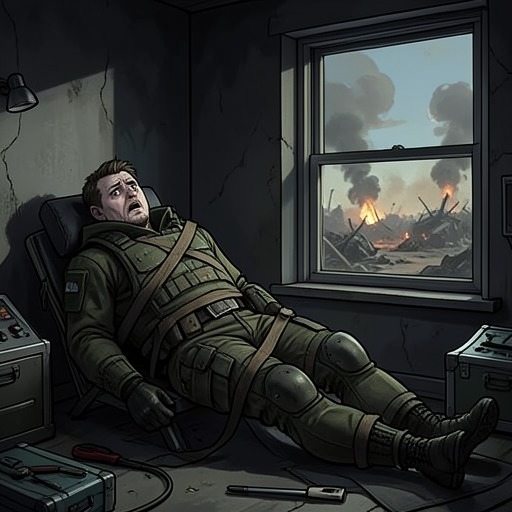
Rounding the helicopter’s tail, Mo'Alim discovered two more Americans: one lying on the ground, apparently dead or gravely wounded, and a living pilot who did not fire. Instead, the pilot laid his weapon on his chest and folded his hands over it. As the crowd surged past, people kicked and beat him. Mo'Alim then intervened, grabbing the pilot’s arm, firing into the air, and shouting for the crowd to stay back. When one of his own men struck the pilot in the face with a rifle butt, Mo'Alim pushed the attacker away. The militia leader who had led an assault on the crash site was now trying to keep the pilot alive.
Captor, protector, and potential bargaining piece
Mo'Alim’s intervention was not an act of reconciliation. He recognized a practical advantage in keeping Durant alive: the Rangers had spent months capturing and holding Somalis, and Mo'Alim thought they might trade prisoners for one of their own, perhaps even surrender all of them. The same militia leader who had helped organize the attack therefore became a barrier between the captured pilot and a crowd bent on revenge. He and several of his fighters formed a ring around Durant, making protection a matter of control as well as calculation.
That protection remained rough and precarious. Some of Mo'Alim’s fighters stripped Durant of his clothes because he had a pistol and a knife, and they feared he might have other weapons or a beacon concealed in his clothing. Durant kept looking toward the sky while the Somalis shouted words he could not understand. His nose was broken, and the bone around his eyes had been shattered by the rifle blow. The encounter thus ends this phase of their relationship in an unresolved imbalance: Mo'Alim had helped make Durant a captive, then tried to preserve his life and value, while Durant depended on a captor whose protection could not erase the violence that had brought him into custody.
The relationship within a blurred battlefield
Mo'Alim’s change from attacker to protector unfolded in a battle where identifying who was fighting—and who was caught among the fighters—had already become difficult. The Rangers had been ordered to fire only at people pointing weapons at them, but armed Somalis moved among women and children, while crowds gathered at disturbances across Mogadishu. The narrative ties the hostility surrounding the crash to earlier Ranger raids and captures, showing that Durant’s appearance as an enemy pilot did not arrive in a politically or emotionally neutral setting. Mo'Alim’s calculation about preserving a prisoner emerged from that same cycle of raids, resistance, and retaliation.
Elsewhere in the fighting, the strain on the distinction between combatant and civilian becomes still more visible. During a convoy’s passage through an alley, Specialist Eric Spalding first shouted for the driver not to shoot a woman because she was carrying a child; when she turned with a pistol in her free hand, he shot her repeatedly and feared he might also have hit the baby. Later, after the rules of engagement were abandoned, Sizemore shot young boys, some armed and some not, and fired into crowds that included women alongside riflemen. A Somali civilian, Abdikarim, likewise saw an American soldier fire toward a woman in the street before a Little Bird helicopter swept down the alley shooting. These separate scenes do not alter what Mo'Alim did at the wreck, but they set its limits in relief: his effort to keep Durant alive was a consequential intervention within a battle marked by civilian deaths, revenge, and unstable control, not an end to the violence that had brought the two men together.