Mogadishu Airport Base
Black Hawk DownMogadishu Airport Base was the American beachfront staging point for the Mogadishu operation: a launch point for the helicopter force, a departure point for the ground convoy, and the place to which soldiers returned after fighting through the city. Its military order and separation from the streets offered neither a complete view of the battle nor a simple refuge from its consequences. The narrative sets the base against a city where residents faced danger, displacement, and accumulating casualties.
Setting and Operational Role
Mogadishu Airport Base stood on the beach in Mogadishu, within a short drive of the operation’s target area. The target was roughly three miles away, and the trip from the base to the area behind the Olympic Hotel was expected to take only about five minutes. That proximity made the base an efficient staging point, but the operation depended on forces moving between it and a crowded urban environment.
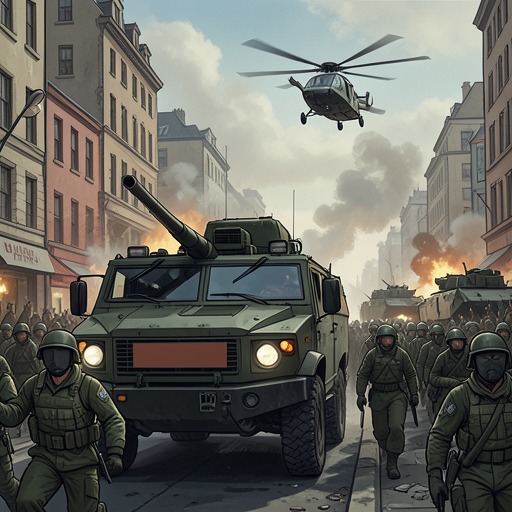
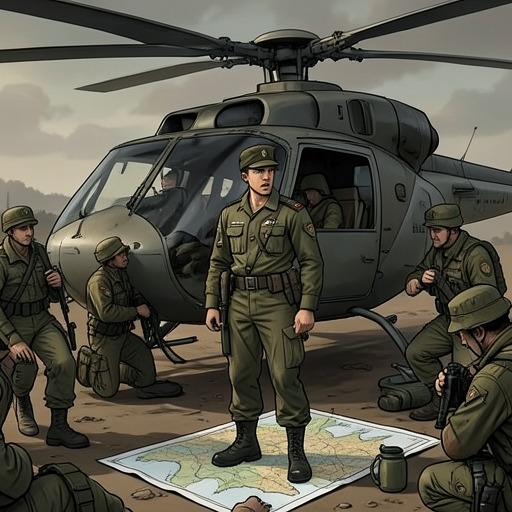
The assault plan combined air and ground elements. About 75 Rangers and 40 Commando troops were to travel in 17 helicopters, while a 12-vehicle convoy waited at the airport. The convoy’s task was to reach a point behind the Olympic Hotel, wait for the assault team to finish at the target building, and escort the team and Somali prisoners back to base. The code word for launch was Irene. The numbers and assignments give the base a practical importance: it was not merely a nearby installation, but the departure and intended return point for the operation’s two linked forces.
Preparation and Departure
The base was also the setting for the final moments before the air assault. Eversmann, responsible for a group of twelve men, rode in a helicopter with two crew chiefs and said a Hail Mary as the aircraft lifted off. Earlier that morning he had prayed silently during Mass at the mess hall. His prayer at takeoff connected a private act of faith with the weight of leading his men into the mission; the scene begins at the base’s edge, just before the force crossed into the city.
The ground convoy did not leave at the same moment as the helicopter force. Staff Sgt. Jeff Struecker waited several minutes in his Humvee with the other vehicles, then led the column toward its designated position behind the Olympic Hotel. The different departure times reflect the plan’s sequencing: the convoy was to reach its waiting point after the helicopters had gone ahead, rather than travel to the target as a single combined force.
A Base Without a Full View
For Rangers who remained at the beachfront base, the battle was at once close and remote. They could not watch events unfold on video screens, unlike commanders at the nearby Joint Operations Center. Their physical proximity to the fighting therefore did not give them the same information or perspective available to the command post. The base’s role as a staging area carried an informational limit: soldiers there waited without a continuous visual account of what was happening in the city.
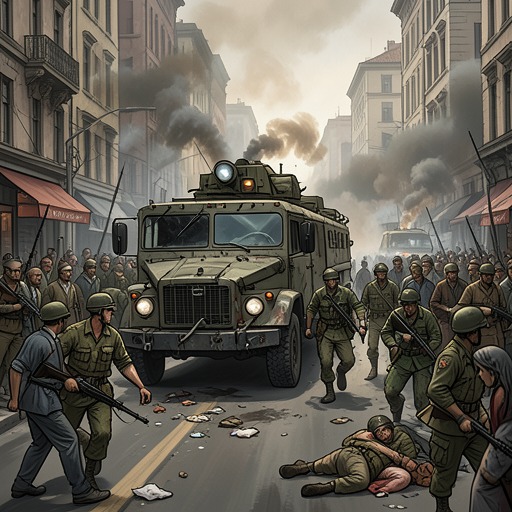
The mission’s rules of engagement sharpened the distance between plan and circumstance. Rangers had been told to fire only at people pointing weapons at them, but armed men were mixed among women and children, and large crowds gathered wherever disturbances occurred. The account connects that difficulty to the hatred stirred by the summer’s missions. From the base, a disciplined plan could be issued; in Mogadishu’s streets, its application confronted a shifting mixture of combatants and civilians.
Return and the City Beyond the Base
When the convoy reached the beachfront American compound, its arrival did not produce the calm welcome Struecker had expected. The returning soldiers were exhausted and disoriented, and the base was already in motion: people hurried across the tarmac while a commander called for attention to orders. The contrast makes the base’s meaning change over the course of the operation. It had been a point of departure and a place of expectation; on the convoy’s return, it became a crowded center of response rather than an undisturbed sanctuary.
The surrounding city’s experience gives that return a wider context. Low-flying American helicopters damaged Abdiaziz Ali Aden’s family home, bringing down part of its roof and trapping his parents and eight siblings beneath it. The family escaped serious injury, left for a nearby friend’s house, and waited there because they feared the aircraft might explode. Elsewhere, helicopter fire at Kassim Sheik Mohamoud’s garage killed two employees. These events occurred in the city, not at the base, but they show what the operational distance between beachfront staging ground and urban target area meant to residents.
The streets also became places of flight, armed resistance, and uncertainty for civilians. Militiamen used megaphones to call people to defend their homes; people encountered crowds of frightened women and children, while armed individuals moved among them. By dusk, a small burial convoy carrying the dead from Kassim Sheik Mohamoud’s household had reached a cemetery where people were digging graves for the newly dead. At Volunteer Hospital, surgeon Abdi Mohamed Elmi had been receiving wounded people since the previous evening, though fear and burning roadblocks initially kept many from venturing out. Against these accounts, Mogadishu Airport Base appears as a defined military site beside a city whose harms extended well beyond the operation’s intended target.