Mogadishu rescue convoy operation
Black Hawk DownThe Mogadishu rescue convoy operation was the belated, heavily armed effort to reach American forces trapped at two helicopter crash sites after an earlier attempt had failed. It turned a rescue into a night-long passage through ambushes and confused command, and its arrival brought not a clean escape but the difficult recovery of the dead and wounded.
Urgency and assembly
More than five hours into the battle, Lieutenant Colonel Bill David understood that delay meant wounded Rangers in the city might die. The force he commanded had already tried to reach the southern crash site, where pilot Mike Durant and his crew faced being overrun. That daylight attempt made it only as far as K-4 Circle, more than a mile from the wreck, before a fierce ambush forced it back. The new mission therefore began with the knowledge that the first effort had not merely stalled: the people it was meant to rescue remained in immediate danger.
David was ordered to assemble a much larger force at the New Port facility: four Pakistani tanks, 28 Malaysian armored personnel carriers, his own men, 150 soldiers from the 10th Mountain Division’s Alpha Company, a platoon of Ranger volunteers, and the ambulatory survivors of the lost convoy. The collection of units and vehicles offered protection and numbers, but assembling it quickly was itself a problem. Drivers had to be found who could operate five-ton trucks while wearing night-vision devices; soldiers had to be assigned to vehicles, and the multinational force had to be given a workable plan. Communication added friction because most Malaysian and Pakistani commanders spoke English, while their men did not, slowing the passage of decisions down the ranks.
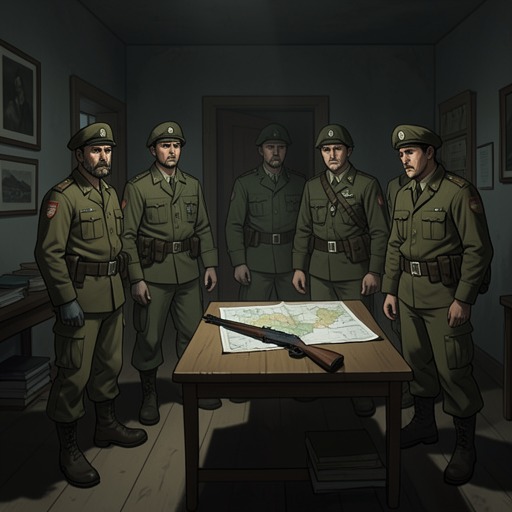
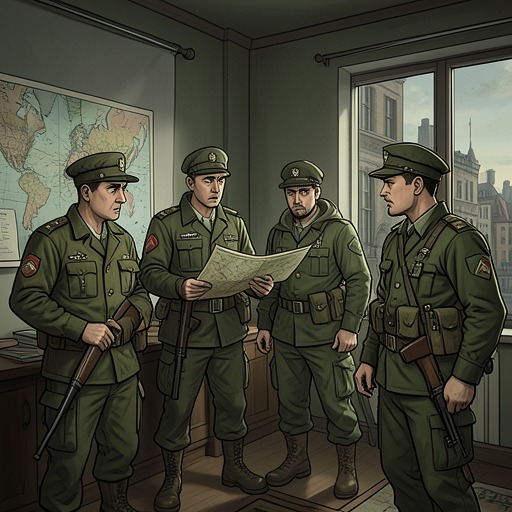
David used a map illuminated by soldiers’ flashlights to explain his intended formation: put his better-trained soldiers aboard the Malaysian armored carriers, place the tanks at the front, advance between the two crash sites, and then send one company to each. The plan was not ready until 11:20 p.m. A Pakistani commander then told David that his force had orders not to lead. David negotiated a compromise: the tanks would escort the convoy through the first few miles, where roadblocks and ambushes were expected, and then withdraw so Alpha Company could take the lead in the carriers. The convoy finally moved, a coalition improvised under pressure before it had even entered the worst of the fighting.
Fighting Through the City
The earlier convoy’s attempt to reach the first crash site exposed how little the view from above could control what was happening below. Navy aviators in helicopters and a surveillance aircraft tried to steer the vehicles around gunfire, but the Orion pilots could not speak to the convoy directly: instructions had to pass through the Joint Operations Center at the beach. By the time a direction such as a turn left reached the drivers, the convoy might have passed the intended street and turned onto the wrong one. On command screens, its movement seemed orderly; the images did not convey the bullets and blasts confronting the men in the vehicles. Lieutenant Colonel Danny McKnight, relying on aerial guidance, had not told the individual drivers where they were headed, so when the lead vehicle faltered, the rest could not simply continue along a shared route. Confusion over which crash site the convoy was seeking compounded the problem.
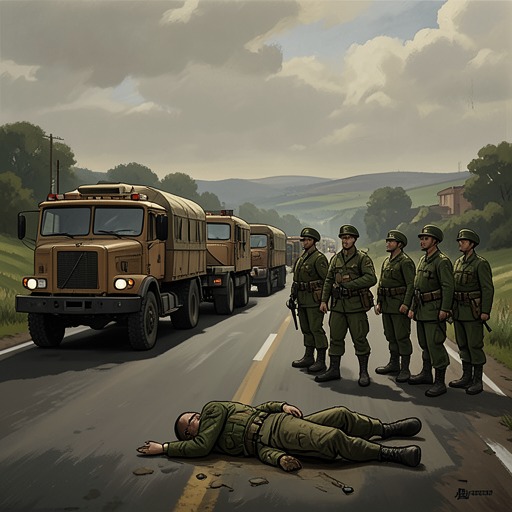
The night rescue column advanced into a city where the road itself could become an obstacle and a firing lane. As it neared the Black Sea neighborhood, the stronghold of Mohamed Farrah Aidid, Somali fighters launched fierce ambushes. The convoy’s two-mile length made its progress a spectacle as well as a target: soldiers at the first crash site could hear it approaching from miles away and see the glow of its weapons against the dark sky. Yet its size did not prevent it from losing its way. A Malaysian driver leading the northbound platoon stopped before a flimsy barricade, wary that it might be mined. Under fire, American soldiers eventually got out and began dismantling it by hand; Specialist Phil Lepre fired first over the heads of an approaching crowd, then into it as the people kept coming, and saw some fall before others dragged them away.
The force ultimately divided to pursue its two urgent objectives. One company headed west toward Super 64, where Somalis had overrun the wreck hours earlier; the other continued north to Super 61, where 99 Rangers and members of the assault force remained pinned down and waiting. The split converted a single, unwieldy march into separate efforts to reach both crash sites, but it did not make either approach safe. At Super 61, the men had been trapped for more than nine hours, and as the moon rose and the surrounding gunfire subsided, the growing thunder of the approaching rescue column was the sound they listened for.
Extraction and Cost
At the first crash site, the approach of the rescue column brought relief to the men who had been pinned down for more than nine hours, but it did not end the danger. Captain Mike Steele knew the quiet was treacherous: the moon was high, most of the shooting had stopped, yet Somalis still wandered inside the perimeter around Cliff Wolcott’s wrecked helicopter. The soldiers sometimes let them walk farther in before shooting them, while Little Bird helicopters returned with rockets and minigun fire. For Steele, the most consequential sound was the growing thunder of the rescue column drawing near.
Recovering Wolcott’s body became a painful operation in its own right. It took hours to free him from the wreckage. A quick-cut saw could not get through the Kevlar lining the cockpit, so soldiers tried to pull the helicopter apart by attaching chains to its front and back. Rangers watching from farther away mistook the effort for an attempt to tear Wolcott’s body out and turned away. The dead were eventually laid across the armored personnel carriers, while the wounded were loaded inside. Amid the relief of reaching the trapped force was the sight of Earl Fillmore’s small assault boots atop a vehicle; Paul Howe recognized them as belonging to his buddy, who had been shot in the head earlier.
Even after the rescue column reached the site and Wolcott’s body was freed, there was not enough room on the vehicles for the exhausted survivors who could still walk. They had to cover the half-mile back to National Boulevard on foot, running under fire, leapfrogging intersections, and shooting back down alleys. Only one Ranger, Randy Ramaglia, was badly injured on that stretch; he was taken by vehicle to the soccer stadium serving as the Pakistani headquarters. There, the field was covered with wounded men, while uninjured soldiers moved among the litters in tears or with stunned, distant expressions. Helicopters bearing red crosses carried the wounded onward to the main hospital by the hangar.
Civilian Risk and the Public Aftermath
The rescue operation unfolded amid a crowd in which armed fighters and civilians were difficult to separate. The Rangers’ rules of engagement permitted them to shoot only at someone pointing a weapon at them, but the account describes weapons intermingled with women and children as crowds gathered around the fighting. In one alley, Specialist Eric Spalding first warned a driver not to fire at a woman because she had a child. The woman then turned with a baby on one arm and raised a pistol with her free hand. Spalding shot her, then fired four more rounds as she fell. The convoy was moving too fast for him to see whether the infant had been hit; he thought it probably had. The scene makes the rule’s severe practical test concrete: the baby was visible, but the woman’s weapon changed what the soldiers confronting her understood themselves to be facing.
On the battered column’s return to the base, one Ranger’s account marks a further change in how the soldiers responded to danger. The rules of engagement were off, and Sizemore described shooting at young boys, some armed and some not, and firing into crowds that included women alongside rifle-carrying men. He said he felt numb and angry, intent on striking as many Somalis as he could, and explained his determination through his bond with the Rangers he considered closer than family and his desire to get them back safely. The column fired through alleys until the shooting abruptly ceased near the airport gate. There, the soldiers encountered open-air markets and crowds moving as if nothing had happened; as the battered vehicles passed, people faced them, grinned, and applauded. The abrupt contrast did not erase what had happened in the streets, but it left the returning soldiers with an unsettling reception rather than a simple account of hostility or welcome.
The account also shifts from the soldiers’ view to that of Abdikarim, a Mogadishu resident who went toward the market seeking news of relatives. Neighbors had told him that the Rangers had captured Mohamed Farrah Aidid, a report that sent him out into a scene of confusion. He saw dead men, women, and children in the road, and an American soldier bleeding from the leg and trying to hide. When a woman ran in front of Abdikarim, the soldier fired in their direction; the woman was hit but got off the street. Abdikarim then pressed himself against a stone wall as a Little Bird helicopter fired down an alley, with bullets kicking dust past him. After Somali men with rifles ran toward the corner to shoot at the American, Abdikarim fled to a friend’s house and spent the night on the floor with others, awake through the continuing gunfire. His passage from anxious observer to witness under fire gives the street fighting a civilian geography of relatives, neighbors, homes, and routes of escape.
In the early morning of October 5, the violence returned to the soldiers as television images. Wounded and exhausted Rangers and Commando soldiers watched CNN footage of Somalis celebrating on the rotor blades of Super 64, then saw a body dragged through the street at the end of a rope while people kicked and poked at it. The images did not let them identify with certainty whose body they were seeing, but they recognized the dead as brothers in the larger sense: crew members or fellow soldiers. Disgusted and angry, they went back to the hangar, cleaned their weapons, and waited for orders. The operation’s consequences thus extended beyond reaching the crash sites: civilian deaths and peril, the soldiers’ exposure to the bodies of their comrades, and the televised spectacle all became part of what the rescue meant.