Mohamed Hassan Awale's Target House
Black Hawk DownMohamed Hassan Awale's Target House was the focal point of the October 3, 1993 raid in Mogadishu: commandos were to seize two senior clan leaders inside, while United States Army Rangers descended around the block to seal it. The house's position near the Olympic Hotel and Hawlwadig Road made it an operational landmark, but the assault quickly outgrew its planned perimeter, and the streets around it became part of a much wider battle.
Setting and Physical Form
The target stood one block from the Olympic Hotel, across Hawlwadig Road, a paved north-south avenue crossed by narrow dirt alleys. The five-story white hotel was one of the few large structures still intact in Mogadishu; three blocks to its west lay the crowded Bakara Market. In the afternoon, sand drifted across the intersections, tinting them rust-orange. The target house was thus set in a busy urban neighborhood, not an isolated compound.
The house had a flat roof, three stories at the rear and two at the front, and an L-shaped plan. A small courtyard sat behind a high stone wall. Cars, pedestrians, and donkey carts moved along the street outside. These details define the space the assault force meant to surround: a walled, irregular building embedded in ordinary neighborhood traffic, with alleys and nearby streets offering routes both into and away from the block.
The Planned Assault
The house was selected because two senior lieutenants of Mohamed Farrah Aidid were expected at a gathering of Habr Gidir clan leaders there. The commando troops were assigned to storm the building and capture the two principal targets. Four helicopter loads of United States Army Rangers, including the chalk assigned to the northern side, were to rope down at the block's four corners and establish a perimeter so that no one could enter or leave.
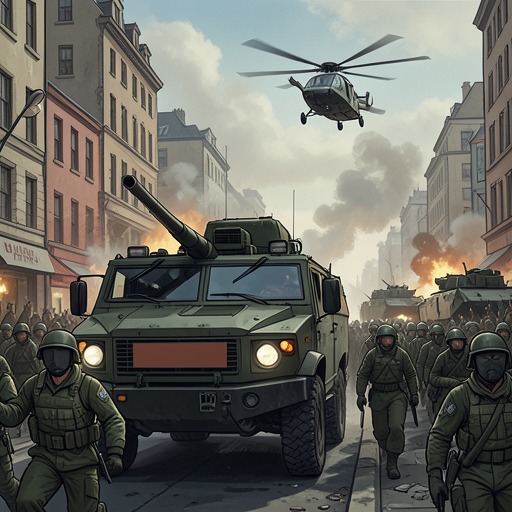
The scale of the plan extended well beyond the house itself. The helicopter force comprised about 75 Rangers and 40 commando troops carried in 17 helicopters. At the airport, a 12-vehicle ground convoy waited to travel roughly three miles to the target, load the prisoners and assault teams, and escort them back to base. When the code word for launch, Irene, was given, surveillance aircraft and orbiting helicopters watched the neighborhood and relayed images to commanders. Two Little Birds first passed over the area looking for trouble; after seeing none, the commando helicopters descended to Hawlwadig Road, and the Black Hawk helicopters carrying Rangers followed.
The plan depended on a swift capture and a controlled withdrawal. Instead, the Rangers' landing was complicated by gunfire and swirling dust. The men could hear shots while their helicopter waited for the others, and the scene below changed as Somali crowds gathered and armed people moved toward the fighting. Strict engagement rules permitted the Rangers to shoot only at someone pointing a weapon at them, but armed men were intermingled with women and children. The dense civilian presence around the house made the intended perimeter difficult to hold and the distinction between threat and bystander harder to apply.
From Target Block to Battlefront
The ground convoy's original assignment was to collect the 24 Somali prisoners seized in the raid and return them to the airport with the teams around the target house. That purpose changed when a Black Hawk helicopter went down four blocks east of the house. The convoy was redirected to rescue the aircraft's crew, then to continue toward the crash site of another downed helicopter about a mile farther south. It was now carrying prisoners while trying to move through Mogadishu under increasingly heavy fire.
The target house remained a point of reference even as the operation moved away from it. The convoy had to navigate confusing streets, and aircraft and commanders tried to direct it from above. Yet the guidance passed through the Joint Operations Center before reaching the vehicles, so a delayed instruction could send the convoy past the intended turn or down the wrong street. Commanders watching screens could not hear the gunfire or feel the blasts, and the orderly appearance of video did not convey the convoy's desperation. Its commander had not told individual drivers their destinations, leaving the column especially vulnerable when vehicles stopped at intersections. The rescue force repeatedly took fire without reaching the first crash site.
Civilian Witness and Wider Significance
The house also stood within sight of civilian life. Across Hawlwadig Road, a teenager watched from the doorway of his family's shop as Rangers descended on ropes and both Americans and Somalis fired. A helicopter then came low and fired from a gun mounted on its side; the teenager's 15-year-old brother fell dead near the gate of their home. The location therefore marks not only the intended capture of two leaders but the proximity of the raid to families and businesses caught in the fighting.
The assault at Mohamed Hassan Awale's Target House was meant to be a brief, bounded operation. Its planned cordon gave way to a struggle across Mogadishu's streets when helicopters were shot down and the convoy's mission shifted from prisoner transport to rescue. The house's lasting narrative importance lies in that reversal: the building was the raid's fixed objective, but the consequences could not be contained within its walls or the surrounding block. By October 4, the wider battle had left 18 American soldiers dead, more than 70 wounded, and hundreds of Somalis dead; those figures describe the battle as a whole, not casualties at the house alone.