Panic was a virus
Black Hawk Down“Panic was a virus” captures how fear spread through a unit when the battle stopped seeming to go its way. The phrase is not an abstract diagnosis: it emerges from the pressure of incomplete casualty reports, men listening for news of their comrades, and the struggle to keep control as the mission deteriorates.
Information and the Spread of Fear
Struecker tried to keep a casualty report brief. Asked whether there were casualties, he answered, “Yeah. One.” He did not want to be the person who announced a death over the radio, and, as far as he knew at that point, nobody on their side had been killed. But information was itself a battlefield necessity: men consumed it “as if downing water,” and its importance rose as danger mounted. Struecker had fought in Panama and the Persian Gulf, and had seen that soldiers fought better while events seemed to be going their way. Once that confidence turned, control was difficult to recover. He could see panic taking hold of Moynihan and the men in his Humvee; the phrase “Panic was a virus” gives that loss of confidence the force of contagion.
Fear, Duty, and Unequal Responses
The radio traffic did not produce one uniform response. Dale Sizemore, a Ranger nicknamed “Adonis,” was eager to join the fight, though an arm cast kept him from the mission. He had injured his elbow wrestling with a Commando colonel and had spent the day miserable as his friends geared up without him. When the surviving men from Pilla’s convoy were to be reinforced for a move toward Michael Durant’s crash site, the prospect of going out into the battle only sharpened Sizemore’s frustration at being left behind.
Steve Anderson, another Ranger from Illinois and Sizemore’s friend, felt the same reports as a threat rather than a summons. Slender, asthmatic, and carrying shrapnel wounds in his legs from an earlier night mission, he had lost some of his former eagerness. The confused shouting and gunfire, and the radio seeming to be used twice as much as usual, left him sweating cold, his stomach churning. Seeing Pilla dead and Todd Blackburn badly injured made the danger immediate; seeing Brad Thomas return with Pilla’s blood on him gave that danger a human weight. Anderson wondered what they were doing there, but dared not show his fear.
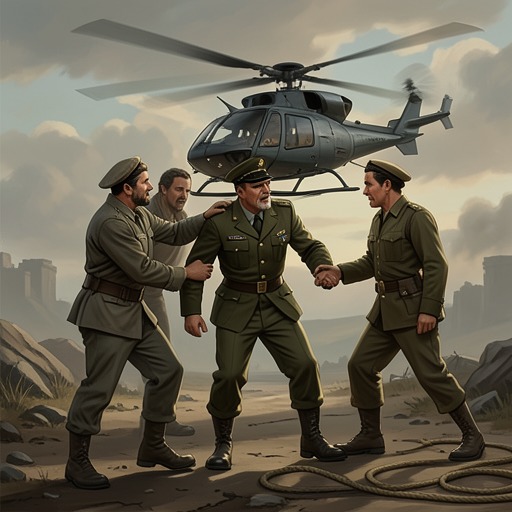
Thomas’s decision brought the conflict between fear and duty into the open. He told Struecker quietly that he could not go back out. Only a few months married, he had decided that he would not risk dying—not from patriotic fervor or solidarity, but because he did not dare refuse until he could no longer endure it. The other men watched for Struecker’s response, expecting the model Ranger, known for obedience and adherence to the rules, to explode. Instead, Struecker drew Thomas aside and spoke to him privately. He acknowledged that he too was scared, and framed courage not as the absence of fear but as what a person does while afraid. Thomas walked away without appearing persuaded, yet climbed aboard before the vehicles pulled out. The moment shows panic not as a simple contagion that makes everyone act alike, but as pressure each man meets differently—and as a force that duty and comradeship can sometimes hold in check.
Panic Beyond the American Radio Net
The same spreading fear appears beyond the soldiers’ communications and command structure, among residents caught in the helicopter attack. When a helicopter crashed into Abdiaziz Ali Aden’s house, part of the building collapsed onto his parents and eight brothers and sisters. Fearing the aircraft might explode, the family fled to a friend’s house three doors away; Aden later returned to guard the damaged home, knowing it could be looted if left undefended. Fear moved people out of immediate danger, but it could not suspend the ordinary necessities of survival.
On the streets, the danger became collective and visible: terrified women and children scrambled among dead people and animals as gunfire cracked and helicopters passed overhead. Militiamen shouted through megaphones for residents to come out and defend their homes. The appeal turned fear into mobilization, drawing neighborhood defenders into the fighting even when they had little experience. In this wider setting, panic is not simply a private loss of nerve; it spreads through a crowded city, where the sounds and consequences of combat shape what people do next.
The hospitals and burial scenes show how that pressure persisted after the immediate shocks. At Volunteer Hospital, surgeon Abdi Mohamed Elmi worked through a night in which the trickle of wounded became a flood: by the end of October 4, all 500 beds would be occupied, with at least 200 more wounded in the hallways. Delays in reaching treatment let infections take hold, while scarce antibiotics could no longer save many patients with gut wounds. Elsewhere, Kassim Sheik Mohamoud’s burial party repeatedly dropped the bodies it was carrying and ran for cover when helicopters swept low over the cemetery. The phrase’s image of contagion thus reaches beyond the soldiers’ wavering confidence: danger, flight, and mounting casualties formed a chain of consequences across Mogadishu.
Resistance, Judgment, and Renewed Readiness
The pressure of the battle did not make every hesitation a surrender to panic. When Mike Steele told Sean Watson to prepare to move out, Watson challenged the order directly. He argued that the men would face bullets and grenades as soon as they left the door, while five wounded men, two of them needing to be carried, and the body of Earl Fillmore would have to be moved with them. Four men would be needed for each litter, creating conspicuous targets; Watson believed the group was safer inside its well-defended courtyard. His objection turned fear into a concrete assessment of the cost and feasibility of the proposed movement, rather than a general refusal to act.
The D-boys’ return to the hangar provides a contrasting response to the same battle’s strain. They cleaned their weapons, checked their equipment, and replenished ammunition, ready to go back out. Their preparation presents renewed action not as evidence that danger had passed, but as disciplined readiness maintained in its presence. Set against Watson’s insistence on the risks of moving the wounded and dead, it shows how the battle’s pressure could produce different forms of resolve: challenging a dangerous plan, or preparing to re-enter the fight.