Rocket-propelled grenade (RPG)
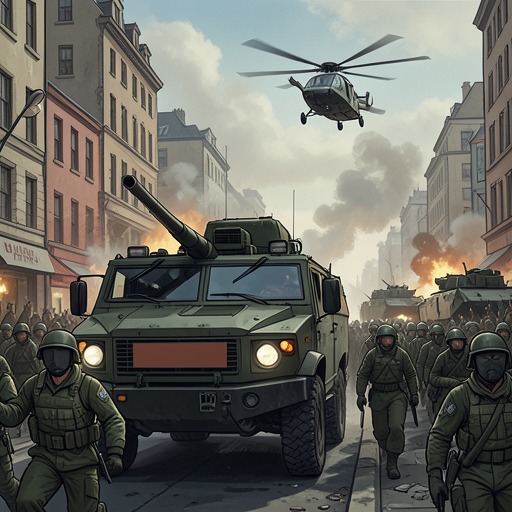
Black Hawk DownThe RPG is a recurring weapon in the account of the fighting, where its importance lies less in technical description than in the danger it poses to aircraft and vehicles. Its appearances are registered by witnesses at different distances and in different circumstances: a militiaman fires from an alley at a helicopter passing overhead; another strike damages a helicopter's gearbox without immediately stopping it; and RPG fire against vehicles disrupts movement and endangers their occupants. Together, these episodes make the launcher a persistent source of sudden threat, while showing that its effects vary from one encounter to another.
A weapon encountered in action
The evidence identifies the RPG through the moments in which it is used and the damage its projectiles cause. It does not describe the weapon's construction, range, or operating procedure in general terms. Instead, the narrative gives the reader partial views: Aden sees a militiaman with a launcher; Shawn Nelson recognizes the flash and puff of a launch; and other witnesses observe the consequences after a projectile reaches an aircraft or vehicle. The difference between seeing a launch and seeing its effects matters. The weapon is present both as an immediate threat and as an explanation for sudden changes in the movement and condition of military equipment.
The scenes also establish that RPG fire does not produce one uniform outcome. A projectile cracks the tail of a helicopter and sends it into an uncontrolled spin; another damages Michael Durant's helicopter gearbox while the aircraft remains intact and apparently functional. On the ground, RPG fire disables a five-ton vehicle. In another vehicle episode, a grenade penetrates a vehicle's steel skin and forces several occupants out of the moving vehicle. The accounts therefore present the RPG not as a guarantee of a particular result, but as a danger whose consequences depend on the circumstances of each strike.
The shot at the passing helicopter
Aden's account places the launch in a narrow alley beneath a helicopter flying at rooftop level. The rotor wash sweeps dust across the alley as Aden runs toward his house. Through the dust, he sees a Somali militiaman carrying an RPG launcher step into the alley and kneel. Rather than fire as the helicopter approaches, the militiaman waits for it to pass overhead, then raises the launcher and fires from behind. Aden sees the flash at the launcher and the grenade explode into the helicopter's rear, cracking its tail. The sequence makes timing and position central to the scene: the aircraft has passed over the shooter before the shot is taken.
Shawn Nelson's view follows the projectile's effect on Cliff Wolcott's Black Hawk helicopter. He catches the flash and puff of the RPG launch, sees the rocket rise into the aircraft's path, and then observes the tail boom crack. The rotor stops, the helicopter shudders, and it begins to spin, slowly at first and then faster. Read alongside Aden's account, Nelson's observation traces the same kind of danger from a different point in the sequence: one witness sees the shooter fire from the alley, while the other registers the strike and the aircraft's immediate loss of stability. The weapon's significance is made concrete through this transition from a brief launch to a rapidly deteriorating flight.
Damage that does not immediately end flight
A separate account shows a different result when Goffena, flying Super 62, closes in behind Michael Durant's helicopter. Goffena sees a grenade hit the gearbox and blow away part of it. Oil spills from the rotor system, yet the aircraft remains intact and continues to function at that moment. The contrast with the helicopter whose tail is cracked is important: an RPG strike can damage a critical part without producing the same immediate loss of control. The scene presents a temporary continuation of flight, not an assurance that the damaged aircraft is safe or that the danger has passed.
This distinction gives the weapon's appearances a cumulative force. The RPG is not only associated with a single dramatic failure; it also figures in damage whose full consequence is not immediately settled. Goffena can see the hit and the loss of oil, but the helicopter is still operating as he observes it. The account thus holds two facts together—the aircraft has sustained serious damage, and it has not yet ceased functioning—without collapsing one into the other.
Strikes against ground vehicles
RPG fire also affects movement on the ground. Othic is among the first men hit in the episode he witnesses. Just beforehand, he sees an RPG launched from a crowd of Somalis and the grenade explode on a five-ton vehicle, disabling it. Staff Sgt. Dave Wilson, who is standing alongside, is injured. The strike therefore has consequences beyond the vehicle itself: it removes a vehicle from use and places a person beside it at risk. The account links the launch, the vehicle's loss of function, and the effect on Wilson in a compressed chain of action and consequence.
Carlson describes another grenade strike from inside a moving vehicle. After hearing a grenade explode behind his Humvee, he experiences a second blast as a grenade penetrates the steel skin near the gas cap and explodes inside. The explosion throws Carlos Rodriguez, Telscher, and Martin out of the vehicle's rear. This account does not identify the launcher in the moment as directly as Aden's or Nelson's observations do, so its value here is in showing the vehicle threat represented in the same body of evidence: protection afforded by a steel exterior does not prevent a grenade from entering the vehicle, and a strike can abruptly displace its occupants.
Narrative significance
Across these episodes, the RPG repeatedly interrupts movement. Helicopters are hit while flying over streets or moving toward other aircraft; a vehicle is disabled; and the occupants of a moving vehicle are thrown out after an explosion inside it. The weapon's presence connects aerial and ground-level danger without making the scenes interchangeable. Each account has its own witness and immediate consequence, from Aden's view of a kneeling gunman to Carlson's experience inside a vehicle.
The narrative also distinguishes between the weapon's visible launch and the damage discovered afterward. Aden sees the militiaman's action; Nelson sees the projectile's path and a helicopter begin to spin; Goffena sees damage to a gearbox and oil escaping while flight continues; Othic witnesses a vehicle disabled by a launch from a crowd. These different vantage points make the RPG a recurring element of the battle rather than a technical aside. Its narrative role is to expose how quickly a passing aircraft or moving vehicle can become vulnerable, and how uncertain the immediate outcome remains after a strike.