Super 61
Black Hawk DownSuper 61 was Cliff Wolcott’s Black Hawk helicopter, an airborne support platform whose sudden destruction turned a fast-moving mission in Mogadishu into a prolonged effort to reach and defend a crash site. The helicopter’s fall was witnessed from the street and live on command-center screens; afterward, its wreck became both the focus of rescue efforts and the point toward which a confused, heavily engaged convoy struggled to move.
Aircraft and Mission
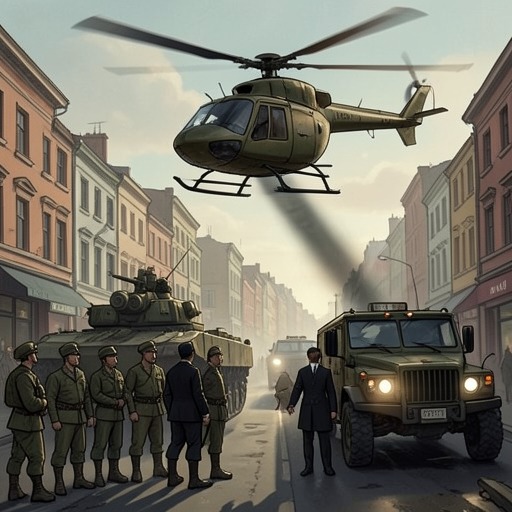
Before it crashed, Super 61 had delivered a Chalk of Rangers and continued flying a low orbit over the target area in central Mogadishu. Its crew chiefs fired mounted miniguns at targets below, while two Commando snipers in the rear engaged gunmen. To soldiers on the ground, the sleek helicopters passing overhead offered a sense of protection. The aircraft was not merely transport: it remained part of the ground force’s support as events around the target developed.
Wolcott was an experienced pilot whose exploits included secret missions behind enemy lines during the Persian Gulf War, with aerial refueling on missions against Iraqi Scud sites. His aircraft was therefore introduced as a familiar presence in the operation before its role abruptly changed. Shawn Nelson heard a Black Hawk approaching just after he had fired his M60 at a crowd; the helicopter was Super 61, Wolcott’s aircraft, passing over the area.
The Hit and the Fall
Nelson saw the flash of a rocket-propelled grenade and the rocket rise into Super 61’s path. The impact broke the tail boom. The rotor stopped, a grinding sound came from the aircraft, and the helicopter began to shudder and rotate. Its spin gathered speed as it moved over the soldiers crouched below. Nelson called the others’ attention to it, unable to look away; John Waddell, by contrast, resisted the urge to watch and turned back to guard his corner against gunmen.
The aircraft tilted as it struck the top of a house, then overturned and crashed on its side into a narrow alley. At the Joint Operations Center beside the airport, surveillance cameras on three helicopters recorded the fall in close-up color. Commanders watched the sequence live: a shudder and puff of smoke near the tail rotor, the helicopter’s awkward counter-rotation and two slow turns, then its belly striking the top of a stone building. Its rotors snapped and flew off as the fuselage smashed into the alley beside a stone wall amid smoke, dust, and debris.
The recorded view made the crash visible in extraordinary detail, but it could not resolve what the loss would mean for the men on board or the operation around them. Officers watching felt the immediate dread of the crew’s fate and a broader alarm. The crash was a crippling blow to a ten-month American mission passed from one president to another, and to the United Nations’ nation-building ambitions. In the street, the moment was less distant: Nelson watched the aircraft hit and crash, then voiced his disbelief to the soldiers with him.
The Wreck as a Rescue Site
The crash site became the destination for soldiers trying to reach and recover the crew. When Tim Wilkinson arrived, dust and nearby gunfire initially kept him from seeing the wreck or the rest of his rescue team. He found medical bags lying in the street, ran out to collect them, and then rounded a corner to discover the helicopter in the alley. Its size startled him: accustomed to seeing aircraft in the air or on spacious tarmacs, he found it lying on its left side in the confined space, like a beached, harpooned whale.
Wilkinson found Rangers and special-operations soldiers already holding a tight perimeter around the wreck. Several Somali bodies lay nearby, with more visible in the distance. He could not see inside the aircraft to determine whether the men aboard were alive. At the helicopter, the search-and-rescue team gathered wounded men and worked to extricate Wolcott’s body from the wreckage. The rescue site was thus also a place of immediate danger: nearby soldiers remained under fire while trying to protect the perimeter and recover the injured and dead.
Elsewhere around the site, the pressure of incoming fire forced soldiers to seek cover. Paul Howe and another soldier broke into a narrow courtyard between houses, where they found a terrified family. Howe coaxed them from a room, searched them, and had them taken to a side room under guard. That encounter illustrates the difficult proximity of civilian life to the fighting around the wreck: the rescue force had to secure shelter and manage those inside while trying to survive the barrage.
The Convoy and the Problem of Finding the Wreck
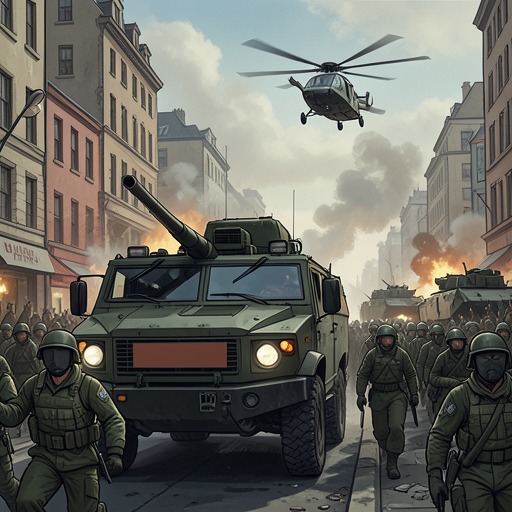
The first ground convoy was ordered to reach Wolcott’s crash site, help rescue its crew, and then continue to Mike Durant’s crash site about a mile south. It struggled to make progress through streets where gunmen moved parallel to the vehicles, setting up to fire at each intersection. Overhead aircraft and a Navy spy plane tried to guide the convoy through the city’s maze, but their pilots could not communicate with it directly. Directions had to pass through the Joint Operations Center, so a delayed instruction could arrive after the vehicles had passed the intended turn. Commanders watching screens also lacked the sound and physical force of bullets and grenades; the video made the convoy’s movement look more orderly than it was.
The convoy’s own organization compounded the difficulty. Danny McKnight, more accustomed to commanding a battalion than a line of vehicles, relied on directions from above and had not told the drivers where they were headed. Without that information, the column could not simply continue toward its destination if its lead vehicle was hit. Inexperienced drivers stopped at or just beyond intersections, exposing vehicles behind them to crossfire. The convoy took several turns onto side streets without getting closer to Super 61. Each stop sent able-bodied soldiers out to guard the column, and some of those soldiers were then wounded; others carried them back to vehicles, becoming smeared with blood.
A later, larger rescue column also divided its effort between the two crash sites. Its vehicles split into two companies: one headed west toward Durant’s Super 64, while the other pushed north toward Super 61, where 99 Rangers and special-operations soldiers were pinned down and waiting. The northbound force encountered a barricade and came under heavy fire as soldiers began pulling it apart by hand. As this column drew nearer, the men at Super 61 heard the increasing thunder of its guns. In the dark, Steele feared that the approaching rescuers—jumpy, firing heavily, and trying to link up in a confusing city—could themselves endanger the force they meant to relieve.
Significance
Super 61’s destruction changed the operation from an airborne-supported raid into a desperate struggle organized around two downed helicopters and the routes leading to them. The aircraft’s fall was simultaneously a precisely observed event on surveillance screens and a source of shock, uncertainty, and immediate danger for soldiers on the ground. That contrast persists after the crash: the command center could see the city from above, but delayed directions and images without the felt violence of the streets could not reliably convey what the convoy faced.
The wreck also gave the rescue effort a fixed but hard-to-reach center. Soldiers held its perimeter, searched among the wreckage, and tried to recover Wolcott’s body while gunfire continued around them. The convoy’s repeated misdirection and exposure made the distance to the alley more than a matter of blocks. Super 61 became the physical marker of a mission’s reversal: an aircraft that had carried Rangers into the operation and protected soldiers from above was now a wreck in a narrow alley, with its crew and rescuers dependent on a ground force struggling to find its way through Mogadishu.