Super 61 crash and recovery
Black Hawk DownThe Super 61 crash and recovery left United States Army Rangers and Commando soldiers pinned around a wrecked Black Hawk helicopter in Mogadishu, trying to treat the wounded and retrieve the dead while under fire. The crash site became more than a rescue scene: as the ground convoy failed to reach them and evacuation by helicopter was judged too dangerous, nearby buildings became makeshift strongpoints and the trapped force faced the prospect of being cut off.
Crash Site and Immediate Response
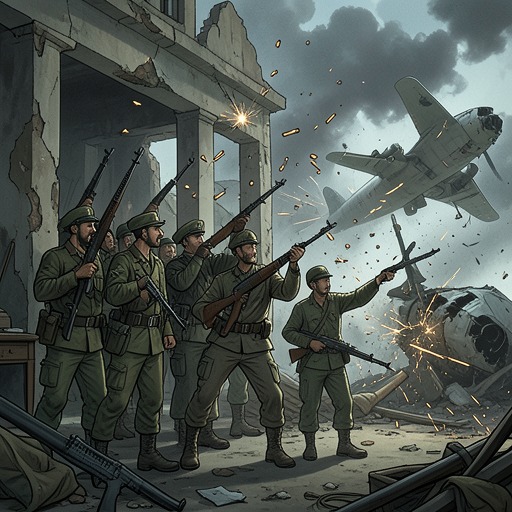
Several groups of United States Army Rangers and Commando soldiers linked up at the wreck, where intense small-arms fire and rocket attacks pinned them down. Most took cover along a wide street that formed an L at the crash-site intersection. At the helicopter, the search-and-rescue team gathered the wounded and worked to extricate pilot Cliff Wolcott’s body from the wreckage.
To get the men off the exposed street, Sgt. Paul Howe and another soldier forced their way into a narrow courtyard between two houses. They found a terrified family—a man, his wife, and several children—cowering in a room. Howe coaxed them out, searched them, and handed them to his team, who handcuffed them and moved them into a side room. Once the adjoining rooms had been cleared, Howe waved in Capt. Scott Miller and the other soldiers. Miller, who had caught up with Howe on the run to the crash site, used the courtyard as a command post and casualty collection point.
The position offered shelter, but not a way out. Nearly three hours into the mission, the soldiers feared they would be stuck there all night, separated from other groups pinned down near the wreck. Commanders had radioed that the fire made it too dangerous to land a helicopter and evacuate the wounded. The rescue problem had become a siege: the men needed to hold their position while the wounded and Wolcott’s body remained at the center of the effort.
Nightfall, Recovery, and the Aftermath
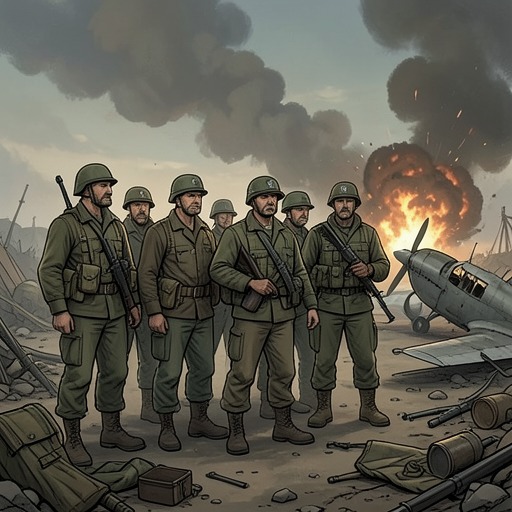
The men at the wreck remained pinned down for more than nine hours. By the time the moon was high, the shooting had mostly subsided, but the perimeter was not secure: Somalis still wandered into it, and Commando soldiers sometimes let them approach before shooting them. Little Bird helicopters returned periodically to fire rockets and miniguns. For Mike Steele, the sound that mattered most was the growing thunder of guns as the rescue column drew nearer.
Recovering Cliff Wolcott’s body proved a separate ordeal. Soldiers spent hours trying to free him from the wrecked Black Hawk helicopter. A quick saw could not cut through the Kevlar lining the cockpit, so they tried pulling the aircraft apart with chains attached to its front and back. Some Rangers watching from a distance thought the vehicles were being used to tear Wolcott’s body out and turned away. The dead were eventually laid on top of armored personnel carriers, while the wounded were loaded inside; Sgt. Mike Goodale, shot in the thigh with a large exit wound in his buttock, had to hobble to an APC and be helped through its doors.
The rescue did not end the violence’s reach. Early the next morning, tired, bruised, and bandaged soldiers gathered around a television in the hangar to watch CNN. The broadcast showed jubilant Somalis bouncing on the rotor blades of Super 64, then showed a dead American soldier being dragged through the streets on a rope, kicked and prodded by the crowd. The images intensified the soldiers’ anger: Paul Howe prepared to return to the streets determined to kill, rejecting the rules of engagement he had previously been expected to follow. On October 4, the wider toll was reported as eighteen American soldiers dead, more than seventy wounded, and hundreds of Somalis dead; the images also reached President Bill Clinton, who was horrified and demanded to know who had authorized the mission without informing him.
Civilian Presence and the Collapse of Restraint
The crash-site fight unfolded in streets where armed men and civilians were difficult to separate. The Rangers had been told to fire only at people pointing weapons at them, but the rule became increasingly hard to apply as gunmen mixed with women and children. Crowds gathered around disturbances in Mogadishu, and the summer’s repeated Ranger missions had stirred widespread hatred. The danger at the wreck was therefore not confined to soldiers exchanging fire: civilians moved through the same streets and alleys, often close to armed fighters.
During the rescue movement, Spec. Eric Spalding saw a woman in a flowing purple robe dart beside a truck. Its driver was shooting at whatever moved, and Spalding shouted for him to hold fire because she had a child. The woman then turned with a baby on one arm and raised a pistol with her free hand. Spalding shot her, firing four more rounds after the first; the vehicles were moving too fast for him to see whether the infant had been hit. He thought he probably had hit the baby. The encounter concentrated the impossible choices of the street into a few seconds: a child visibly in the line of fire, a weapon raised, and no time to know what the shots had done.
By the return to base, restraint had given way to rage. After the vehicles survived a crash back onto all four wheels, the column shot its way through the streets; the account says the rules of engagement were off. Sizemore fired at young boys, some carrying weapons and some not, and at crowds of women running alongside riflemen. Numb, angry, and intent on getting his friends home, he no longer cared whether he was shot or whom he hit. Near the airport gate, the gunfire abruptly stopped. The battered column passed through open-air markets where people had been strolling as if the battle were elsewhere, and the crowd parted for the wounded, dead, and horrified soldiers before applauding them as they approached the gate.
Abdikarim’s experience records the same violence from the street rather than from a vehicle. After neighbors told him that the Rangers had captured Mohamed Farrah Aidid, he went toward the market to learn what had happened to relatives living nearby. He saw dead men, women, and children in the road, and an American soldier bleeding from the leg and trying to hide. When a woman ran in front of him, the soldier fired in their direction; she was hit but got off the street. A Little Bird helicopter then swept down an alley firing, and Abdikarim pressed himself against a stone wall as bullets kicked up dust past him. Armed Somali men ran toward the corner to shoot at the American. Abdikarim fled to a friend’s house, where he and others stayed on the floor through a night of shooting without sleep. His route to the market, undertaken for news of family, became a close encounter with the battle’s indiscriminate hazards.
Political Accountability
The battle’s political aftermath quickly turned toward the decisions behind the raid. The day after the fighting, members of Congress questioned Secretary of Defense Les Aspin and Secretary of State Warren Christopher about how the operation had unfolded and why American soldiers were dying in Somalia. President Bill Clinton was asking similar questions of his aides, but with an added grievance: he had been briefed on missions in advance before, whereas this raid had been organized so quickly that he was not told beforehand. He wanted an account spanning both policy and military tactics.
On October 6, Clinton’s advisers and senior officials gathered first at the East Wing breakfast table and then in the Oval Office with Robert Oakley, who had long experience in Somalia but had not been consulted by the White House or State Department as events in Mogadishu developed. The meeting brought the consequences of the crash and the wider battle into a political inquiry over who had shaped the mission, how it had been authorized, and what the United States was trying to accomplish. The rescue had brought soldiers out of the wreck’s perimeter; it had not resolved the questions the operation left behind.