The White House
Black Hawk DownThe White House is where the consequences of the October 3, 1993, battle in Mogadishu become a decision about the future of the U.S. mission in Somalia. In the days after the fighting, its rooms gather the military and political questions left by the raid: eighteen American soldiers dead, dozens wounded, hundreds of Somalis dead, and Michael Durant held captive. The meeting there ends not with a renewed effort to capture Mohamed Farrah Aidid, but with a timetable for withdrawal and a diplomatic mission to secure Durant’s release.
From battlefield images to a political crisis
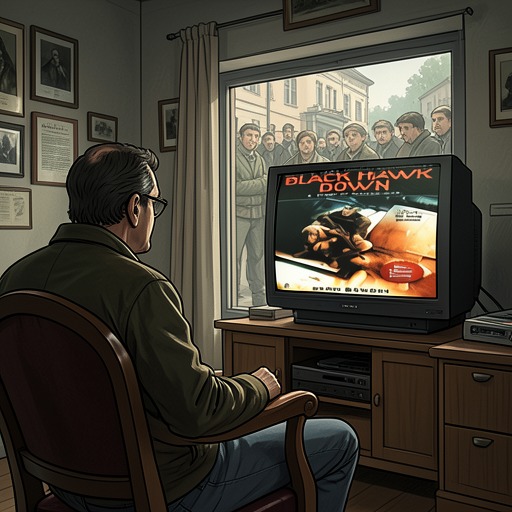
The crisis reaches the White House through television as well as official channels. On October 4, the country wakes to reports of the losses and images of a dead American soldier being dragged through Mogadishu’s streets. Bill Clinton sees the pictures while in a hotel room in San Francisco and is horrified and angry. He wants to know who authorized the mission and why he had not been informed. Unlike earlier missions, this raid had been mounted so quickly that the President had not received an advance briefing.
The political pressure is already visible on October 5, when Secretary of Defense Les Aspin and Secretary of State Warren Christopher face angry members of Congress. Lawmakers ask how the battle happened and why American soldiers are dying in Somalia. Clinton, too, wants answers spanning policy and military tactics. The White House’s role in the aftermath is therefore not simply to receive a report on casualties: it must respond to a public tragedy, congressional scrutiny, and a president’s demand to understand how the operation proceeded without his prior knowledge.
Oakley is called back into the discussion
On October 5, former U.S. ambassador to Somalia Robert Oakley is at a party at the Syrian Embassy in Washington when Anthony Lake, the President’s national security adviser, calls. Lake asks to speak with him the next morning. Oakley is surprised: he has been home for six months. He had been a senior civilian figure in Mogadishu during the humanitarian mission that began the previous December and eventually ended the famine, leaving in March with 20,000 Marines. Since returning, he has watched events in Somalia with dismay, but neither the White House nor the State Department has consulted him.
Lake’s follow-up invitation is for breakfast at 7:30. On October 6, the meeting begins in the East Wing with Lake, his deputy Samuel R. Berger, and U.S. Ambassador to the United Nations Madeleine K. Albright. Oakley then walks with them into the Oval Office, where they join Clinton, the vice president, Christopher, Aspin, the chairman of the Joint Chiefs of Staff, and other advisers. The movement from breakfast in the East Wing to the Oval Office gives the consultation a defined progression: Oakley is brought into a larger gathering in which the immediate military disaster is considered alongside the national response.
Six hours and a change of course
The Oval Office meeting lasts six hours. Its central question is what to do next, with the costs of the battle still sharply present: eighteen soldiers are dead, 73 are wounded, hundreds of Somalis are dead, and Michael Durant is a captive. The public is outraged, and Congress is demanding withdrawal. The image of a dead American being dragged through the streets gives the debate a visible and painful focus, while Durant’s captivity leaves an immediate human consequence unresolved.
Continuing in Mogadishu to pursue Aidid is considered, but the White House rejects it. Retired Admiral Jonathan Howe, who heads the United Nations effort there, and Major General William F. Garrison, commander of Task Force Ranger, believe Aidid has been dealt a mortal blow and could be finished with limited further effort. Intelligence reports say Aidid’s supporters are fleeing the city, their rocket-propelled-grenade arsenals spent, while others are making peace overtures and offering to abandon him. Those assessments do not determine the decision: the meeting concludes that America has lost its appetite for further action in Somalia.
Withdrawal and the Durant mission
The decision made at the White House is to pull out. Task Force Ranger will remain temporarily, reinforced to demonstrate military resolve, but its withdrawal is to be completed with dignity by March 1994. All efforts to capture Aidid are called off. The outcome marks a sharp change from the commanders’ view that the battle may have weakened Aidid enough to make his capture attainable. The White House instead sets the limit of the U.S. commitment and gives the mission an end date.
The meeting also sends Oakley back to Mogadishu, both to deliver the withdrawal message and to try to obtain Michael Durant’s release. He is instructed not to negotiate with Aidid, but to convey a stern presidential demand that the pilot be released immediately. The distinction matters: withdrawal from the campaign against Aidid does not mean that Durant’s captivity is left unattended. In the book’s account, the White House is the place where battlefield losses, political accountability, and the remaining obligation to a captive are translated into a new course of action.