Triangle Force
Black Hawk DownThe D-boys, referred to in the account as the Commando force, are portrayed through a small number of consequential scenes rather than a full description of their organization. Their part in the fighting in Mogadishu centers on taking command amid confusion, securing shelter for troops and civilians, and continuing to search for missing comrades even after repeated operations. The narrative’s picture of the force is therefore defined less by formal structure than by what its members do when a rescue plan fails and the night stretches on.
Identity and Command
The narrative identifies Paul Howe as one of the Commando team leaders and Scott Miller as the Commando ground commander. These roles appear in the urgent effort to move men off the street and organize a position around the downed aircraft. The account does not provide a broader organizational chart, but it does show leadership operating at more than one level: Howe acts directly with soldiers on the ground, while Miller arrives with the authority to establish a command post and casualty collection point.
The force is also called the D-boys. That name recurs in the account of its members’ readiness to return to action and in the relationships between operators who search for their own. The evidence portrays a distinct commando element working alongside the United States Army Rangers, not as an isolated body: during the night, the two forces’ commanders argue over where to position the 99 men scattered through the streets near Cliff Wolcott’s downed Black Hawk. Their disagreement is a concrete sign that the danger of the situation did not erase differences in command judgment.
Securing a Position in the City
As the fighting continued, Howe recognized that his men needed to leave the exposed street. He and another soldier drove their shoulders into the gate of a narrow courtyard between two houses and entered with their weapons ready. Inside, they found a frightened family sheltering in a room: a man, his wife, and several children. Once the adjoining rooms had been cleared, Howe signaled Miller and the other men in the street to come in.
Miller had caught up with Howe while moving toward the crash site. Radio traffic had made clear that the ground convoy was lost and had suffered heavy casualties. The courtyard offered something the street could not: a cleared place to gather the scattered force, care for casualties, and direct operations. Miller accepted it as a command post and casualty collection point. The possibility that the men would be stuck there all night gave the decision added weight; this was not simply a brief pause on the way to the objective, but a position that might have to sustain them through the hours ahead.
Later, as darkness fell, friction between the Commando and Ranger commanders continued over the radio. Ninety-nine men were dispersed through narrow streets around the downed aircraft, and the leaders disputed where best to place them. The account gives no resolution to the argument in this moment, but its placement alongside the use of the courtyard shows the force confronting two related problems: finding physical protection in a hostile urban environment and coordinating a large group when the convoy that should have reached them was lost and badly damaged.
Comradeship and Return to Action
The D-boys’ connection to one another appears most clearly in the search for missing men. John Macejunas had gone out into the fighting three or four times during the preceding day and night. When a rescue convoy could not reach Michael Durant’s crash site, Macejunas led a small squad there on foot, searching for his friends. He was preparing to go out again, this time dressed as a civilian journalist, to look for his comrades, whether alive or dead. United States Army Rangers who saw him were impressed by his courage and composure. The episode links the unit’s repeated exposure to danger with a specific objective: finding its own people rather than treating the failed convoy as the end of the effort.
The relief of the men pinned down overnight did not end the cost of the operation. When the convoy finally reached the two blocks where they had been trapped, about 200 Americans were in and around the area, at the front of a convoy stretching half a mile. Paul Howe looked up at the top of a vehicle and recognized the soles of small assault boots as belonging to Earl Fillmore, his D-boy friend, who had been shot in the head hours earlier. The detail turns the return of the force into a moment of both relief and loss: the men had been brought out, but one of their own had not survived.
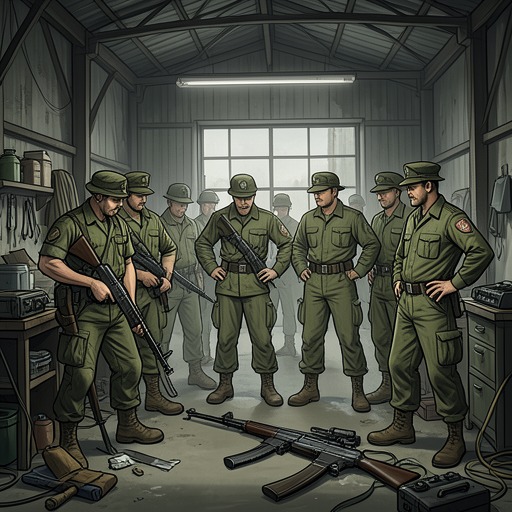
The organization’s continued readiness is visible in the routine that followed. After an early helicopter lift back to the hangar, the D-boys cleaned their weapons, checked their equipment, and replenished their ammunition. They were prepared to go back out. The sequence matters because it places the possibility of renewed action directly after the exhaustion and losses of the night. Readiness is shown as practical work—maintenance, inspection, and restocking—not merely as a declaration of courage.
Reputation and Significance
The account places the D-boys’ conduct beside contrasting responses among the United States Army Rangers, without suggesting that every soldier reacted in the same way. Dale Sizemore was eager for the fight and had the word Ranger tattooed twice on his left arm; Steve Anderson, his friend, felt dread as he heard gunfire and radio traffic. Anderson had previously been enthusiastic, but shrapnel wounds in his legs from an earlier night mission had weakened that confidence. These details concern the Rangers rather than the D-boys, but they sharpen the larger account of military cohesion: unit identity does not remove fear, and the effects of earlier combat can alter a soldier’s response.
The narrative’s clearest formal recognition of the D-boys comes with the statement that Gary Gordon and Randy Shughart would be awarded the Medal of Honor. The evidence here names the award but does not set out its citation or full circumstances, so its significance is best understood in the context the account does establish: the force’s operations unfolded amid command disputes, failed movement, casualties, and continuing efforts to reach isolated comrades. Together, the secured courtyard, the repeated searches, the return to equipment preparation, and the later recognition present the D-boys as a unit whose identity is bound to action and to responsibility for fellow soldiers, even when that responsibility does not prevent loss.