U.S. military Code of Conduct
Black Hawk DownThe U.S. military Code of Conduct is presented as a set of boundaries for a captured service member under interrogation. Its clearest expression comes when Mike Durant, injured and in captivity, faces questions about who he is and what his unit was doing in Somalia. Rather than a general account of military ethics, the episode shows the Code operating as practical guidance under pressure: it defines what he may disclose and shapes how he responds.
Guidance in Captivity
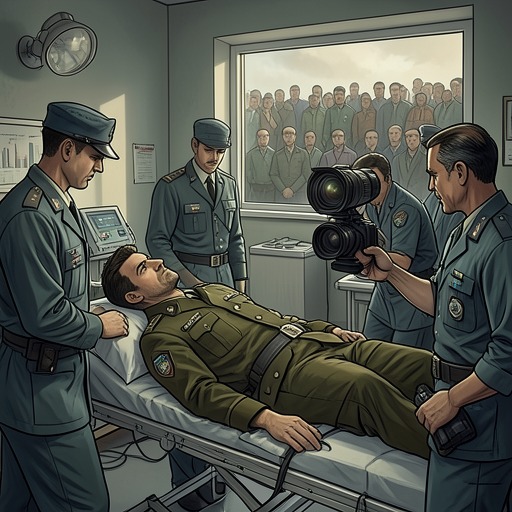
By the evening of October 4, roughly a day after his helicopter crashed, Mike Durant was hungry, thirsty, frightened, and visibly injured. His face was bloody and swollen from a blow with a rifle butt. A camera crew of about ten young men set up lights; one man, who spoke fairly good English, conducted the interview. Durant had already been questioned intermittently throughout the day about his identity and the task force’s purpose.
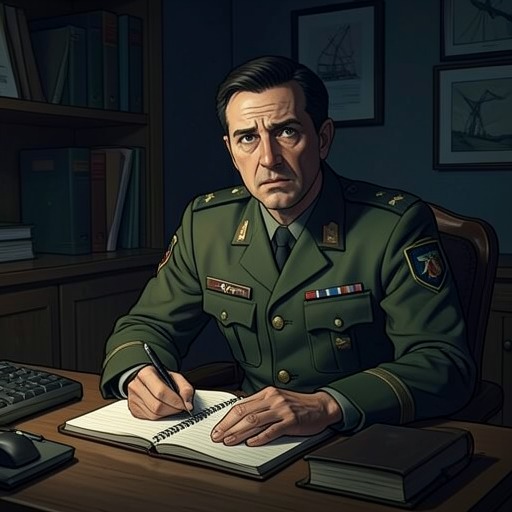
Durant had been trained for such trials. The account describes the Code as spelling out what he could and could not say, and says he was determined to abide by it. His approach was to provide as little information as possible while remaining guarded rather than confrontational. The rule’s significance here is both formal and immediate: it gives him a standard to follow when captivity, injury, and repeated questioning make disclosure a live risk.
The Interview and Its Limits
The televised questioning returned to the same subjects the interrogators had raised earlier: who Durant was and what the Americans were trying to do in Somalia. His captors treated the task force’s personnel as Rangers. Durant corrected that assumption, telling the interviewer that he was a pilot, not a Ranger. The distinction is concrete, but the account does not present him as revealing the purpose of his unit or supplying additional operational information.
The interviewer also accused him of killing innocent people. That accusation placed the interview in the wider violence of Mogadishu, but the Code’s specific role in this scene remains narrower: it governs what Durant can say as a prisoner. The account does not set out the Code’s full provisions or claim that it resolves the interviewer’s accusation. Instead, it shows Durant maintaining his limited, controlled approach while under scrutiny.
Distinction from Battlefield Rules
The book also describes strict rules of engagement for the Rangers, who were told to fire only at someone pointing a weapon at them. Those rules addressed the use of force during combat, where armed people and civilians could be intermingled; they are distinct from the Code of Conduct invoked during Durant’s captivity. The difference matters because the account presents both kinds of constraint amid the same battle, without treating them as interchangeable.
The pressure on battlefield judgment is shown in sharply different circumstances. Eric Spalding initially called out to stop a driver from shooting at a woman because she had a child with her; when she turned with a pistol in her free hand, he shot her and feared he might also have hit the baby. Later, as the battered column fought its way back toward base, Dale Sizemore fired at people in crowds, including children, after the narrative says the rules of engagement were off. These scenes concern combat decisions and changing conditions, not the rules for a captive’s answers. Read alongside Durant’s interview, they show why the Code should be understood as one specific military obligation rather than a catch-all label for every rule or moral choice in the battle.
Significance
Durant’s adherence to the Code gives the captivity scene a measure of order without removing its danger. The interviewer controls the setting and the camera, while Durant retains a narrow form of agency in deciding how much to disclose and in correcting the claim that he is a Ranger. The episode makes the Code consequential not through a lengthy explanation of its clauses, but through its use as a remembered standard at the moment when questioning becomes public and coercive.