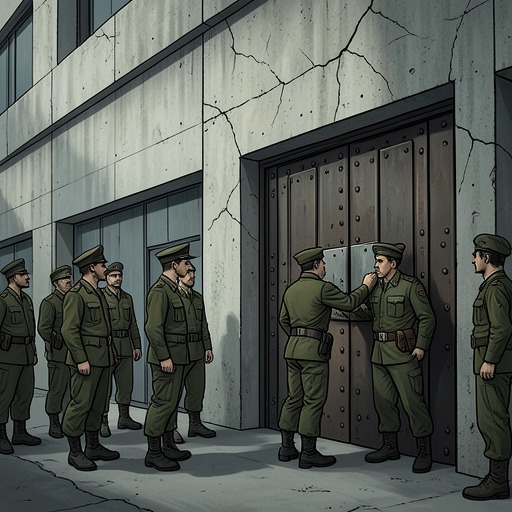
U.S. no-payment, no-exchange position on Durant's release
Black Hawk DownThe U.S. no-payment, no-exchange position on Mike Durant’s release turned his captivity into a test of American resolve and a dangerous limit on negotiation. Robert Oakley was instructed to demand that Durant be released immediately, without conditions, and to make clear that the United States would neither pay nor trade for him. Yet the policy was not simply silence or refusal to communicate: Oakley carried the demand to Somali clan leaders, offered limited assurances about their detained associates, and warned that a failed release could bring a rescue attempt and renewed violence.
Policy in the aftermath of the battle
The position took shape after the Battle of Mogadishu had transformed a capture mission into a political crisis. In Washington, officials faced public outrage and congressional demands for withdrawal; eighteen American soldiers were dead, seventy-three wounded, hundreds of Somalis were dead, and Durant was being held captive. The White House had not been informed in advance of the rapidly mounted raid, and Bill Clinton wanted answers about both policy and military tactics.
At an October 6 meeting, the administration concluded that staying in Mogadishu to pursue Mohamed Farrah Aidid was no longer tenable. Some military and United Nations officials believed Aidid had been badly weakened, and intelligence suggested that supporters were leaving the city, their rocket-propelled grenades expended, while others were offering peace feelers. But the political will to continue the campaign had collapsed. The decision was to reinforce Task Force Ranger as a show of resolve, keep it in Mogadishu temporarily, and withdraw by March 1994; efforts to capture Aidid would stop.
That strategic retreat did not mean Durant’s release would be left to a prisoner exchange. The administration dispatched Oakley to Mogadishu both to deliver the end-of-operation message and to seek Durant’s release. He was specifically instructed to convey that the President wanted the pilot released at once. The distinction was consequential: the United States would end its pursuit of Aidid, but it would not make payment or exchange American custody for Durant’s freedom.
Oakley’s message to the clan leaders
When Oakley arrived in Mogadishu on October 8, Aidid was still in hiding. Oakley therefore met with Habr Gidir clan leaders and told them that the U.S. military operation against Aidid was over and that Task Force Ranger’s original mission had ended. The leaders were skeptical, and Oakley acknowledged that the truth of the announcement would have to become evident over time.
He then stated Clinton’s demand for Durant’s immediate, unconditional release. The leaders answered from the logic of reciprocal custody: Task Force Ranger had detained sixty or seventy men from their leadership, including Omar Salad and Mohammed Hassan Awale, and those senior figures were held in a makeshift prison camp on an island off the coast. In their view, Durant’s release would have to involve a trade. Oakley did not accept that premise. He said he would do his best to secure the detainees’ release, but could not promise it, and would speak to the President about them only after Durant had been released.
This was a narrow opening for discussion, not an offer to exchange prisoners. Oakley distinguished a possible later effort on behalf of the detained Somali leaders from any bargain that would condition Durant’s freedom on their release. The sequence mattered: Durant first, any subsequent appeal about the detainees second. The policy thus rejected the very reciprocity the clan leaders regarded as the expected mechanism for resolving the captivity.
The warning behind the refusal
Oakley presented the no-concessions position as both a fixed boundary and a warning about what might follow if it were ignored. He was careful to frame his remarks as friendly advice rather than a threat. He said that he had no plan to rescue Durant and would do everything he could to prevent such an operation, but that continued captivity could leave the United States deciding it had to act.
He made the consequences explicit. The United States would not pay or trade for Durant, and a rescue attempt could lead to a fight with Somali forces whether American forces went to the right place or the wrong one. Oakley warned that, once fighting began again, American restraint would end. He pointed to the military assets arriving in the area, including an aircraft carrier, tanks, and gunships, and described the potential destruction as extending beyond combatants to the wider population and animals in the city.
The force of the warning came from its combination of qualification and certainty. Oakley disavowed an existing rescue plan and said he wanted to prevent one, but he also presented renewed combat as the likely consequence of prolonged captivity. His message offered the leaders a choice only within a sharply constrained framework: release Durant promptly, or risk a new battle without a negotiated payment or exchange to avert it.
Delivery and immediate outcome
The clan leaders carried Oakley’s message and warning to Aidid, who remained in hiding. Aidid offered to hand Durant over. Oakley asked the intermediaries to delay the transfer for a few hours so that he could leave the country; he directed them to turn Durant over to Jonathan Howe, then flew back to Washington.
The immediate sequence shows the policy’s practical effect without establishing that it resolved every question surrounding the Somali detainees. The demand was transmitted through the clan rather than through a direct meeting with Aidid; Durant’s release was offered without a stated exchange; and Oakley left before the handover, assigning its receipt to Howe. The American position therefore combined an unequivocal refusal to bargain for Durant with indirect communication and a limited willingness to discuss the fate of the detained Somali leaders afterward.
Significance and limits
The policy drew a hard line around what the United States would concede to secure a captive’s return, even when Somali leaders treated reciprocal release as the natural basis for a deal. It also placed that refusal inside a broader reversal: the United States was abandoning the effort to capture Aidid while warning that an attempt to recover Durant could restart combat. Ending the mission and maintaining an uncompromising demand for the pilot were not contradictory in the administration’s formulation, but together they left the stakes unusually stark: no payment, no trade, and the prospect of force if the demand went unmet.
The episode also exposes the tension between a declared boundary and its threatened consequence. Oakley’s warning was designed to make release preferable to renewed fighting, yet the violence he described would put civilians at risk as well as armed opponents. The policy’s urgency arose from Durant’s captivity; its danger lay in the possibility that enforcing a no-concessions stance could produce another battle in a city already devastated by war.