United States Army 10th Mountain Division
Black Hawk DownThe 10th Mountain Division entered the battle’s rescue effort as both a combat force and an organizer of an improvised multinational convoy. Under ground commander Bill David, it had to bring together American troops, Pakistani tanks, Malaysian armored personnel carriers, Ranger volunteers, and the battered survivors of an earlier convoy. Its role was consequential but difficult: the Rangers needed relief, while the division had to coordinate forces with different equipment, experience, and communication constraints before attempting to cross a city where an earlier rescue advance had been ambushed.
Command and the First Attempt
David commanded the 10th Mountain Division’s Quick Reaction Force. By the time he was confronting the rescue problem, wounded Rangers were stranded in the city, and delay threatened their survival. His force included about 150 men from Charlie Company, travelling in nine flatbed trucks and a dozen Humvees. Before sunset, this convoy had already attempted to reach the southern crash site, where Michael Durant and his crew faced being overrun. It reached K-4 Circle, still more than a mile from the crash site, before a heavy ambush forced it to turn back.
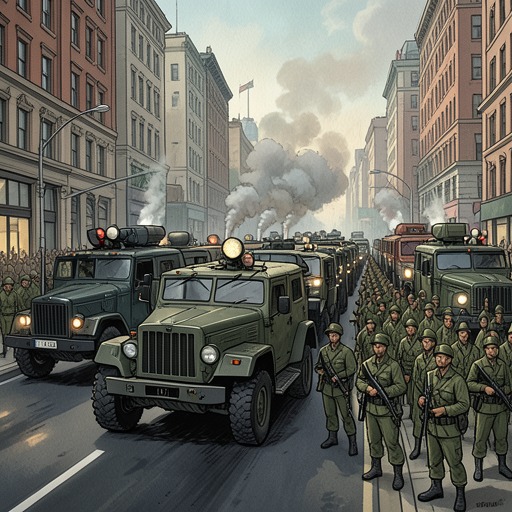
That failed attempt shaped the next effort. David was ordered to assemble a much larger force: four Pakistani tanks, 28 Malaysian armored personnel carriers, his own troops, 150 men from the division’s Alpha Company, Ranger volunteers, and the ambulatory survivors of the lost convoy. This was not simply a matter of adding vehicles to the road. The force had to be put together quickly, and its components had to be assigned roles that made sense for a night movement through likely ambushes. The division’s task was therefore operational as well as logistical: organize a new attempt after the first had shown how far the crash sites remained from safety.
Building the Night Convoy
The assembly took place at the New Port facility, a few miles up the coast from Task Force Ranger’s base. Rangers and American special-operations troops were anxious to get moving, and their frustration with the delays was visible. Yet assembling the mixed force raised problems that urgency could not erase. Drivers had to manage five-ton trucks while wearing night optical devices. Even finding someone with relevant experience was uncertain: a lieutenant asked Peter Squeglia, whose experience riding a motorcycle with night-vision equipment seemed potentially useful, to drive a truck, then walked away to find another driver.
Language and command arrangements added further friction. Most Pakistani and Malaysian commanders spoke English, but their troops did not, so instructions took longer to carry out. Soldiers gathered around David’s map as others held flashlights to illuminate it. David also had to explain a delicate division of labor to the Malaysians: their vehicles were wanted, but their soldiers were not. His proposed arrangement placed better-trained American troops on the Malaysian carriers, the tanks at the head of the column, and the force between the two crash sites, where separate companies could be sent toward each one. The plan made the convoy’s intended structure clear, but turning it into a moving force required negotiation across national and unit boundaries.
The column was not ready to leave the gate until 11:20 p.m. Even then, its formation changed to meet a command restriction: the Pakistani leader said his tanks had been ordered not to lead. David negotiated a compromise in which the tanks would escort the convoy for the first few miles, helping it through possible ambushes and roadblocks, before withdrawing and allowing Alpha Company to take the lead in the armored carriers. The convoy then moved toward the Black Sea neighborhood, a stronghold of Mohamed Farrah Aidid, where Somali fighters launched fierce ambushes. Its progress was the result of a carefully negotiated plan, but the route remained dangerous.
Relief Under Fire
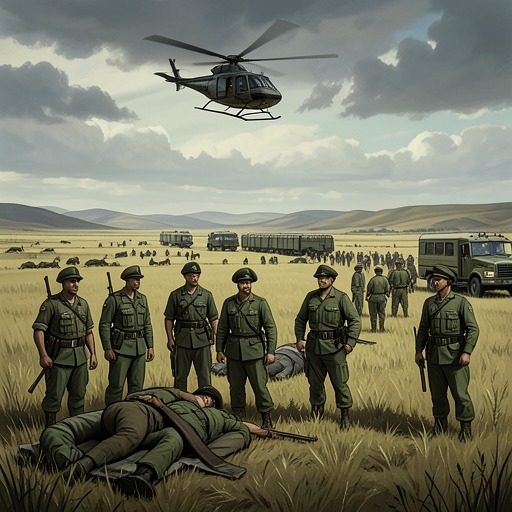
At the crash site of Cliff Wolcott’s helicopter, the Rangers had been pinned down for more than nine hours. As night continued, the shooting around their perimeter had largely stopped, but the approaching rescue column could be heard growing louder. The Rangers were waiting for the force that the division had helped assemble, not simply for the arrival of vehicles but for a route out of their exposed position. Their long wait gave the convoy’s movement an immediate human consequence: men holding the perimeter had to remain in place until relief could reach them.
The relationship between the units was not uncomplicated. Many Rangers regarded the 10th Mountain Division as poorly trained regular Army soldiers, an attitude that sharpened the tension as they waited. When the column did not arrive quickly, one Ranger officer ordered his men away from courtyards, doors, and windows, and the minutes continued to pass. This distrust coexisted with their dependence on the rescue force. The Rangers could doubt the division’s readiness and still need its men and armored vehicles to reach them through the city.
Medical Work and Organizational Significance
The division’s role also extended beyond the convoy’s advance. After the rescue vehicles brought casualties in, a 10th Mountain medic treated the wounded Ranger Goodale in a makeshift field hospital in a stadium. Goodale lay with his pants cut off beneath a clear, sunny sky; though the temperature was at least 90 degrees, he was shaking with cold. As the medic tried to insert an IV, ash from his cigarette fell onto him. A doctor then gave Goodale hot tea. The scene places the division’s personnel not only in the mechanics of the rescue but also in the exhausting work of receiving and treating its wounded.
The division is shown through concrete tasks rather than a general account of its institutional history: command of the Quick Reaction Force, organization of a convoy, negotiation with allied forces, movement under ambush, and medical care after arrival. The operation depended on coordination across those tasks, yet the evidence also shows how easily coordination could be slowed by language barriers, vehicle assignments, command restrictions, and mutual distrust. The 10th Mountain Division’s significance in the account lies in this practical burden. It had to turn a scattered collection of units and vehicles into a force capable of reaching soldiers trapped at the crash sites, then help manage the casualties brought back from the fighting.