Vietnam War
Black Hawk DownThe Vietnam War enters the account not through a separate history of its battles, but through two comparisons that give the Mogadishu fighting a longer frame: a veteran’s hard-won knowledge of combat loss and a senior military leader’s measure of casualty scale. In one instance, the past informs a father’s response to news of his son’s death; in the other, it becomes a benchmark for judging how many deaths draw public notice.
A war remembered through service
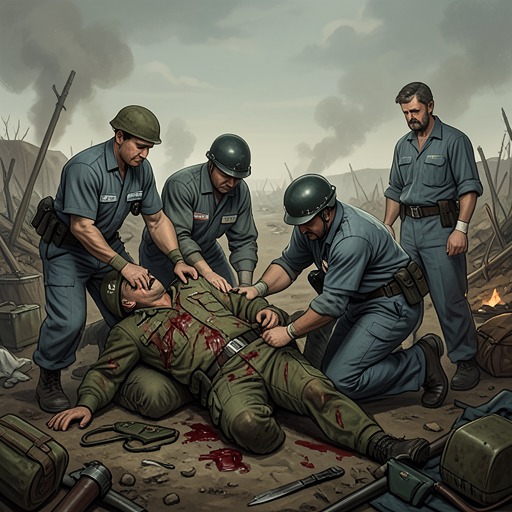
Jamie Smith’s father had served as a Ranger captain in Vietnam and lost a leg in combat. The book presents that experience as more than a biographical detail: it had taught him something about the ways a close military unit handles a death. When his family was told that Jamie had been killed, his wife held open the possibility that the report was mistaken. He was certain it was not. In his understanding, the unit would not notify a family of a death unless it had the soldier’s body.
Combat knowledge carried home
The Vietnam War’s presence in this family scene is practical and intimate. Smith’s certainty did not come from a new confirmation in the conversation; it came from what he believed his experience as a combat veteran allowed him to know about the unit and its procedures. His wartime injury and his son’s death belong to different moments, but the earlier war shaped how he received the later loss: hope gave way to quiet recognition.
Vietnam as a measure of casualties
Former Chairman of the Joint Chiefs of Staff Colin L. Powell, who had approved sending Task Force Ranger to Mogadishu, invoked Vietnam in a retrospective interview about the battle. He described Mogadishu as a bad afternoon in which no one had done anything wrong militarily, and questioned whether 18 deaths counted as a large number by comparison with Vietnam, when people had not begun to notice until losses reached 500 a week. The comparison placed Mogadishu’s toll against the much greater scale of deaths associated with Vietnam; it also revealed the institutional and public yardstick Powell was using to discuss what counted as a conspicuous loss.
Two different uses of the past
These references give the Vietnam War distinct functions in the account. For Jamie Smith’s father, it is lived experience that informs a family’s encounter with a death notification. For Powell, it is a historical measure used to contextualize the number of soldiers killed in Mogadishu. The book does not develop the Vietnam War as an independent narrative; its significance here lies in how its memory travels forward, shaping both private certainty and public judgments about the scale of wartime loss.