“There's only one direction”
Black Water (Joyce Carol Oates Edition)“There's only one direction” is a recurring phrase whose apparent certainty changes as the road journey becomes a catastrophe. The Senator first uses it to reassure Kelly Kelleher that they are not lost; after the Toyota plunges into black water, Kelly turns the phrase into a private promise that he will come back to her. Its movement from easy assurance to desperate faith exposes how little either character can command when the road, the car, and their bodies escape control.
The Senator’s Reassurance
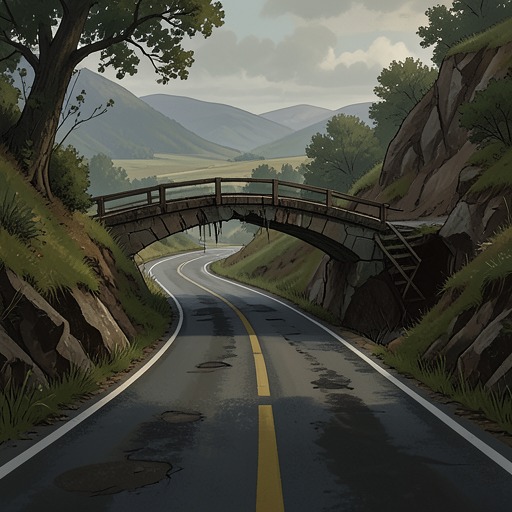
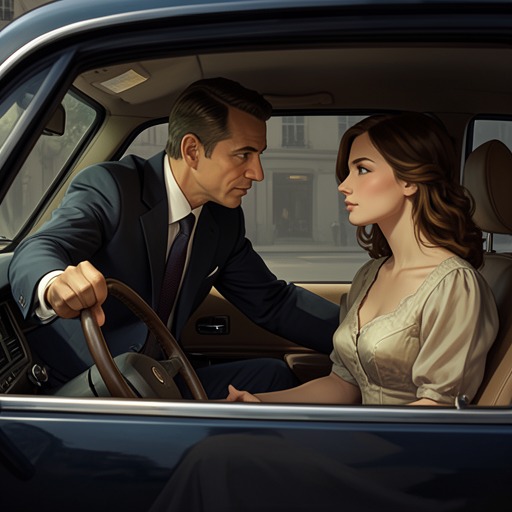
As they drive through a dark, overgrown route, The Senator calls the road a shortcut and insists that there is only one direction. Kelly, parched and trying to answer tactfully, points out that the road is poor. He treats the route’s difficulty as confirmation of its usefulness: because it is a shortcut, he says, he is sure of it. The phrase sounds less like a considered assessment than a confident declaration that uncertainty can be dismissed.
The saying recurs in a joking, self-evident form when The Senator specifies that there is only one direction on an island. Kelly laughs without quite knowing why. The playful exchange precedes the crash, but its island setting gives the phrase a sharper irony: the pair are surrounded by water, and the road they have chosen does not lead safely to their intended destination.
A Direction Chosen Without Knowing
The Senator is not wholly lost in the ordinary sense: he is headed toward Brockden's Landing, but takes Old Ferry Road, an obsolete, badly rutted route whose sign has been absent for years. The newer paved Ferry Road has displaced it, and the correct turn lies three-quarters of a mile earlier. Old Ferry Road is no longer maintained by Grayling Township and should have been officially closed. The phrase’s certainty thus rests on a mistaken choice made on a road that ought not to be used.
The route’s danger is not merely symbolic. The Toyota skids on a sandy rut, breaks through a guardrail, and plunges into Indian Creek. The car sinks in black water; its passenger door buckles, and water begins to enter through cracks and openings. The narrative also considers a counterfactual: had the Toyota continued out of control on the hairpin curve at an estimated forty-five miles per hour, it might have hit the railing of a narrow bridge and fallen into the water there instead. That possibility is explicitly presented as speculation, not as the route the crash actually took.
Kelly’s Reversal of the Phrase
Trapped in the submerged car, Kelly fixates on the possibility of rescue. She thinks there is only one direction, and that The Senator will come to her from it. The earlier assertion has shifted speakers and purpose: what he had offered as casual certainty about the road, she now uses to sustain hope that he will return. Yet the car is filling by degrees, and the phrase cannot alter the physical conditions closing around her.
The narrative sets that hope against what happened outside the car. In terror, The Senator kicked free of the doomed vehicle and swam to shore, leaving Kelly behind; the account describes his action as blind panic and says he did not know what he was doing. Kelly later understands that he had escaped, but continues to have faith. Her conviction that he will come back therefore persists beyond the evidence of his departure, making the phrase both a survival thought and a painful misreading of what he can—or will—do.
After the Crash
The phrase’s logic follows The Senator beyond the water, but in a different form. He limps along the marsh road with one shoe on and one off, fears being seen or recognized, and worries that the accident will destroy his political ambitions. At a telephone booth, he calls Ray Annick, initially using the name Gerald Ferguson to reach him. He tells Ray there has been an accident and that the girl is dead; when Ray urges him not to explain over the phone, The Senator then blames Kelly, claiming that she was drunk, became emotional, and grabbed the wheel. The account distinguishes that self-protective version from the narrated course of events, in which The Senator was driving the Toyota and Kelly was his passenger.
Across these scenes, “one direction” is not a dependable guide but a repeated verbal gesture against uncertainty. It first makes a dangerous wrong turn sound manageable; later, Kelly invests it with the hope of rescue, while the reader knows The Senator has escaped without her. The phrase’s return binds the drive to the drowning and gives the journey its grim reversal: one character’s certainty becomes another’s last imagined route back to safety.